Calcari Grigi Group
| Calcari Grigi Group | |
|---|---|
| Stratigraphic range: Hettangian-Pliensbachian ~ | |
 Outcrop with dinosaur tracks at Lavini di Marco | |
| Type | Geological formation |
| Sub-units |
|
| Area | Trento |
| Location | |
| Country | Italy |
The Calcari Grigi di Group is a geological group in Italy, dating to roughly between 200 and 190 million years ago and covering the Hettangian to Pliensbachian stages of the Jurassic System. Fossil prosauropod tracks have been reported in the formation.[1] It represented a carbonate platform, being located over the Trento Platform and surrounded by the Tofino Formation (deep-water), Massone Oolite (marginal calcarenitic bodies), the Fanes Piccola Encrinite (condensed deposits and emerged lands), the Lombadian Basin Medolo Group and Belluno Basin Soverzene Formation (open marine), and finally towards the south, deep water deposits of the Adriatic Basin.[2] This formation was deposited within a tropical lagoon environment, similar to modern Bahamas which was protected by oolitic shoals and bars from the open deep sea located to the east (Belluno Basin) and towards the west (Lombardia Basin).[3][4]
The sedimentary cover of the Southern Alps has been recognized as a well-preserved section of the Mesozoic Tethys' southern continental margin, featuring a horst and graben structure linked to the rifting associated with the opening of the central North Atlantic that in the Late Triassic and Early Jurassic, created elevated blocks separated by troughs.[5] While the western margin (Piedmont and Lombardy) quickly submerged in the Early Jurassic (As seen by the Moltrasio Formation), the eastern regions maintained shallow water sedimentation, including the Friuli and Trento Platforms, this last one latter evolving into a pelagic plateau, and separated from the Lombardian basin by the Garda escarpment fault system.[6]
Subunits

Monte Zugna Formation (Hettangian–upper Sinemurian)
This formation consists of shallow-water carbonate deposits, several hundred metres thick, organised in metre-scale shallowing-upward cycles.[7] It includes three main informal units: a lower cyclic subtidal unit (bioturbated micritic to bioclastic limestones with green clay interbeds), a middle peritidal unit (alternating stromatolitic bindstones, peloidal mudstones, bioclastic wackestones, and reddish mudstones with mud cracks, teepees, and pedogenic features), and an upper subtidal unit (nodular mudstone-wackestones with increasing grainy intercalations).[8] It was deposited on a broad peritidal to shallow subtidal platform in a warm, tropical shallow sea. The middle peritidal unit records tidal-flat conditions with microbial mats, periodic subaerial exposure, dinosaur tracks and freshwater influence (evidenced by stable isotopes and karst-like features). Overall arid to semi-arid climate with occasional humid pulses.[8]
Loppio Oolitic Limestone (upper Sinemurian)
A prominent, poorly bedded to massive oolitic grainstone unit, up to tens of metres thick, composed mainly of ooids with minor intraclasts and bioclasts, cemented by sparry calcite. It shows progradational geometry and transitions upward from the Monte Zugna Formation.[4] High-energy shallow subtidal shoals and ooid bars on the carbonate platform during a phase of increased carbonate production and relative sea-level stability/highstand. It represents a shift to more open-marine, agitated conditions compared to the underlying peritidal facies. Syn-sedimentary faulting affected this rigid, early-cemented unit, creating extensional structures later sealed by overlying deposits.[4] Locally the so called "Arnioceras time Event", and to a larger extent the Sinemurian-Pliensbachian Event, analogue to the Carnian pluvial episode is seen.[9][10]
Rotzo Formation (Pliensbachian)
Main article: Rotzo Formation
Biota
The richest assamblage of the group is the Rotzo Formation.
Color key
|
Notes Uncertain or tentative taxa are in small text; |
Foraminifera
| Genus/Family | Species | Provenance | Material | Notes | Images |
|---|---|---|---|---|---|
| Aeolisaccus[5] | A. dunningtoni | Monte Cumieli | Isolated Tests/Shells | A foraminifer of the Earlandiidae family | |
| Everticyclammina[5] | E. praevirguliana | Foza section; Monte Cumieli | Isolated Tests/Shells | A foraminifer of the Everticyclamminidae family. | |
| Meandrovoluta[5][11] | M. asiagoensis | Monte Cumieli | Isolated Tests/Shells | A foraminifer of the Cornuspiridae family | |
| Mayncina[5] | M. (Paleomayncina) termieri | Chizzola section; Foza section; Monte Cumieli | Isolated Tests/Shells | A foraminifer of the Mayncinidae family | |
| Rectocyclammina[5] | R. spp. | Monte Cumieli | Isolated Tests/Shells | A foraminifer of the Everticyclamminidae family. | |
| Siphovalvulina[5] | S. spp. | Monte Cumieli | Isolated Tests/Shells | Shallow-subtidal benthic foraminifera of Siphovalvulinidae |
Invertebrates
Indeterminate Ostracod, Gastropod and Echinoderm material is know in the Lavini di Marco ichnosite.[12]
| Genus/Family | Species | Provenance | Material | Notes | Images |
|---|---|---|---|---|---|
| Aulichnites[12] | cf. A. isp. | Lavini di Marco | Locomotion/feeding traces | Gastropod traces, Present on subtidal beds. | |
| Gervillioperna[12] | G. buchi | Chizzola section; Foza section; Lavini di Marco; Monte Cumieli | Shells | Plicatostylidae oyster | |
| Favreina[5] | F. sp. | Foza section | Coprolites | Decapod coprolites | |
| Pisirhynchia[12] | P. uhligi | Lavini di Marco | Shells | Norellidae brachiopod | |
| Rhizocorallium[12] | cf. R. isp. | Lavini di Marco | Burrows / traces | Part of a moderately diversified assemblage. | |
| "Terebratula"[12] | ''T.'' ''dubiosa'' | Lavini di Marco | Shells | Terebratulida brachiopod | |
| Thalassinoides[12] | T. isp. | Lavini di Marco | Burrows | Decapod? convex structures at the base of subtidal beds; also in inter-supratidal interval. | |
| Zoophycos[12][13] | Z. isp. | Lavini di Marco | Traces | Present in the inter-supratidal bed-set. |
Non-Dinosaur
| Genus/Family | Species | Provenance | Material | Notes | Images |
|---|---|---|---|---|---|
| Brasilichnium?[14][15] | B.? isp. | Lavini di Marco | Footprints | Synapsid track reported at the site |  |
| Crocodylomorpha indet.[15] | Indeterminate | Lavini di Marco | Footprints | Small terrestrial taxon |  |
| Lepidosauria indet.[15] | Indeterminate | Lavini di Marco | Footprints | "Lizard-like" trackmaker |  |
Dinosaurs
| Genus/Family | Species | Provenance | Material | Notes | Images |
|---|---|---|---|---|---|
| Anchisauripus[12][14][16][17] | A. isp. | Lavini di Marco | Footprints | Small theropod tracks |  |
| Anomoepus[14][16] | A. isp. | Lavini di Marco | Footprints | Primitive ornithischian tracks; some indicate sitting posture. |  |
| Ceratosauria? indet.[17] | Indeterminate | Lavini di Marco | Footprints | Referred to the coeval genus Saltriovenator. |  |
| Eubrontes[12][14][16][17] | E. isp. | Lavini di Marco; Chizzola; Pizzo di Levico; Monte Pasubio, Becco di Filadonna | Footprints | Medium to large-sized theropod tracks; common in Upper Subtidal Unit. | |
| Grallator[12][14][16][17] | G. isp. | Lavini di Marco; Monte Pelmo; other Monte Zugna sites | Footprints | Small tridactyl theropod tracks. |  |
| Kayentapus[12][14][16][17] | K. isp. | Lavini di Marco; Chizzola; Pizzo di Levico; Monte Pelmo | Footprints | Most abundant theropod ichnotaxon in Middle Peritidal Unit; Dilophosaur-like trackmakers. |  |
| Lavinipes[18] | L. cheminii | Lavini di Marco | Footprints | Basal Gongxianosaurus-like sauropod. | |
| Ornithischia indet. (Iguanodontidae-like)[12][14][16] | Indeterminate | Lavini di Marco; other Monte Zugna sites | Footprints | Very deep tridactyl bipedal footprints similar to later iguanodontids; possibly large graviportal forms. | |
| Parabrontopodus/Breviparopus-like[12][14][16] | Indeterminate | Lavini di Marco; Becco di Filadonna; Monte Pasubio | Footprints | Narrow-gauge quadrupedal sauropodomorph tracks; pear-shaped pes, kidney/horseshoe-shaped manus. Larger forms in Upper Subtidal Unit. | 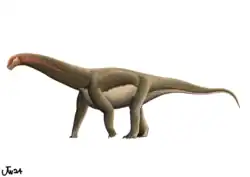 |
| Sauropodomorpha indet.[12][14][16] | Indeterminate | Lavini di Marco; Monte Pasubio (Dente Italiano/Cima Palon); Becco di Filadonna; Monte Finonchio; Malga Buse Bisorte | Footprints | Medium to large sauropodomorphs; sub-circular underprints with raised rims at Monte Pasubio. | |
| Theropoda indet.[12][14][16][17] | Indeterminate (Panguraptor-like and Sinosaurus-like pes) | Lavini di Marco; Sega di Ala; Monte Pelmo; Chizzola | Footprints | Most abundant dinosaur group across megasites. |
Flora
| Genus/Family | Species | Provenance | Material | Notes | Images |
|---|---|---|---|---|---|
| Aratrisporites[15] |
|
Chizzola section | Spores | Affinities with Isoetaceae. |  |
| Cayeuxia[5] |
|
Monte Cumieli | Imprints | Maybe Bryopsidales. | |
| Cerebropollenites[15] |
|
Chizzola section | Pollen | Aff. Sciadopityaceae conifer |  |
| Chasmatosporites[15] |
|
Chizzola section | Pollen | Affinities with the family Zamiaceae. |  |
| Classopollis[12] |
|
Lavini di Marco | Pollen | Cheirolepidiaceae Conifer, dominant palynomorph | |
| Eodasycladus[5] |
|
Foza section | Imprints | A green alga of the family Dasycladaceae. | |
| Eucommiidites[15] |
|
Chizzola section | Pollen | Type pollen of the Erdtmanithecales, related to the Gnetales. | |
| Fanesella[15] |
|
Foza section | Imprints | A green alga of the family Dasycladaceae. | |
| Linoporella[15] |
|
Foza section | Imprints | A green alga of the family Dasycladaceae. | |
| Palaeodasycladus[12][19] |
|
Foza section; Lavini di Marco; Monte Cumieli | Imprints | A green alga of the family Dasycladaceae. A reefal algae usually found in carbonate settings along all the Mediterranean |  |
| Porcellispora[12] |
|
Lavini di Marco | Spores | Affinities with Bryophyta or Marchantiophyta, potentially Riellaceae. | |
| Retitriletes[15] |
|
Chizzola section | Spores | Aff. Lycopodiaceae |  |
| Sestrosphaera[20] |
|
Monte Cumieli | Imprints | A green alga of the family Triploporellaceae. | |
| Terquemella[5] |
|
Foza section | Imprints | A green alga of the family Dasycladaceae. | |
| Tersella[5] |
|
Monte Cumieli | Imprints | A green alga of the family Dasycladaceae. | |
| Thaumatoporella[12] |
|
Lavini di Marco; Monte Cumieli | Imprints | A green alga of the Thaumatoporellales group. The dominant alga locally |
See also
Footnotes
- ↑ Weishampel, et al. (2004). "Dinosaur distribution." pp. 517–607.
- ↑ Masetti, D.; Fantoni, R.; Romano, R.; Sartorio, D.; Trevisani, E. (2012). "Tectonostratigraphic evolution of the Jurassic extensional basins of the eastern southern Alps and Adriatic foreland based on an integrated study of surface and subsurface data". AAPG Bulletin. 96 (11): 2065–2089. Bibcode:2012BAAPG..96.2065M. doi:10.1306/03091211087. Retrieved 12 November 2021.
- ↑ Urban, I. (2017). "Petrografia e geochimica delle ooliti del Giurassico inferiore della Piattaforma di Trento". Area 04 - Scienze della Terra > GEO/02 Geologia Stratigrafica e Sedimentologica. 1 (1): 1–203. Retrieved 3 January 2022.
- 1 2 3 Preto, N.; Breda, A.; Dal Corso, J.; Franceschi, M.; Rocca, F.; Spada, C.; Roghi, G. (2017-01-01). "The Loppio Oolitic Limestone (Early Jurassic, Southern Alps): A prograding oolitic body with high original porosity originated by a carbonate platform crisis and recovery". Marine and Petroleum Geology. 79: 394–411. Bibcode:2017MarPG..79..394P. doi:10.1016/j.marpetgeo.2016.10.027. ISSN 0264-8172.
- 1 2 3 4 5 6 7 8 9 10 11 12 Masetti, Daniele; Figus, Billy; Jenkyns, Hugh C.; Barattolo, Filippo; Mattioli, Emanuela; Posenato, Renato (2017). "Carbon-isotope anomalies and demise of carbonate platforms in the Sinemurian (Early Jurassic) of the Tethyan region: evidence from the Southern Alps (Northern Italy)". Geological Magazine. 154 (3): 625–650. Bibcode:2017GeoM..154..625M. doi:10.1017/S0016756816000273. hdl:11392/2360109. ISSN 0016-7568.
- ↑ Castellarin, A.; Picotti, V. (1990). "Jurassic tectonic framework of the eastern border of the Lombardian basin". Eclogae Geologicae Helvetiae. 83 (3): 683–700.
- ↑ Franceschi, Marco; Massironi, Matteo; Franceschi, Pietro; Picotti, Vincenzo (2014). "Spatial analysis of thickness variability applied to an Early Jurassic carbonate platform in the central Southern Alps (Italy): a tool to unravel syn-sedimentary faulting". Terra Nova. 26 (3): 239–246. Bibcode:2014TeNov..26..239F. doi:10.1111/ter.12092. ISSN 1365-3121.
- 1 2 Martinelli, M.; Franceschi, M.; Massironi, M.; Rizzi, A.; Salvetti, G.; Zampieri, D. (2017-01-01). "An extensional syn-sedimentary structure in the Early Jurassic Trento Platform (Southern Alps, Italy) as analogue of potential hydrocarbon reservoirs developing in rifting-affected carbonate platforms". Marine and Petroleum Geology. 79: 360–371. Bibcode:2017MarPG..79..360M. doi:10.1016/j.marpetgeo.2016.11.002. ISSN 0264-8172.
- ↑ Franceschi, Marco; Corso, Jacopo Dal; Cobianchi, Miriam; Roghi, Guido; Penasa, Luca; Picotti, Vincenzo; Preto, Nereo (2019-02-06). "Tethyan carbonate platform transformations during the Early Jurassic (Sinemurian–Pliensbachian, Southern Alps): Comparison with the Late Triassic Carnian Pluvial Episode". GSA Bulletin. 131 (7–8): 1255–1275. Bibcode:2019GSAB..131.1255F. doi:10.1130/B31765.1. ISSN 0016-7606.
- ↑ Jiang, Hang; Franceschi, Marco; Yin, Runsheng; Petranich, Elisa; Pavoni, Elena; Barago, Nicolò; Preto, Nereo; Covelli, Stefano; Bonini, Lorenzo; Jin, Xin (2025-03-11). "Large-scale volcanogenic Hg enrichment coincided with the Sinemurian-Pliensbachian boundary event (Early Jurassic)". GSA Bulletin. 137 (7–8): 3606–3616. Bibcode:2025GSAB..137.3606J. doi:10.1130/B37640.1. ISSN 0016-7606.
- ↑ Fugagnoli, A.; Giannetti, A.; Rettori, R. (2003). "A new foraminiferal genus (Miliolina) from the Early Jurassic of the Southern Alps (Calcari Grigi Formation, Northeastern Italy)" (PDF). Revista Española de Micropaleontología. 35 (1): 43–50.
- 1 2 3 4 5 6 7 8 9 10 11 12 13 14 15 16 17 18 19 20 Avanzini, M.; Leonardi, G.; Mietto, P.; Piubelli, D. (2003). "The dinosaur ichnosite at the Lavini di Marco (Calcari Grigi Group, Lower Jurassic)". Studi Trent. Sci. Nat., Acta Geol. 80 (1): 31–36.
- ↑ Baucon, A.; Avanzini, M. (2008). "Zoophycos-like structures associated with dinosaur tracks in a tidal-flat environment: Lower Jurassic (Southern Alps, Italy)" (PDF). Studi Trentini di Scienze Natulari Acta Geologica (83): 123–131.
- 1 2 3 4 5 6 7 8 9 10 Petti, F.M.; Avanzini, M.; Antonelli, M; Bernardi, M.; Leonardi, G.; Manni, R.; Mietto, P.; Pignatti, J.; Piubelli, D.; Sacco, E.; Wagensommer, A. (2020). "Jurassic tetrapod tracks from Italy: a training ground for generations of researchers". Tetrapod Ichnology in Italy: The State of the Art. Journal of Mediterranean Earth Sciences. 12 (3): 137–165. Retrieved 3 January 2022.
- 1 2 3 4 5 6 7 8 9 10 Avanzini, M.; Piubelli, D.; Mietto, P.; Roghi, G.; Romano, , &, R.; Masetti, D. (2006). "Lower Jurassic (Hettangian-Sinemurian) dinosaur track megasites, southern Alps, Northern Italy". The Triassic-Jurassic Terrestrial Transition. New Mexico Museum of Natural History and Science Bulletin. 37 (5): 207–216.
{{cite journal}}: CS1 maint: multiple names: authors list (link) - 1 2 3 4 5 6 7 8 9 Dal Sasso, Cristiano (2003). "Dinosaurs of Italy". Comptes Rendus Palevol. 2 (1): 45–66. Bibcode:2003CRPal...2...45D. doi:10.1016/S1631-0683(03)00007-1. ISSN 1631-0683. Archived from the original on 2023-03-19.
- 1 2 3 4 5 6 Antonelli, Matteo; Petti, Fabio Massimo; Sacco, Enrico; Romano, Marco (2025). "Ichnological review of the theropod footprints from the Lavini di Marco tracksite (Lower Jurassic, Southern Alps, NE Italy)". Italian Journal of Geosciences. 144 (2025) f.3 (3): 332–363. doi:10.3301/IJG.2025.15. ISSN 2038-1719.
- ↑ Avanzini, Marco; Leonardi, Giuseppe; Mietto, Paolo (January 2003). "Lavinipes Cheminii Ichnogen., Ichnosp. nov., A Possible Sauropodomorph Track from the Lower Jurassic of the Italian Alps". Ichnos. 10 (2–4): 179–193. Bibcode:2003Ichno..10..179A. doi:10.1080/10420940390256195.
- ↑ Avanzini, M.; Petti, F. M. (2008). "Updating the dinosaur tracksites from the Lower Jurassic Calcari Grigi Group (Southern Alps, northern Italy)". Studi Trentini di Scienze Naturali, Acta Geologica. 83 (8): 289–301. Retrieved 3 January 2022.
- ↑ Romano, Roberta; Barattolo, Filippo (2009). "Note on Sestrosphaera liasina (Pia, 1920) from the Lowermost Jurassic of Malga Mandrielle (type-locality, Southern Alps, Italy)". Geobios. 42 (1): 101–115. Bibcode:2009Geobi..42..101R. doi:10.1016/j.geobios.2008.07.005. ISSN 0016-6995.
References
- Weishampel, David B.; Dodson, Peter; and Osmólska, Halszka (eds.): The Dinosauria, 2nd, Berkeley: University of California Press. 861 pp. ISBN 0-520-24209-2.