Clavesin-2
Clavesin-2 (CLVS2) is a protein-coding gene located on chromosome 6 in humans. The protein belongs to the clavesin family of neuronal proteins and is expressed in the nervous system. CLVS2 contains a lipid-binding Sec14 domains and a CRAL-TRIO family of lipid binding.

Gene: Clavesin-2
The CLVS2 gene is located on the long arm of chromosome 6 (6q22.31) between base pairs 1222,996,235 - 123,072,925 on the forward strand The gene is approximately 77kb of genomic DNA.[1] The gene has multiple exons and produces splice variants alternatively.
Function/Biochemistry
Clavesin-2 gene is involved in membrane organization and vesicle dynamics. The expression of CLVS2 in neuronal tissues indicates that its cellular function is specialized within the nervous system.[2] CLVS2 contributes to trafficking pathways required for neuronal maintenance and synaptic function.

The structural biochemistry of CLVS2 suggest that it has a globular fold with several alpha-helical regions surrounding a central core[3][4]

Transcripts
The CLVS2 gene produces multiple transcript alternative splicing variants XM_001010852.4 & MN_047418196.1.[1] These transcripts contribute to difference in intracellular localization or regulation of the protein. Research shows that elevated CLVS2 mRNA expression in the neuronal tissues relative to other tissues within humans.[5]The longest transcript encodes the protein sequence represent by NP_001010852.2.[6]
Proteins
The size of the protein NP_001010852.2 is 327 amino acids. It also binds to phosphatidylinositol 3,5-bisphosphate (Ptdins(3,5)P2).[6] The human CLVS2 protein has a predicted molecular wight of 38.0 kdal.[7] The theoretical isoelectric (pI) is 5.97 which is considered acidic.[8]
Domains & Motifs
There are 6 motif domains important to the human CLVS2, which are the CRAL-TRIO lipid-binding domains within the central region.[9]
Interacting Proteins
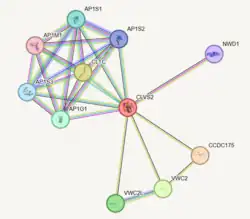
There are 4 major CLVS2 protein interacting partners such as AP1S1, AP1M1, AP1G1, CLTC (Clathrin Heavy Chain).[10] CLVS2 has several identified proteins associated with vesicle trafficking and intracellular transport with the presence of the CRAL-TRIO lipid-binding domain . This suggest that CLVS2 participates in intracellular mediated trafficking.
| Protein | Name | Relationship to CLVS2 | Function |
| AP1S1 | Adaptor Related Protein Complex 1 Sigma 1 | AP1S1 is part of the AP-1 adaptor complex that sorts proteins into transport vesicles | Vesicle trafficking |
| AP1M1 | Adaptor Related Protein Complex Mu 1 | AP1M1 recognizes cargo proteins destined for vesicular transport | Cargo sorting |
| AP1G1 | Adaptor Related Protein Complex 1 Gamma 1 | AP1G1 is a core component of the AP-1 complex | Intracellular transport |
| AP1S3 | Adaptor Related Protein Complex 1 Sigma 3 | AP1S3 functions in vesicle-mediated transport | Endosomal trafficking |
| AP1S2 | Adaptor Related Protein Complex 1 Sigma 2 | AP1S2 participates in vesicle formation between the Golgi apparatus and endosomes | Vesicle formation |
| CLTC | Clathrin Heavy Chain | CLTC forms the structural scaffold of clathrin-coated vesicles. Since clathrin-mediated transport is essential for intracellular trafficking | Endocytosis |
| NWD1 | NACHT and WD Repeat Domain Protein 1 | NWD1 is involved in protein complex assembly and signaling regulation. | Signaling regulation |
| CCD175 | Coiled-Coil Domain Containing 175 | Unknown | Unknown |
| VWC2 | Von Willebrand Factor C Domain Protein 2 | VWC2 is involved in extracellular signaling and developmental pathways | Extracellular signaling |
Cellular Localization
CLVS2 primarily localizes to the cytoplasm and is enriched on Clathrin-coated vesicles. Evidence predicted localization to the cytoplasm with a 73.9% confidence, 17.4% to the nucleus, and 8.7% to the mitochondria.[11] CLVS2 co-localize with markers of endosomes and the trans-Golgi network (TGN), as well as with adaptor protein-1.
Regulation
Gene level regulation
CLVS2 promoter identified several predicted transcription factor binding sites located within conserved noncoding regions upstream of the transcription start site. Many of the highest-scoring transcription factors, including LHX3, SP8, ZIC2, and ZIC5, are known regulators of neural development and nervous system differentiation.[12] This finding is consistent with the strong brain-specific expression observed for CLVS2. Several zinc-finger proteins (ZNF530, ZNF93, ZFP14, and ZBED4) were also identified and likely contribute to transcriptional regulation of CLVS2 expression.
| Transcription Factor | Name | What does it does? | Score | Reason for importance |
| Lhx3 | LIM homebox 3 | It regulates the neuronal development and spinal cord differentiation | 546 | Neural development with CLVS brain expression |
| SP8 | Specificity protein 8 | Controls the Forebrain and neuron patterning | 511 | Located in a conserved promoter region |
| Zic2 | Zic Family Member 2 | Regulates the neural tube and brain development | 511 | Near the binding site near the promoter |
| ZNF530 | Zinc Finger Protein 530 | Putative DNA-binding transcription regulator | 514 | Transcriptional start region and close to the transcription start site |
| ZNF93 | Zinc Finger Protein 93 | Transcriptional regulator involved in gene expression | 583 | Highest scoring binding site near transcription initiation |
| ZFP14 | Zinc Finger Protein 14 | Transcription regulator | 514 | Conserved region |
| ZBED4 | Zinc Finger BED-Type Containing 4 | Transcription regulator | 502 | Location near transcriptional site |
| ZIC5 | Zic Family Member 5 | Regulates neural crest and developmental signaling | 521 | Relation to neural expression and a conserved region |
Protein level regulation
CLVS2 exhibits tissue specific expression and is enriched within mainly the brain and prostrate. Within the brain it can be found in separate areas such as the cerebrum and the central nervous system.[13]
The CLVS2 protein has a low abundance than other proteins. The cerebral cortex shows moderate cytoplasmic positivity in neuronal cells.[2] This is heavily related to neuronal vesicle trafficking and synaptic function.
Homolog/ Evolution
The CLVS2 gene first appeared in fish, reptiles, birds, and mammals. More distant homologs identified in invertebrates suggested an ancestral form. The most distantly related species compared to humans is Drosophila Willistoni.[14] The CLVS2 gene family contains two primary members in humans CLVS2 and CLVS1.


Paralogs
There is 1 known paralog within the human genome. Clavesin 1 (CLVS1).[15]
| CLVS1 | Genus & Species | Common Name | Taxanomic Group | Divergence Time MYA | Acession # | Sequence Length (aa) | Sequence Identity to Human Protein (%) |
| Mammal | Homo sapiens | Humans | Primate | 0 | NP_775790.1 | 354 | 100% |
| Giraffa tippelskirchi | Masai giraffe | Artiodactyla | 94 | XP_081357274.1 | 354 | 80.10% | |
| Cnephaeus nilssonii | Bat | Chiropetra | 94 | XP_079652655.1 | 354 | 98.00% |
Orthologs
| CLVS2 | Genus & Species | Common Name | Taxanomic Group | Divergence Time MYA | Acession # | Sequence Length (aa) | Sequence Identity to Human Protein (%) |
| Mammal | Homo sapiens | Humans | Primate | 0 | NP_001010852.2 | 327 | 100% |
| Mus musculus | House Mouse | Rodentia | 87 | NP_780657.1 | 327 | 97.3% | |
| Desmodus rontundus | Vampier bat | Phyllostomidae | 94 | XP_024407932.2 | 327 | 98.0% | |
| Aves | Melopsittacus undulatus | Budgerigar | Psittaciformes | 319 | XP_005154777.1 | 327 | 97.3% |
| Falco cherrug | Saker Falcon | Falconiformes | 319 | XP_005443818.4 | 327 | 96.3% | |
| Gallus gallus | Red Junglefowl | Galiformes | 319 | XP_040525051.1 | 327 | 97.3% | |
| Reptilia | Pelodiscus sinensis | Chinese Softshell Turtle | Testudinidae | 319 | XP_075780188.1 | 327 | 97.3% |
| Alligator mississippiensis | American Alligator | Alligatoridae | 319 | XP_059589422.1 | 327 | 96.2% | |
| Fish | Boleophthalmus pectinirostris | Gobie bony fish | Actinopterygii | 429 | XP_020784658.1 | 313 | 69.4% |
| Danio rerio | Zebrafish | Cypriniformes | 429 | NP_001020716.1 | 329 | 88.8% | |
| Betta splendens | Siamese fighting fish | Anabantiformes | 429 | XP_027887306.1 | 333 | 86.2% | |
| Invertebrate | Pocillopora verrucosa | Cauliflower coral | Pocilloperidae | 685 | XP_058958459.0 | 309 | 64.0% |
| Lingula anatina | Brachiopod | Brachiopoda | 686 | XP_013418372.1 | 323 | 51.1% | |
| Drosophila willistoni | Fuit Flies | Insecta | 686 | XP_023033937.2 | 312 | 40.3% | |
| Nemastostella vectensis | Starlet sea anemone | Cnidaria | 685 | XP_001625862.3 | 334 | 68% |
Mammalian orthologs exhibit greater than 95% amino acid sequence identity to the human CLVS2 protein.[16]
Clinical Significance
Although CLVS2 has not been extensively characterized clinically, CLVS2 has been likened to cognitive decline and neurological disease pathways.
Research has been noted to show some link between CLVS2 and Fanconi Anemia, Complementation Group D1 (FA-D1). FA-D1 is a genomic instability syndrome typically linked to defects in the BRCA2 gene at 13q12,[17] and the CLVS2 association may reflect proximity or co-deletion events rather than a direct causal role.
Rare coding variants in CLVS2 are associated with early stages on Alzheimer's disease[18] A genome-wide search for loci interacting with known prostate cancer risk-associated genetic variants identified CLVS2 as a region of interest.[17]
References
- 1 2 GeneCards Human Gene Database. "CLVS2 Gene - GeneCards | CLVS2 Protein | CLVS2 Antibody". www.genecards.org. Archived from the original on 2025-08-14. Retrieved 2026-06-08.
- 1 2 "49011219 - GEO Profiles - NCBI". www.ncbi.nlm.nih.gov. Retrieved 2026-06-08.
- ↑ "NCBI 3D Protein Structure".
- ↑ "AlphaFold Protein Structure Database". alphafold.ebi.ac.uk. Retrieved 2026-06-09.
- ↑ "CLVS2 clavesin 2 - NIH Genetic Testing Registry (GTR) - NCBI". www.ncbi.nlm.nih.gov.
- 1 2 "clavesin-2 [Homo sapiens] - Protein - NCBI". www.ncbi.nlm.nih.gov. Retrieved 2026-06-08.
- ↑ EMBL-EBI; Institute, European Bioinformatics. "Job Dispatcher homepage | EMBL-EBI". www.ebi.ac.uk. Retrieved 2026-06-08.
- ↑ Bjellqvist, B.; Hughes, G. J.; Pasquali, C.; Paquet, N.; Ravier, F.; Sanchez, J. C.; Frutiger, S.; Hochstrasser, D. (1993-10-23). "The focusing positions of polypeptides in immobilized pH gradients can be predicted from their amino acid sequences". Electrophoresis. 14 (10): 1023–1031. doi:10.1002/elps.11501401163. ISSN 0173-0835. PMID 8125050.
- ↑ "Error". www.genome.jp. Retrieved 2026-06-09.
- ↑ "CLVS2 protein (human) - STRING interaction network". string-db.org. Retrieved 2026-06-09.
- ↑ "PSORT II Prediction". psort.hgc.jp. Retrieved 2026-06-08.
- ↑ "UCSC Human Genome Jaspar Transcription Factors". genome.ucsc.edu. Retrieved 2026-06-08.
- ↑ "CLVS2 clavesin 2 [Homo sapiens (human)] - Gene - NCBI". www.ncbi.nlm.nih.gov. Retrieved 2026-06-08.
- ↑ IGS-CNRS. "Phylogeny.fr - Robust Phylogenetic Analysis For Non-Specialists". Phylogeny.fr. Retrieved 2026-06-08.
- ↑ "CLVS1 clavesin 1 [Homo sapiens (human)] - Gene - NCBI". www.ncbi.nlm.nih.gov. Retrieved 2026-06-08.
- ↑ "NCBI BLAST Sequence Identity".
- 1 2 Tao, Sha; Wang, Zhong; Feng, Junjie; Hsu, Fang-Chi; Jin, Guangfu; Kim, Seong-Tae; Zhang, Zheng; Gronberg, Henrik; Zheng, Lilly S.; Isaacs, William B.; Xu, Jianfeng; Sun, Jielin (March 2012). "A genome-wide search for loci interacting with known prostate cancer risk-associated genetic variants". Carcinogenesis. 33 (3): 598–603. doi:10.1093/carcin/bgr316. PMC 3291863. PMID 22219177.
- ↑ Katoh, Yohei; Ritter, Brigitte; Gaffry, Thomas; Blondeau, Francois; Höning, Stefan; McPherson, Peter S. (2009-10-23). "The Clavesin Family, Neuron-specific Lipid- and Clathrin-binding Sec14 Proteins Regulating Lysosomal Morphology". Journal of Biological Chemistry. 284 (40): 27646–27654. doi:10.1074/jbc.m109.034884. ISSN 0021-9258. PMC 2785693. PMID 19651769.
Alpha Fold CLVS2 3D protein structure https://alphafold.ebi.ac.uk/entry/AF-Q5SYC1-F1
CLVS1 clavesin 1 [Homo sapiens (human)] - Gene - NCBI
CLVS2 clavesin 2 [Homo sapiens (human)] - Gene - NCBI
GeneCards. CLVS2 gene — Clavesin 2. UniProt Q5SYC1 / CLVS2_HUMAN.
Phylogentic Tree https://phylogeny.fr/
MOTIF/DOMAIN Sequence Identifier CLVS2-protein
NCBI 3D protein Structure https://www.ncbi.nlm.nih.gov/Structure/icn3d/full.html?protein=Clvs2
NCBI GEO on CLVS2 - Normal various tissue types [https://www.ncbi.nlm.nih.gov/geoprofiles/49011219]
UCSC Human Genome Jaspar Transcription Factors [https://genome.ucsc.edu/cgi-bin/hgTracksd]