Putative uncharacterized protein C6orf52
| C6orf52 | ||||||||||||||||||||||||||||||||||||||||||||||||||||||
|---|---|---|---|---|---|---|---|---|---|---|---|---|---|---|---|---|---|---|---|---|---|---|---|---|---|---|---|---|---|---|---|---|---|---|---|---|---|---|---|---|---|---|---|---|---|---|---|---|---|---|---|---|---|---|
| Identifiers | ||||||||||||||||||||||||||||||||||||||||||||||||||||||
| Aliases | C6orf52, chromosome 6 open reading frame 52 | |||||||||||||||||||||||||||||||||||||||||||||||||||||
| External IDs | GeneCards: C6orf52 | |||||||||||||||||||||||||||||||||||||||||||||||||||||
| ||||||||||||||||||||||||||||||||||||||||||||||||||||||
| ||||||||||||||||||||||||||||||||||||||||||||||||||||||
| ||||||||||||||||||||||||||||||||||||||||||||||||||||||
| Wikidata | ||||||||||||||||||||||||||||||||||||||||||||||||||||||
| ||||||||||||||||||||||||||||||||||||||||||||||||||||||


Putative uncharacterized protein C6orf52 (C6orf52) is a protein in humans that is encoded by the gene "C6orf52" and has six known isoforms.[3] C6orf52 was identified in 2002 by The National Institutes of Health Mammalian Gene Collection (MGC) Program.[4] C6orf52 has one known paralog, tRNA selenocysteine 1-associated protein 1 (TRNAU1AP).[5]
Gene
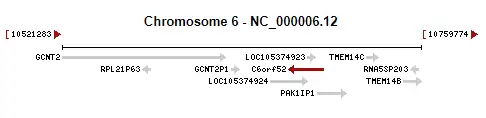
The cytogenetic location of C6orf52 is 6p24.2 on the shorthand of chromosome 6.[6] It is 23,379 nucleotides long, spanning from nucleotide 10671418 to 10694797 and has a molecular weight of 17,383 Da with 9 different exons. C6orf52 has no common aliases although the major protein product is sometimes referred to as "Q5T4I8".[7]
mRNA
C6orf52 is known to undergo alternative splicing and has six known isoforms of varying length.
Homology
Paralogs
C6orf52 has one identified paralog, tRNA selenocysteine 1-associated protein 1 (TRNAU1AP), which is located on chromosome one at 1p35.3.[5] TRNAU1AP is involved selenocysteine biosynthesis, selenoproteins synthesis efficiency enhancement and may be involved in the methylation of tRNA(Sec).[8]
Orthologs
C6orf52 is conserved through many species. It can be found it many mammals, reptiles, and birds, such as the Zebra Finch.[9]
| Scientific name | Name | Accession | Sequence Similarity % | Date of Divergence (Estimated MYA)[10] |
|---|---|---|---|---|
| Sus scrofa | Wild Boar | NP_001138494.1 | 60.976 | 96 |
| Taeniopygia guttata | Zebra Finch | XP_004175377.1 | 56.90 | 312 |
| Ailuropoda melanoleuca | Giant Panda | XP_019651607.1 | 64.43 | 96 |
| Pelodiscus sinensis | Chinese Softshell Turtle | XP_006138812.1 | 42.55 | 312 |
| Canis lupus familiaris | Dog | XP_005640089.1 | 64.29 | 96 |
| Pan troglodytes | Common Chimpanzee | XP_009448762.2 | 98.03 | 6.65 |
| Macaca mulatta | Rhesus macaque | NP_001180810.1 | 94.08 | 29.44 |
There is a domain of high conservation across species starting near the last third of the polypeptide.

Isoforms
Q5T4I8 has six known isoforms of varying amino acid length.
| Isoform | Polypeptide Length |
|---|---|
| X1 | 207 |
| X2 | 182 |
| X3 | 177 |
| X4 | 176 |
| X5 | 126 |
| X6 | 93 |
Tissue distribution
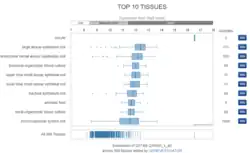
Tissue expression is highest within the oocyte, with high expression in the testes and female gonad.[7]
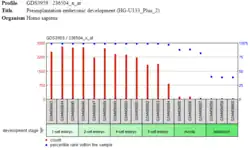
Expression is extremely high (2000-3000 transcripts per million) in the first stages of embryonic development up until the blastocyst.
Subcellular localization
It is predicted to be a non-transmembrane protein that is located within the nucleus.[11]
Structure
The protein composition is relatively high in glutamic acid and serine residue levels and is relatively low in tryptophan and arginine when compared to the average human protein composition.[12][13]
The secondary structure of C6orf52 consists mostly of coiled regions, however there is an extended alpha helix region within the highly conserved domain.[14][15]
Post-translational modifications
C6orf52 has two commonly predicted post-translational modifications present in the highly conserved domain.[16][17] The lysine at position 123 (of the major protein) within the highly conserved domain is expected to undergo sumoylation often, while the tyrosine at position 128 is expected to undergo phosphorylation. Sumoylation sites allow for the binding of SUMO (small ubiquitin-like modifier protein) which are known to alter different functional parameters of proteins such as subcellular localization, protein parenting, DNA binding and transactivation functions of transcription factors.[18] Tyrosine phosphorylation is associated with many things, namely growth factor signaling and cell differentiation during development which are recurring aspects of C6orf52.[19]
Clinical significance
Two proteins in cattle that have been linked to fat or energy metabolism were predicted to be similar to C6orf52, however there is no known clinical study done examining C6orf52.[20]
References
- 1 2 3 ENSG00000285312 GRCh38: Ensembl release 89: ENSG00000137434, ENSG00000285312 – Ensembl, May 2017
- ↑ "Human PubMed Reference:". National Center for Biotechnology Information, U.S. National Library of Medicine.
- ↑ "NCBI(National Center for Biotechnology Information)". Retrieved 2019-02-22.
- ↑ "NCBI(National Center for Biotechnology Information)". Virginia Medical. 105 (4): 272–277. April 1978. Retrieved 2019-02-25.
- 1 2 "NCBI(National Center for Biotechnology Information)". Retrieved 2019-02-25.
- ↑ "HUGO Gene Symbol Report". Retrieved 2019-02-25.
- 1 2 "UniProt". Retrieved 2019-02-25.
- ↑ "UniProt - TRNAU1AP - tRNA selenosysteine 1-associated protein 1 - Homo sapiens". UniProt. Retrieved 2019-05-06.
- ↑ "Blast NCBI". Retrieved 2019-02-25.
- ↑ "TimeTree: The Timescale of Life". Retrieved 2019-02-25.
- ↑ "PSORT II Prediction". Retrieved 2019-05-05.
- ↑ "The Institute for Environmental Modeling (TIEM)". Retrieved 2019-05-05.
- ↑ "ProtScale - Amino Acid Composition (in UniProKB/Swiss-Prot data bank)". Retrieved 2019-05-05.
- ↑ "NPS@: Network Protein Sequence Analysis - SOPMA". Retrieved 2019-05-05.
- ↑ "I-TASSER server for protein structure and function prediction". Retrieved 2019-05-05.
- ↑ "NetPhos 3.1 Server". Retrieved 2019-05-05.
- ↑ "SUMOplot Analysis Program - Abgent". Retrieved 2019-05-05.
- ↑ Hilgarth RS, Murphy LA, Skaggs HS, Wilkerson DC, Xing H, Sarge KD (December 2004). "Regulation and function of SUMO modification". The Journal of Biological Chemistry. 279 (52): 53899–53902. doi:10.1074/jbc.R400021200. PMID 15448161.
- ↑ Pasantes-Morales H, Franco R (April 2002). "Influence of protein tyrosine kinases on cell volume change-induced taurine release". Cerebellum. 1 (2). London, England: 103–109. doi:10.1080/147342202753671231. PMID 12882359. S2CID 9909209.
- ↑ Chow YW, Pietranico R, Mukerji A (1975). "NCBI(National Center for Biotechnology Information)". Biochemical and Biophysical Research Communications. 66 (4): 1424–1431. doi:10.1016/0006-291x(75)90518-5. PMID 6.