C22orf39
| C22orf39 | ||||||||||||||||||||||||||||||||||||||||||||||||||||||
|---|---|---|---|---|---|---|---|---|---|---|---|---|---|---|---|---|---|---|---|---|---|---|---|---|---|---|---|---|---|---|---|---|---|---|---|---|---|---|---|---|---|---|---|---|---|---|---|---|---|---|---|---|---|---|
| Identifiers | ||||||||||||||||||||||||||||||||||||||||||||||||||||||
| Aliases | C22orf39, chromosome 22 open reading frame 39 | |||||||||||||||||||||||||||||||||||||||||||||||||||||
| External IDs | MGI: 1919557; GeneCards: C22orf39 | |||||||||||||||||||||||||||||||||||||||||||||||||||||
| ||||||||||||||||||||||||||||||||||||||||||||||||||||||
| ||||||||||||||||||||||||||||||||||||||||||||||||||||||
| ||||||||||||||||||||||||||||||||||||||||||||||||||||||
| ||||||||||||||||||||||||||||||||||||||||||||||||||||||
| Wikidata | ||||||||||||||||||||||||||||||||||||||||||||||||||||||
| ||||||||||||||||||||||||||||||||||||||||||||||||||||||


Synaptic plasticity regulator Plasticity Associated Neural Transcript (PANTS) is a protein which in humans is encoded by the C22orf39 gene. C22orf39 is expressed at high levels throughout the body, though expression is highest in skeletal muscle and the heart.
Gene
The human C22orf39 gene is located on the minus strand on chromosome 22 (22q11.21), has 3 exons, and spans 6,826 bp.[5]
Transcript

Human C22orf39 has 2 main transcripts. Variant 1 is 318 nt long and differs from Variant 2 by having a longer but overlapping 3’ exon and encoding a different C-terminus of the C22orf39 protein.[5] Both transcripts are the same total length with the same number of exons.

Protein
In humans, C22orf39 comes in two isoforms, 1 (105 aa) and 2 (80 aa). Isoform 1 of C22orf39 has a calculated molecular weight of approximately 12.4 kDa and an isoelectric point (pI) of 7.71[6] in humans, though pI is not conserved throughout homologs. C22orf39 has a domain of unknown function (DUF3128). [7] The C22orf39 protein is tryptophan and arginine rich and low in threonine.[8]
Regulation
Gene

C22orf39 has variable expression at relatively high levels throughout most tissues in the body. mRNA expression of C22orf39 is highest in skeletal muscle and the heart.[9][10] The C22orf39 protein is also found abundantly throughout the whole organism.[11] Antibody imaging reveals that C22orf39 is localized to the endoplasmic reticulum.[12]
Transcript
C22orf39 has a highly conserved miRNA binding site in the 3' UTR.[13]
Protein (post-translational modifications)
C22orf39 is localized to the cytoplasm or mitochondria.[14] C22orf39 has several predicted phosphorylation sites[15] and an acetylation site.[16]
Homology/evolution
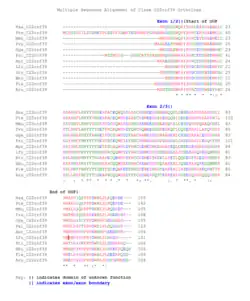
C22orf39 has no paralogs.[17]
C22orf39 orthologs are found in almost all multicellular animals, excluding several select taxonomic groups including flatworms and roundworms. The most distant related orthologs are sponges. Orthologs range in sequence identity from 24% to 98%: mammals (60-98%), birds/reptiles (50-59%), amphibians (46-50%), fish (49-50%), and invertebrates (24-39%).[17][18]

| Genus/Species | Common Name | Taxonomic Group | Date of Divergence (MYA) | Accession # | Sequence Length | Sequence Identity % | Sequence Similarity % | |
|---|---|---|---|---|---|---|---|---|
| Mammals | Homo sapiens | Human | Primate | 0 | NP_776154.4 | 105 | 100 | 100 |
| Piliocolobus tephrosceles | Red Colobus Monkey | Primate | 28.8 | XP_023048350.2 | 142 | 98 | 100 | |
| Mus musculus | Mouse | Rodentia | 87 | NP_001028336.1 | 81 | 72 | 82 | |
| Trichosurus vulpecula | Bushtail Possum | Marsupial | 160 | XP_036613470.1 | 108 | 60 | 75 | |
| Birds/Reptiles | Gallus gallus | Chicken | Avian | 319 | XP_015131179.1 | 105 | 59 | 68 |
| Pelodiscus sinensis | Chinese Softshell Turtle | Testudines | 319 | XP_006135010.3 | 123 | 51 | 75 | |
| Ahaetulla prasina | Vine Snake | Squamata | 319 | XP_058014370.1 | 106 | 50 | 72 | |
| Amphibians | Leptodactylus fuscus | Rufous Frog | Amphibian | 352 | XP_075132091.1 | 106 | 48 | 70 |
| Xenopus tropicalis | Western Clawed Frog | Amphibian | 352 | XP_004910632.1 | 106 | 47 | 69 | |
| Bufo bufo | Common Toad | Amphibian | 352 | XP_040272282.1 | 106 | 46 | 71 | |
| Fish | Acipenser ruthenus | Sterlet Sturgeon | Fish | 429 | XP_058888772.1 | 108 | 50 | 66 |
| Plectropomus leopardus | Leopard Coral Grouper | Fish | 429 | XP_042344043.1 | 109 | 49 | 69 | |
| Invertebrates: Cnidarians | Orbicella faveolata | Star Coral | Anthozoa | 685 | XP_020628890.1 | 109 | 24 | 53 |
| Hydra viridissima | Hydra | Hydrozoa | 685 | XP_079916326.1 | 108 | 24 | 42 | |
| Invertebrates: Anthropods | Penaeus japonicus | Prawn | Crustacean | 686 | XP_042862443.1 | 149 | 36 | 56 |
| Vespula pensylvanica | Western Yellow Jacket | Insect | 686 | XP_043677143.1 | 145 | 35 | 58 | |
| Uloborus diversus | Orb Weaver | Spider | 686 | XP_054709478.1 | 156 | 31 | 51 | |
| Invertebrates: Mollusks | Gigantopelta aegis | Sea Snail | Gastropod | 686 | XP_041347459.1 | 150 | 39 | 58 |
| Invertebrates: Sponges | Halichondria panicea | Breadcrumb Sponge | Porifera | 758 | XP_064392711.1 | 115 | 33 | 40 |
| Corticium candelabrum | Marine Sponge | Porifera | 758 | XP_062516804.1 | 119 | 27 | 34 |

Comparing C22orf39 ortholog data to the known evolution rates of cytochrome C and complement factor 1 suggests that the C22orf39 gene evolves relatively quickly.
Clinical significance
In a study inducing hepatocarcinogenesis (production of liver cancer) in mice through overexpression of the human MYC gene, the C22orf39 gene was shown to be silenced in PICM-19 cells (a liver cell line from fetal pigs) following MYC-induction (the overexpression of MYC oncogenes), suggesting that the absence of the C22orf39 protein is necessary for carcinogenesis.[19]
C22orf39 is part of the regulatory network of transcription factor breast cancer type 1 susceptibility protein (BRCA1), the up-regulation of which has a high connectivity with differentially expressed genes (DEG’s) that may contribute to increased risk of esophageal squamous cell carcinoma (ESCC). [20]
Individuals with Duchenne muscular dystrophy are shown to have lower C22orf39 expression, though this is likely an effect of the condition rather than a cause.[21]
A study of 22q11.2 deletion syndrome in mice (a condition that increases risk of schizophrenia, among other neurological and physiological issues), identified a C22orf39 ortholog in mice (referred to as mouse Pants). In control mice, Pants was found to have increased expression in the hippocampus of aging mouse brains. This study suggests that the loss of C22orf39 in 22q11.2 deletion syndrome could be a major contributor to the age-related plasticity deficits displayed by mice with this deletion.[22][23]
References
- 1 2 3 GRCh38: Ensembl release 89: ENSG00000242259 – Ensembl, May 2017
- 1 2 3 GRCm38: Ensembl release 89: ENSMUSG00000071632 – Ensembl, May 2017
- ↑ "Human PubMed Reference:". National Center for Biotechnology Information, U.S. National Library of Medicine.
- ↑ "Mouse PubMed Reference:". National Center for Biotechnology Information, U.S. National Library of Medicine.
- 1 2 "C22orf39 chromosome 22 open reading frame 39 [Homo sapiens (human)] - Gene - NCBI". www.ncbi.nlm.nih.gov. Retrieved 2026-05-26.
- ↑ "Expasy - Error". web.expasy.org. Retrieved 2026-06-04.
- ↑ "synaptic plasticity regulator PANTS isoform 1 [Homo sapiens] - Protein - NCBI". www.ncbi.nlm.nih.gov. Retrieved 2026-05-26.
- ↑ European Bioinformatics Institute. "Job Dispatcher homepage | EMBL-EBI". www.ebi.ac.uk. Retrieved 2026-06-04.
- ↑ "C22orf39 chromosome 22 open reading frame 39 [Homo sapiens (human)] - Gene - NCBI". www.ncbi.nlm.nih.gov. Retrieved 2026-06-04.
- ↑ "GDS3113 / 218945". www.ncbi.nlm.nih.gov. Retrieved 2026-06-04.
- ↑ von Mering Lab, Swiss Institute of Bioinformatics, University of Zurich. "PaxDb: Protein Abundance Database". pax-db.org. Retrieved 2026-06-04.
{{cite web}}: CS1 maint: multiple names: authors list (link) - ↑ "Anti-C22orf39 Human Protein Atlas Antibody". www.atlasantibodies.com. Retrieved 2026-06-04.
- ↑ "TargetScanHuman 8.0". www.targetscan.org. Retrieved 2026-06-05.
- ↑ "DeepLoc 2.0 - DTU Health Tech - Bioinformatic Services". services.healthtech.dtu.dk. Retrieved 2026-06-05.
- ↑ "ScanProsite". prosite.expasy.org. Retrieved 2026-06-05.
- ↑ "PhosphoSitePlus". www.phosphosite.org. Retrieved 2026-06-05.
- 1 2 "BLAST: Basic Local Alignment Search Tool". blast.ncbi.nlm.nih.gov. Retrieved 2026-06-04.
- ↑ "TimeTree :: The Timescale of Life". timetree.org. Retrieved 2026-06-04.
- ↑ Aravalli RN, Talbot NC, Steer CJ (February 2015). "Gene expression profiling of MYC-driven tumor signatures in porcine liver stem cells by transcriptome sequencing". World Journal of Gastroenterology. 21 (7): 2011–2029. doi:10.3748/wjg.v21.i7.2011. PMC 4326136. PMID 25717234.
- ↑ Zhang Y, Xu Y, Li Z, Zhu Y, Wen S, Wang M, et al. (January 2018). "Identification of the key transcription factors in esophageal squamous cell carcinoma". Journal of Thoracic Disease. 10 (1): 148–161. doi:10.21037/jtd.2017.12.27. PMC 5863113. PMID 29600044.
- ↑ "GDS609 / 49719_at". www.ncbi.nlm.nih.gov. Retrieved 2026-06-04.
- ↑ Kragness S, Harrison MA, Westmoreland JJ, Burstain A, Earls LR (June 2018). "Age-dependent expression pattern in the mammalian brain of a novel, small peptide encoded in the 22q11.2 deletion syndrome region". Gene Expression Patterns. 28: 95–103. doi:10.1016/j.gep.2018.03.004. PMID 29571919.
- ↑ Peter B, Scherer N, Liang WS, Pophal S, Nielsen C, Grebe TA (May 2021). "A phenotypically diverse family with an atypical 22q11.2 deletion due to an unbalanced 18q23;22q11.2 translocation". American Journal of Medical Genetics. Part A. 185 (5): 1532–1537. doi:10.1002/ajmg.a.62121. PMID 33569883.