Byrgius (crater)
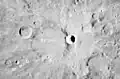
 Lunar Orbiter 4 image of Byrgius, with Byrgius A at right, and Byrgius D in upper left | |
| Location | The Moon |
|---|---|
| Coordinates | 24°42′S 65°18′W / 24.7°S 65.3°W |
| Diameter | 84.46 km (52.48 mi)[1] |
| Depth | 4.6 km (2.9 mi) |
| Age | c. 48 million years |
| Eponym | Joost Burgi |
Byrgius is a lunar impact crater located in the western part of The Moon, near the limb. As a result, Byrgius appears strongly oval in shape due to foreshortening. It lies northwest of Vieta.[2] To the northwest is the nearly ruined crater Lamarck.[3] The low rim of Byrgius is worn and eroded,[2] with Byrgius A overlying the eastern rim and Byrgius D lying across the northwest. The floor of Byrgius is relatively flat and undistinguished by significant craters.[4]: 92 Byrgius A possesses its own ray system that crosses Byrgius,[5] and extends for over 300 kilometres.[6] This fresh crater has an estimated age of around 48 million years.[7]
This crater is named after Swiss horologist Jost Burgi.[1] His name was introduced into lunar nomenclature in 1651 by Giovanni Ricciolli.[8] The designation was formally adopted by the International Astronomical Union in 1651.[1]
Satellite craters
By convention these features are identified on lunar maps by placing the letter on the side of the crater midpoint that is closest to Byrgius.[9]
| Byrgius[4]: 294 | Latitude | Longitude | Diameter |
|---|---|---|---|
| A | 24.5° S | 63.7° W | 19 km |
| B | 23.9° S | 60.8° W | 23 km |
| D | 24.1° S | 67.1° W | 27 km |
| E | 23.5° S | 66.2° W | 18 km |
| H | 23.7° S | 62.4° W | 27 km |
| K | 23.0° S | 61.8° W | 14 km |
| N | 22.3° S | 63.1° W | 20 km |
| P | 22.6° S | 64.1° W | 19 km |
| R | 26.5° S | 60.7° W | 7 km |
| S | 26.2° S | 61.4° W | 43 km |
| T | 25.1° S | 61.5° W | 5 km |
| U | 25.8° S | 67.2° W | 13 km |
| V | 26.0° S | 67.8° W | 9 km |
| W | 26.1° S | 68.5° W | 14 km |
| X | 25.7° S | 65.4° W | 6 km |
Gallery
 The rays of Byrgius A extend for hundreds of km, and it is the brightest feature in the region.
References
- 1 2 3 "Byrgius". Gazetteer of Planetary Nomenclature. USGS Astrogeology Research Program.
- 1 2 Moore, Patrick (2001). On the Moon. Sterling Publishing Co. p. 195. ISBN 978-0-304-35469-6.
- ↑ "LAC 92" (PDF). Gazeteer of Planetary Nomenclature. Retrieved 2026-06-20.
- 1 2 Bussey, B.; Spudis, P. (2004). The Clementine Atlas of the Moon. New York: Cambridge University Press. ISBN 978-0-521-81528-4.
- ↑ Chu, Alan; et al. (2012). The Cambridge Photographic Moon Atlas. Cambridge University Press. p. 181. ISBN 978-1-107-01973-7.
- ↑ Grego, Peter (2005). The Moon and How to Observe It. Astronomers' Observing Guides Series. London: Springer-Verlag. p. 191. ISBN 1-85233-748-6.
- ↑ Raney, R. Keith; et al. (May 2012). "The m-chi decomposition of hybrid dual-polarimetric radar data with application to lunar craters". Journal of Geophysical Research. 117 E00H21. Bibcode:2012JGRE..117.0H21R. doi:10.1029/2011JE003986.
- ↑ Whitaker, Ewen A. (1999). Mapping and Naming the Moon. Cambridge University Press. pp. 60, 210. ISBN 978-0-521-62248-6.
- ↑ Grego, P. (2015). "Satellite Crater". In Hargitai, H.; Kereszturi, Á. (eds.). Encyclopedia of Planetary Landforms. New York, NY: Springer. doi:10.1007/978-1-4614-3134-3_328.
Sources
- Price, Fred W. (1988). The Moon Observer's Handbook. Cambridge University Press. ISBN 978-0-521-33500-3.
- Rükl, Antonín (1990). Atlas of the Moon. Kalmbach Books. ISBN 978-0-913135-17-4.
- Wlasuk, Peter T. (2000). Observing the Moon. Springer. ISBN 978-1-85233-193-1.
External links
 Media related to Byrgius (crater) at Wikimedia Commons
| Physical properties |  | |
|---|---|---|
| Orbit | ||
| Surface and features | ||
| Science | ||
| Exploration | ||
| Time-telling and navigation | ||
| Phases and names | ||
| Daily phenomena | ||
| Related |
| |
