Busa Grande fortification
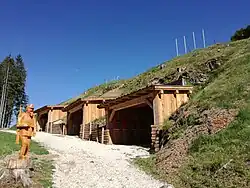
Fort Busa Grande is an Austro-Hungarian fort built between March and May of 1915.[1] The fort had the aim of retiring the antiquated forts of Col De Le Benne and Tenna, which were nearby.[2] The work on the fort was completed very quickly due to the use of Russian prisoners of war. They disarmed the outdated fort of Col De Le Bene and transferred its arms to the newly constructed Busa Grande. The fort was built at the extreme range of the Italian heavy artillery batteries at Porta Manazzo and the Sella Valley. The fort housed a battery of howitzers in a shell-proof cave. 2 10cm M05 guns and the observation dome from De Benne were placed here after being removed from their locations. [1]
In a short while, Busa Grande amassed a large amount of artillery, with 8 9cm QF guns emplaced in 3 field batteries. A little while later, 4 12cm guns were emplaced in field batteries nearby. Busa Grande was one of the most equipped Austro-Hungarian fortifications ever built, with its own electricity, water, small field hospital, ammo supply, a kitchen, and even a telephone exchange. Supply never became a problem because the supply road from Pergine was out of sight of the Italian artillery. Busa Grande was never hit by enemy artillery, but the remains of Italian 28cm shells litter the approaches to the fort. [1]
When the Austro-Hungarian Spring Offensive, also known as the Battle of Asiago, was launched, it pushed the front line out of range of the guns located at or nearby Busa Grande. Summarily, the fort was disarmed and its guns were moved to more active parts of the front line. Despite being disarmed, an anti-aircraft and spotlight battery was stationed at Busa Grande to protect Levico Terme.[1]
Post-war
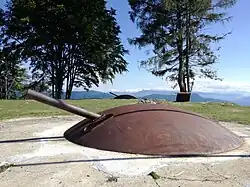
After the war the fort was looted by the locals and the internal components like the steel and wiring were taken out by the Italian authorities. The commune of Vignola-Falesina began restoring the fort in 2014, with renovations being finished in 2016. When the renovations were finished in Sept. 2016, the howitzer battery was opened to the public. It was later found out that the replacement armored domes were the wrong specifications and had to be replaced.[1]
References
- 1 2 3 4 5 OeGF. "Panzerhaubitzbatterie/ howitzer battery Busa Grande | Österreichische Gesellschaft für Festungsforschung Austrian Society for Fortification Research" (in German). Retrieved 2026-08-21.
- ↑ Valsugana, A. P. T. "Forts (First World War) - Busa Granda Fort - Levico Terme - APT ValsuganaEN". APT Valsugana. Retrieved 2026-08-21.
- Forts in Italy
- 20th-century fortifications
- Military installations established in 1915
- 1915 establishments in Italy
- 20th-century architecture in Italy
- Buildings and structures in Bergamo
- History of Bergamo
- Tourist attractions in Bergamo
- Buildings and structures in Trentino
- History of Trentino
- Austro-Hungarian Army
- Military history of Austria-Hungary
- 1915 establishments in Austria-Hungary