Bugesera massacres
| Bugesera Massacres | |
|---|---|
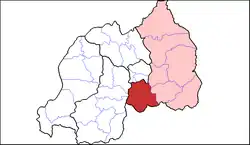 Bugesera District where the massacres happened | |
| Location | 2°13′59″S 30°09′32″E / 2.23295°S 30.158911°E Bugesera District |
| Date | March 1992 |
Attack type | Genocidal massacre |
| Deaths | 300+ |
| Victims | Tutsi |
| Perpetrators | Ferdinand Nahimana, Hutu civilians, Hutu Power militants |
| Motive | broadcasting Disinformation on Radio Rwanda |
The Bugesera massacres were a series of attacks perpetrated by people belonging to the Hutu ethnicity, against Tutsi civilians in the Bugesera District of southeastern Rwanda. The massacres occurred in March 1992, after false information was broadcast by Radio Rwanda. Some observers saw this as a prelude to the genocide of the Tutsi in Rwanda that took place in 1994.
Background
Bugesera, a district located southeast of Kigali and bordering Burundi, comprises three sectors: Kanzenze, Gashora and Ngenda.[1] Tutsis were " forcibly settled there after November 1959, when the Nyamata refugee camp was created".[2] Depending on the area, they constituted up to 40% of the population.[3]
Role of the Media
The public station Radio Rwanda fell into the hands of Hutu extremists who started to broadcast hateful propaganda against the Tutsi.[4] In 1992 Ferdinand Nahimana ordered Radio Rwanda to broadcasts false information allegeding that the Rwandan Patriotic Front (RPF), had allegedly drawn up a kill-list of local Hutus.[5][6] In late February [7] or early March, Radio Rwanda broadcast a leaflet, "falsely attributed to the Liberal Party, [The Leaflet] claimed that some twenty prominent figures of Hutu origin—the majority ethnic group in Rwanda and dominant within the government—were going to be assassinated":[5] the alleged document was supposedly released by "Committee for Non-Violence in Rwanda"[7] The Leaflet revelead a "destabilization plan", in which the third and imminent phase of which would be triggered by "foreign terrorist agents" infiltrating the population .[3] The announcement was repeated several times in the following days. [8][9] At the same time, Hassan Ngeze, director of the magazine Kangura, traveled to Rwanda to also spread false information. Referring to the danger of an attack by the Inyenzi[a], one of the leaflets he distributed on the March 1st to the population ends with "We must not let them [the Inyenzi] escape us!", language echoing those of Léon Mugesera.[11] For Alison Des Forges, this is a typical case of mirror accusation, a propaganda technique which consists of attributing to the opposing side what one is preparing to do in order for the listeners to feel threatened and then act with the feeling of being in a situation of " legitimate defense.[12]
The massacres
On 4 March 1992 Tutsi began to be targeted in several localities.[5][13] The Massacres continued from March 4 to 10.[14][15] The massacres were perpetrated by "civilians under the leadership of their mayor" although witnesses reported that the groups were supervised by armed men "brought in from outside". The armed men conisted of Interahamwe[16] and Hutu soldiers from the Rwandan Armed Force (FAR),[17] some of the armed men were also from the presidential guard.[18] The role of the FAR, though more "passive," remained effective: they disarmed those who tried to defend themselves and then blocked access to the parish of Nyamata, thus leaving the Tutsis at the mercy of the attackers.[19] Furthermore, the civil and military authorities gathered the Tutsis in certain locations, such as municipal offices, where they were then massacred. Nevertheless, they did not attempt to enter the churches, where many civilians spontaneously sought refuge.[6] Access to food and water was cut off to force the Tutsis to return home, the authorities did not yet have sufficient organization and logistics to attack these sanctuaries, unlike what would happen during the three months of the genocide two years later.[20] Jean-Baptiste Gatete, mayor of Murambi who was later convicted by the ICTR[21] participated in the massacres.[22]
At the time, Interior Minister Sylvestre Nsanzimana announced that the massacres had killed 60 civilians, while the opposition reported 150 deaths, as well as the arson of hundreds of houses, leaving between "6000 and 9000 Tutsi civilians" without shelter or food.[5] The final death toll according to the Rwandan government was 182.[8]
When questioned by members of an investigative mission consisting of several NGOs, the mayor of Kanzenze, Fidèle Rwambuka, initially denied knowing the origin of the massacres. He then presented a letter written by some of his constituents to exonerate him, a letter attempting to justify the killings on the grounds of "defamation" allegedly uttered by "Tutsi activists" against the mayor during a meeting held on March 1, 1992.[15] His responsibility and that of the sub-prefect was nevertheless established from the start. On March 9 the French embassy in Rwanda, sent two staff members to the area, as well as the soldiers from the Gendarmerie. The Duclert report adds that Georges Martres — ambassador in office at the time of the events — did not deny the ethnic nature of the violence.[23]
Aftermath
Dismissal of Ferdinand Nahima
Following the installation of the coalition government in April 1992, The MDR, the PL, and the PSD demanded changes within the media, particularly Radio Rwanda.[24][6] This was compounded by international pressure that left Juvénal Habyarimana with no choice but to act.[13][25] Because of his role in the Bugesera massacres, which he helped to instigate, Ferdinand Nahimana was dismissed from his position as director of ORINFOR (Rwandan Information Office), where he had coordinated the public radio station, without any other sanctions.[26] After the dismissal he established, a private radio station: Radio Télévision Libre des Mille Collines (RTLM), which played a crucial role in inciting the genocide in 1994.
Prosecution
The Kigali prosecutor's office arrested around 450 individuals, many of whom were released very quickly, others due to a procedural flaw; ten months after the events, no one had been tried and the survivors had received no restitution.[27]
Notes
- ↑ In Kinyarwanda, the term means "cockroaches". Initially referring to refugees, it was later used to describe fighters of the RPF. Ultimately, it came to designate all members of the Tutsi community [10]
References
- ↑ FIDH et al. 1993, p. 41.
- ↑ Piton 2018, p. 99.
- 1 2 Périès et Servenay 2007, p. 214.
- ↑ Gordon 2017, p. 50.
- 1 2 3 4 "Massacres au Rwanda Alors que le pays s'ouvre timidement à la démocratie, de nouvelles violences ont éclaté entre les Hutus au pouvoir et les Tutsis". Le Monde.
- 1 2 3 Guichaoua 2010, p. 120.
- 1 2 "Le Rwanda, il y a vingt ans : l'option du génocide". Libération (journal. Retrieved 4 May 2026.
- 1 2 Mission d'information parlementaire sur le Rwanda 1998, p. 97.
- ↑ FIDH et al. 1993, p. 43.
- ↑ Piton 2018, p. 246
- ↑ Des Forges 2004, p. 109.
- ↑ Des Forges 2004, p. 83.
- 1 2 Piton 2018, p. 89
- ↑ Commission de recherche sur les archives françaises relatives au Rwanda et au génocide des Tutsi 2021, p. 320.
- 1 2 FIDH et al. 1993, p. 46.
- ↑ Des Forges 2004, p. 122.
- ↑ Mission d'information parlementaire sur le Rwanda 1998, p. 97-98.
- ↑ Commission de recherche sur les archives françaises relatives au Rwanda et au génocide des Tutsi 2021, p. 953.
- ↑ FIDH et al. 1993, p. 78.
- ↑ Des Forges 2004, p. 111.
- ↑ "Génocide Rwanda: un ancien haut fonctionnaire condamné à perpétuité". JeuneAfrique.com (in French). Retrieved 4 May 2026.
- ↑ Périès et Servenay 2007, p. 281.
- ↑ Commission de recherche sur les archives françaises relatives au Rwanda et au génocide des Tutsi 2021, p. 153-154.
- ↑ Des Forges 2004, p. 84.
- ↑ Périès et Servenay 2007, p. 216.
- ↑ Mission d'information parlementaire sur le Rwanda 1998, p. 98.
- ↑ FIDH et al. 1993, p. 47,83.
Books
- Chrétien, Jean-Pierre; Kabanda, Marcel (2016). Rwanda, racisme et génocide. Paris: Belin. ISBN 9782410001525.
- Des Forges, Allison (1999). Aucun témoin ne doit survivre: le génocide au Rwanda. Paris: Editions Karthala. ISBN 2-86537-937-X.
- Dumas, Hélène (2020). Sans ciel ni terre: paroles orphelines du génocide des Tutsi, 1994-2006. Paris: la Découverte. ISBN 978-2-348-05789-2.
- Gordon, Gregory. Atrocity Speech Law. Oxford University Press. ISBN 978-0-19-061270-2.
- Guichaoua, André (2010). Rwanda, de la guerre au génocide: les politiques criminelles au Rwanda, 1990-1994. Paris: la Découverte. ISBN 978-2-7071-5370-8.
- Périès, Gabriel; Servenay, David (2007). Une guerre noire: enquête sur les origines du génocide rwandais (1959-1994). Paris: La Découverte. ISBN 978-2-7071-4914-5.
- Piton, Florent (2018). Le génocide des Tutsi du Rwanda. Paris: la Découverte. ISBN 978-2-7071-9068-0. Piton 2018.
Reports
- La France, le Rwanda et le génocide des Tutsi, 1990-1994: rapport remis au Président de la République le 26 mars 2021. Malakoff: Armand Colin. 2021. ISBN 9782200632656.
- Rapport de la commission internationale d'enquête sur les violations des droits de l'homme au Rwanda depuis le 1er octobre 1990, (7-21 janvier 1993) : rapport final (in French). Fédération Internationale des Ligues des Droits de l'Homme. 1993.
- Mission d'information parlementaire sur le Rwanda (1998). Rapport n°1271 (PDF) (in French). Retrieved 4 May 2026.
News articles
"Rwanda: au moins trente morts au cours de violences interethniques" (in French). 10 March 199. Retrieved 4 May 2026.