Brugmansia aurea
| Brugmansia aurea | |
|---|---|
 | |
Scientific classification  | |
| Kingdom: | Plantae |
| Clade: | Embryophytes |
| Clade: | Tracheophytes |
| Clade: | Angiosperms |
| Clade: | Eudicots |
| Clade: | Asterids |
| Order: | Solanales |
| Family: | Solanaceae |
| Genus: | Brugmansia |
| Section: | Brugmansia sect. Brugmansia |
| Species: | B. aurea |
| Binomial name | |
| Brugmansia aurea Lagerh. | |
 | |
| Synonyms[2] | |
| |

Brugmansia aurea, also known as golden angel's trumpet,[3][4] is a species of flowering plant in the nightshade family Solanaceae that was native to Ecuador and Colombia,[2] but is now Extinct in the Wild.[1][4] Despite being declared extinct in its native range, Brugmansia aurea is a popular ornamental and is widely cultivated, like the other members of its genus.
Description

Vegetative characteristics
Brugmansia aurea is an up to 8 m tall shrub or small tree[5] with spreading or drooping, almost smooth branches and smooth, grey bark.[6] The leaves are glabrous or nearly glabrous.[7]
Generative characteristics
The axillary, tubular, pendent, sulphur yellow to golden yellow, pleasantly fragrant, nectariferous flowers have 7–8 cm long, smooth pedicels.[6] The tubular, 13–16 cm long calyx with a pubescent outer surface is divided into 2–5 lobes at the apex.[6] The yellow, 15–18 cm long corolla bears five 5–6 cm long,[6] recurved teeth.[7] The stamens are 14.5 cm long.[6]
Taxonomy
Brugmansia aurea Lagerh. was published by Nils Gustaf Lagerheim in 1893.[6][8] However, Brugmansia aurea Harrison had already been published by Harrison in 1837, making the later publication of Brugmansia aurea Lagerh. illegitimate.[9] As Brugmansia aurea Lagerh. had been widely used, it was proposed to conserve it against Brugmansia aurea Harrison.[9] It is placed in the section Brugmansia sect. Brugmansia.[10]
Etymology
The specific epithet aurea means "golden".[11]
Distribution and habitat
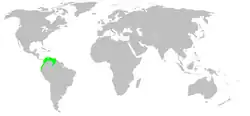
It was native to the Andes from south-central Ecuador to northeast Colombia at elevations of 2000–3000 m above sea level.[1] It grew mainly in Andean cloud forests and damp ravines with a subtropical mountainous climate, characterised by high humidity, moderate temperatures and frequent fog.[5] It has been introduced into Italy,[5][2] Rwanda,[2] France (Southern Corsica), and Spain.[5]
Ecology
The very fragrant, trumpet-shaped flowers attract bees, butterflies, and birds.[12] The flowers are pollinated by the hummingbird Ensifera ensifera.[6] The floral tube is very often pierced by short-billed, nectar robbing hummingbirds.[6]
Conservation
No natural wild populations are known and Brugmansia aurea is now Extinct in the Wild.[1] It is threatened by introgressive hybridisation with Brugmansia versicolor, via the hybrid Brugmansia × candida.[1]
Cultivation

Brugmansia aurea is cultivated as an ornamental plant.[12] Several cultivars exist, notably 'Grand Marnier' with peach-coloured flowers. As with other members of its genus, it cannot handle temperatures below 5 °C (41 °F), but in colder climates can be placed outside in a sheltered spot during the summer months.[13][14]
Toxicity
All parts of the plant are poisonous.[15]
Uses
It is used as a hallucinogen. Its most potent cultivar is Culebra Borrachero, which has a high concentration of the psychoactive scopolamine.[16] It has also been used as a truth serum.[17] Borrachero loosely translates to "get-you-drunk", and scopolamine is also known as Devil's Breath[18] and burundanga.[19]
References

- 1 2 3 4 5 Hay, A. (2014). "Brugmansia aurea". IUCN Red List of Threatened Species. 2014 e.T38124A58906215. doi:10.2305/IUCN.UK.2014-1.RLTS.T38124A58906215.en. Retrieved 15 November 2021.
- 1 2 3 4 Brugmansia aurea Lagerh. (n.d.). Plants of the World Online. Retrieved May 30, 2026, from https://powo.science.kew.org/taxon/urn:lsid:ipni.org:names:37434-2
- ↑ Brugmansia aurea Lagerh. (n.d.-b). Catalogue of Life. Retrieved May 30, 2026, from https://www.catalogueoflife.org/data/taxon/NFCP
- 1 2 Holmes, B. (n.d.). Brugmansia aurea Lagerh. (1893:33). The Recently Extinct Plants and Animals Database. Retrieved May 30, 2026, from https://recentlyextinctspecies.com/solanales-tomatoes-potatoes-eggplants-nightshades-etc/brugmansia-aurea
- 1 2 3 4 Giardi, L., & Fried, G. (2026) Brugmansia aurea Lagerh., a newly introduced species in Southern Corsica. Carnets botaniques Article n° 304 – 13 mai 2026
- 1 2 3 4 5 6 7 8 Lagerheim, N. G. (1893). Eine neue, goldgelbe Brugmansia (B. aurea Lagerh.). Gartenflora (Vol. 42, p. 33).
- 1 2 De Lorenzo Cáceres, J. M. S. (2003). Las especies del género Brugmansia cultivadas en España. Arboles Ornamentales. Retrieved May 31, 2026, from https://www.arbolesornamentales.es/Brugmansia.htm
- ↑ Brugmansia aurea Lagerh. (n.d.). International Plant Names Index. Retrieved May 31, 2026, from https://www.ipni.org/n/37434-2
- 1 2 Hay, A. (2021). (2802) Proposal to conserve the name Brugmansia aurea Lagerh. against B. aurea Harrison (Solanaceae). Taxon, 70(1), 212-213.
- ↑ Hay, A., & Gottschalk, M. (n.d.). Arten. GdS-Fachgruppen Dahlien, Fuchsien Und Kübelpflanzen. Retrieved April 25, 2026, from https://www.ddfgg.de/brugmansien/brugmansien_arten.php
- ↑ Harrison, Lorraine (2012). RHS Latin for Gardeners. United Kingdom: Mitchell Beazley. ISBN 978-1-84533-731-5.
- 1 2 Laface, V. L. A., Musarella, C. M., Cano Ortiz, A., Quinto Canas, R., Cannavò, S., & Spampinato, G. (2020). Three New Alien Taxa for Europe and a Chorological Update on the Alien Vascular Flora of Calabria (Southern Italy). Plants, 9(9), 1181. https://doi.org/10.3390/plants9091181
- ↑ "Brugmansia aurea 'Grand Marnier'". RHS. Retrieved 7 September 2021.
- ↑ "Angel's Trumpet, Brugmansia". Wisconsin Horticulture. Retrieved 2024-01-14.
- ↑ "Angel's Trumpet," The Better Homes and Gardens Plant Encyclopedia.
- ↑ Pratt, Christina (2007). "Brugmansia Aurea". An Encyclopedia of Shamanism. Rosen Publishing. pp. 68–70. ISBN 978-1-4042-1040-0.
- ↑ House, Robert E. (1931). "The Use of Scopolamine in Criminology". The American Journal of Police Science. 2 (4): 328–336. doi:10.2307/1147361. ISSN 1547-6154. JSTOR 1147361.
- ↑ Draper, Lucy (September 3, 2015). "Does the 'Devil's Breath' Drug Really Exist?". Newsweek. Retrieved April 13, 2017.
- ↑ Cotroneo, Christian (September 3, 2013). "The World's Scariest Drug". The Huffington Post. Retrieved April 13, 2017.