Bruce Lusignan
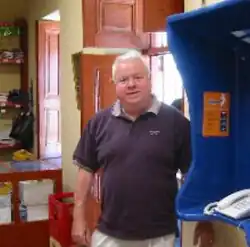
Bruce Lusignan (1936[1] – October 27, 2025[2]) was an emeritus associate professor[2] of electrical engineering at Stanford University[3][4] and a visiting professor at Portland State University.[5] He earned his B.S.E.E ('58), M.S.E.E. ('59) and Ph.D. ('63) degrees from Stanford.[5] In the early 1960s, he worked in radio astronomy at Stanford.[6][7] He has been director of Stanford's Communication Satellite Planning Center[8][9] and Stanford's Center for International Cooperation in Space.[4] He has also owned a small company designing cellular phones and pagers.[10]
His areas of specialization were communications satellites, telephone switches, cellular networks and the related signal processing problems.[5] He is inventor or co-inventor on 16 patents, including devices for metering power,[11] RF signal reception,[12] satellite transceivers,[13] alarm systems for cellular base stations,[14] tone generators for telephony,[15] and VSAT terminals.[16]
He worked on designs for reusable launch vehicles[8] based on the Black Horse concept.[17] and helped direct planning efforts for international cooperation on Mars exploration with the then-Soviet Union.[3][18][19][20] He led later post-Soviet cooperation in planning for an international Mars mission that included a space logistics function for ICBMs: using missiles such as the SS-18 to pre-position fuel and other supplies in Earth orbit, and Russia's Energia booster to send the supplies to Mars ahead of the crew.[21]
Lusignan also took a strong interest in the politics and issues that arise in economic development,[5] including sustainable development in Africa,[9] earthquake relief and reconstruction in Peru,[22] and rural telecommunications in the Middle East.[23] For a number of years he ran EDGE – "Ethics of Development in a Global Environment"[24] – a weekly seminar at Stanford about issues in international conflict, trade, environmental sustainability, and amelioration of poverty and racism.[25][4]
In 1982, he was one of a number of professors who, with the support of their institutions, openly defied restrictions on use of otherwise-publicly available materials rationalized via the Arms Export Control Act.[26]
References
- ↑ "Bruce Lusignan". International House/Adelfa Alumni Reunion Newsletter: 99–101.
- 1 2 "2025: Stanford remembers". Stanford University. Retrieved June 13, 2026.
- 1 2 "Bruce B. Lusignan". Faculty & Research. Stanford School of Engineering. 2007. Archived from the original on August 12, 2010.
- 1 2 3 "Bruce Lusignan – associate professor". Faculty. Stanford Electrical Engineering Department. 2007. Archived from the original on September 25, 2008.
- 1 2 3 4 "Bruce Lusignan". Faculty Research Interests and Publications. Portland State University. Retrieved 2011-08-09.
- ↑ "Start 'Em Early". Life. September 14, 1962. p. 118.
- ↑ Bruce Lusignan (1963). Detection of solar particle streams using high-frequency radio waves. Palo Alto, CA: Stanford University Department of Electrical Engineering.
- 1 2 Hudgins, Edward Lee; Boaz, David, eds. (2002). Space: the free-market frontier. Cato Institute. p. 79. ISBN 1-930865-19-8.
- 1 2 "Parallel programs (schedule)". Pacific West Coast Regional Summit on Africa. Women's Intercultural Network. 1999. Archived from the original on 2011-10-01. Retrieved 2011-08-09.
- ↑ Keith Bradsher (NY Times) (June 23, 1991). "Cellular Phone Calls Easy Pick for Unintended Ears". Lakeland Ledger. p. 10A.
- ↑ US 5391983, Lusignan, Bruce B. & Rezvani, Behruz, "Solid state electric power usage meter and method for determining power usage", issued Feb 21, 1995
- ↑ US 5640698, Shen, David H.; Hwang, Chien-Meen & Lusignan, Bruce B. et al., "Radio frequency signal reception using frequency shifting by discrete-time sub-sampling down-conversion", issued Jun 17, 1997
- ↑ US 5930680, Lusignan, Bruce B., "Method and system for transceiving signals using a constellation of satellites in close geosynchronous orbit", issued Jul 27, 1999
- ↑ US 4972507, Lusignan, Bruce B., "Radio data protocol communications system and method", issued Nov 20, 1990
- ↑ US 4571723, Lusignan, Bruce B.; Sytwu, James & Badawi, Amr, "Pulse code modulated digital telephony tone generator", issued Feb 18, 1986
- ↑ US 5745084, Lusignan, Bruce B., "Very small aperture terminal & antenna for use therein", issued Apr 28, 1998
- ↑ Lusignan, Bruce B (19–25 May 1996). "An international single stage to orbit". International Symposium on Space Technology and Science. Vol. 20. Gifu, Japan; JAPAN. pp. 910–915.
{{cite encyclopedia}}: CS1 maint: location missing publisher (link) - ↑ "Group of Scientists Propose Quick, Cheap Flight to Mars". Times-Union. Warsaw, IN. Jul 2, 1991.
- ↑ Harry F. Rosenthal (AP). "Quicker, Cheaper Journey to Mars?". Gainesville Sun. Gainesville, FL. pp. 1A, 8A.
- ↑ AP (June 26, 1991). "Cheaper Flight to Mars Proposed". Reading Eagle.
- ↑ "Students plan Mars mission in 20 years". News Release. Stanford University. June 8, 1993.
- ↑ "Stanford Will Plan Peru City in Quake Area". Los Angeles Times. Apr 28, 1971. p. B5. Archived from the original on November 7, 2012.
- ↑ "Stanford Working for Iran TV". The News and Courier. Charleston, SC. June 26, 1975. Retrieved 2011-08-09.
- ↑ "Ethics of Development in a Global Environment". Stanford University. July 27, 1999. Retrieved 2011-08-10.
- ↑ Perkowski, Marek A (ed.). "Bruce Lusignan". Portland State University.
- ↑ Robert C. Owen (Jan 13, 1982). "Police state for scientists?". Record-Journal.
Bibliography
- Lusignan, Bruce; Kiely, John (1970). Global weather prediction: the coming revolution. Holt, Rinehart and Winston. ISBN 9780030827990.
External links
- "Dr. Bruce Lusignan". The Space Show. Archived from the original on 2011-09-27. Retrieved 2011-08-09.
- "Broadcast 121: Dr. Bruce Lusignan". The Space Show. May 21, 2003. Archived from the original on 2011-09-27. Retrieved 2011-08-09.
- "Broadcast 10: Dr. Bruce Lusignan, Stanford University, the militarization of space". The Space Show. Sep 12, 2001. Retrieved 2011-08-09.