Two pence (British decimal coin)
United Kingdom | |
| Value | £0.02 pound sterling |
|---|---|
| Mass | 7.12 g |
| Diameter | 25.9 mm |
| Thickness | |
| Edge | Plain |
| Composition |
|
| Years of minting | 1971–present |
| Obverse | |
 | |
| Design | Queen Elizabeth II |
| Designer | Jody Clark |
| Design date | 2015 |
| Reverse | |
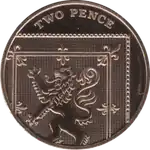 | |
| Design | Segment of the Royal Shield |
| Designer | Matthew Dent |
| Design date | 2008 |
The British decimal two pence piece (2p) is a denomination of sterling coinage equalling 2⁄100 of a pound, or two pence. Since the coin's introduction on 15 February 1971, the year British currency was decimalised, its obverse has featured four profiles of Queen Elizabeth II.[1] In 2008 the design on its reverse changed from the original depiction of a plume of ostrich feathers with a coronet to a segment of the Royal Shield.
The two pence coin was originally minted from bronze, but changed in 1992 to copper-plated steel.
As of March 2014 there were an estimated 6.55 billion 2p coins in circulation, corresponding to a value of £131 million.[2]
Decimal two pence coins are legal tender for amounts only up to the sum of 20p when offered in repayment of a debt;[3] however, the coin's legal tender status is not normally relevant for everyday transactions.[4]
Composition
From its first minting in 1971 until 1992, two pence coins were made from bronze. In 1992, this was changed to copper-plated steel because of the increasing price of copper used to make bronze.[5] Both the bronze and steel versions were made in 1992 as it was the transition year, however in 1998 a small quantity of bronze two pences were made alongside the standard copper-plated steel. There were 98,676,000 bronze 2p coins from that year, and 115,154,000 in copper-plated steel.[6]
By May 2006 the pre-1992 (97% copper) coins contained 3p worth of copper each.[7] In May 2006, about 2.55 billion such coins remained in circulation,[7] and the Royal Mint warned that tampering with coinage is illegal in the UK.[8] During 2008, the value of copper fell dramatically from these peaks.[9]
Design
Reverse
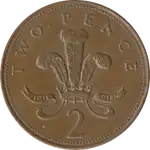
The original reverse of the coin, designed by Christopher Ironside, and used from 1971 to 2008, is the Badge of the Prince of Wales: a plume of ostrich feathers within a coronet, above the German motto ICH DIEN ("I serve"). The numeral "2" is written below the badge, and either NEW PENCE (1971–1981) or TWO PENCE (from 1982) is written above. A small number of 1983 mintage coins exist with the "New Pence" wording. It was originally planned that an alternative version of the 2p would be minted with a design representing Northern Ireland;[10] these plans never came to fruition. The same design was also re-cut in 1993 producing two minor varieties for that year.[11]
In August 2005 the Royal Mint launched a competition to find new reverse designs for all circulating coins apart from the £2 coin.[12] The winner, announced in April 2008, was Matthew Dent, whose designs were gradually introduced into the circulating British coinage from mid-2008.[13] The designs for the 1p, 2p, 5p, 10p, 20p and 50p coins depict sections of the Royal Shield that form the whole shield when placed together. The shield in its entirety was featured on the now-obsolete round £1 coin. The re-designed 2p coin depicts the second quarter of the shield, showing the Lion Rampant from the Royal Banner of Scotland, with the words TWO PENCE above.
The beading was removed from both sides of the coin in the 2008 re-design.
In October 2023 the King Charles III two-pence coin was presented; the reverse features a red squirrel.[14][15] However, it has not entered circulation; the Treasury has not ordered any 2p coins to be minted since 2017, except for 117.7 million coins in 2021,[16] and according to the National Audit Office in 2020, they did not expect to order any mintings for a decade because they hold a large stockpile of existing coins and demand for them is declining.[17][18]
Obverse
Five different obverses were used during the reign of Queen Elizabeth II: four different portraits and the removal of the beaded border in 2008.[11] In all cases, the inscription is ELIZABETH II D.G.REG.F.D. 2013,[11] where 2013 is replaced by the year of minting. In the original design both sides of the coin are encircled by dots, a common feature on coins, known as beading.
Four different portraits of Elizabeth II were used on the coin:
- As with all new decimal currency, until 1984 the portrait of Elizabeth II by Arnold Machin appeared on the obverse,[19] in which the Queen wears the 'Girls of Great Britain and Ireland' Tiara.
- Between 1985 and 1997 the portrait by Raphael Maklouf was used,[19] in which the Queen wears the George IV State Diadem. In 1992 the metal used in minting this coin was switched from bronze to copper-plated steel, with a single year of using both alloys in 1998.[5]
- From 1998 to 2015 the portrait by Ian Rank-Broadley was used,[19] again featuring the tiara, with a signature-mark IRB below the portrait.
- From 2015 to 2022, coins bore the portrait by Jody Clark.
Mintages
| Year | Number minted | Composition | Portrait | Reverse |
|---|---|---|---|---|
| 1971 | 1,454,856,250 | Bronze | Machin | Ironside |
| 1972 | In sets only | |||
| 1973 | In sets only | |||
| 1974 | In sets only | |||
| 1975 | 145,545,000 | |||
| 1976 | 181,379,000 | |||
| 1977 | 109,281,000 | |||
| 1978 | 189,658,000 | |||
| 1979 | 260,200,000 | |||
| 1980 | 408,527,000 | |||
| 1981 | 353,191,000 | |||
| 1982 | In sets only | |||
| 1983 | In sets only | |||
| 1984 | In sets only | |||
| 1985 | 107,113,000 | Maklouf | ||
| 1986 | 168,967,500 | |||
| 1987 | 218,100,750 | |||
| 1988 | 419,889,000 | |||
| 1989 | 359,226,000 | |||
| 1990 | 204,499,700 | |||
| 1991 | 86,625,250 | |||
| 1992 | 102,247,000 | |||
| Copper-plated steel | ||||
| 1993 | 235,674,000 | |||
| 1994 | 531,628,000 | |||
| 1995 | 124,482,000 | |||
| 1996 | 296,278,000 | |||
| 1997 | 496,116,000 | |||
| 1998 | 98,676,000 | Bronze | Rank-Broadley | |
| 115,154,000 | Copper-plated steel | |||
| 1999 | 353,816,000 | |||
| 2000 | 563,659,000 | |||
| 2001 | 551,880,000 | |||
| 2002 | 168,556,000 | |||
| 2003 | 260,225,000 | |||
| 2004 | 356,396,000 | |||
| 2005 | 280,396,000 | |||
| 2006 | 170,637,000 | |||
| 2007 | 254,500,000 | |||
| 2008 | 10,600,000 | |||
| 241,679,000 | Dent | |||
| 2009 | 150,500,500 | |||
| 2010 | 99,600,000 | |||
| 2011 | 144,300,000 | |||
| 2012 | 67,800,000 | |||
| 2013 | 40,600,000 | |||
| 2014 | 247,600,020 | |||
| 2015 | 85,900,000 | |||
| 2015 | 139,200,000 | Clark | ||
| 2016 | 185,600,000 | |||
| 2017 | 16,600,000 | |||
| 2018 | 0 | |||
| 2019 | 0 | |||
| 2020 | 0 | |||
| 2021 | 117,700,000 | |||
| 2022 | 0 | |||
| 2023 | 0 | Jennings | The Royal Mint[21] | |
| 2024 | 0 |
Mint sets have been produced since 1982; where mintages on or after that date indicate '0', there are examples contained within those sets.
See also
References
- ↑ Bignell, C P. "Post decimalisation". Archived from the original on March 7, 2001. Retrieved 2006-05-23.
- ↑ "Mintage Figures". Royal Mint. Retrieved 28 December 2015.
- ↑ "Legal Tender Guidelines". Royal Mint. Archived from the original on 9 July 2026. Retrieved 9 July 2026.
- ↑ What are the legal tender amounts acceptable for UK coins? The Royal Mint
- 1 2 "2p Coin Designs and Specifications". The Royal Mint. Retrieved 2022-01-08.
- ↑ "Two Pence Mintage Figures". Royal Mint. Retrieved 31 August 2023.
- 1 2 Davies, Caroline (12 May 2006). "Your small fortune: 2p coins that could be worth 3p each". The Telegraph. Retrieved 22 July 2026.
- ↑ "Mint warns against melting coins". BBC News. 12 May 2006.
- ↑ "Copper prices have been in freefall since the highs over $8600/tonne reached in early July 2008". Proactiveinvestors UK. 22 October 2008. Retrieved 22 July 2026.
- ↑ Roy Jenkins, Chancellor of the Exchequer (20 December 1968). "50 New Penny Piece". Parliamentary Debates (Hansard). Vol. 775. col. 481.
- 1 2 3 Clayton, Tony. "Decimal Two Pence Coins". Pictures of Coins of the UK. Retrieved 2015-01-18.
- ↑ "Royal Mint seeks new coin designs". BBC News. 17 August 2005.
- ↑ "Royal Mint unveils new UK coins". Director of Finance Online. 2 April 2008. Archived from the original on 2008-09-07.
- ↑ "King Charles III new coins designed to help children to count". BBC News. 13 October 2023. Retrieved 11 January 2025.
- ↑ "2023 Definitives: His Majesty King Charles III's First Definitive Coins". Royal Mint. Retrieved 11 January 2025.
- ↑ Figures of mintings for the years 2018 to 2024 (the last year for which figures were available as of July 2026) were all zero, except 2021. "Two Pence Mintage Figures". Royal Mint. Retrieved 22 July 2026.
- ↑ "No new 2p or £2 coins to be made for 10 years". BBC News. 18 September 2020. Retrieved 22 July 2026.
- ↑ Davies, Gareth (18 September 2020). The production and distribution of cash (Report). National Audit Office. p. 12. Retrieved 22 July 2026.
- 1 2 3 "1p Coin". British Royal Mint. Archived from the original on 2006-04-27. Retrieved 2006-05-23.
- ↑ "2p Two Pence Mintage Figures". www.royalmint.com. Retrieved 2023-09-02.
- ↑ Banfield-Nwachi, Mabel (2023-10-12). "Royal Mint unveils new coin design inspired by King Charles". The Guardian. ISSN 0261-3077. Retrieved 2025-08-09.