List of amphibians of Great Britain
| Part of a series on the |
| Wildlife of Great Britain |
|---|
 |
This is a list of amphibians of Great Britain. There are seven extant amphibian species native to Great Britain, in addition, there are a number of naturalized species and extirpated/extinct species. Native is taken to mean a species which arrived in Britain by its own agency and became resident during the Holocene, as defined by the UK nature watchdog, Natural England.[1] For amphibians, this means colonising through Doggerland (the dry North Sea), prior to marine inundation, to the landmass that would become Britain at the end of the Last Ice Age.[2][3] The extant natives comprise three newts, two toads and two frogs. In addition, there are at least a further two species of lost native amphibian, which became extinct prior to 1800 AD.[2] Therefore, including the pool frog, Britain has historically lost 30% of all amphibian species.[2][4][5] Creating a complete list of native species can be challenging due to the paucity and interpretation of limited archeological/subfossil evidence.[5][2][6]
Extant native species
| Adult | Name | Larva |
|---|---|---|
 |
Great crested newt (Triturus cristatus) |  |
 |
Smooth newt (Lissotriton vulgaris) |  |
 |
Palmate newt (Lissotriton helveticus) |  |
| Adult | Name | Tadpole |
|---|---|---|
 |
Common toad (Bufo bufo) | 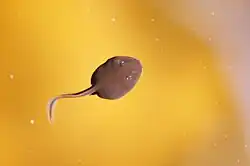 |
 |
Natterjack toad (Epidalea calamita) |  |
| Adult | Name | Tadpole / froglet |
|---|---|---|
 |
Common frog (Rana temporaria) |  |
|
|
Northern pool frog (Pelophylax lessonae) | |

Extirpated species
- Moor frog (Rana arvalis) — Extinct prior to 1800 AD (or perhaps later) due to wetland drainage and destruction of peat bogs for fuel use.[7][2][8][5]
- Agile frog (Rana dalmatina) — Became extinct prior to 1800 AD due to woodland clearance and drainage. It may have survived into the Industrial Period.[7][2][3][5]
- European tree frog (Hyla arborea) — Became extinct in initially around 1700 AD due to overcollection for medicinal use. It is unclear as to whether the original population is of natural or human descent.[2][4][9]
There is an expressed monetary momentum and interest to investigate whether the reintroduction some or all of these lost amphibians could be undertaken in the future, as part of stringent feasibility studies.[10][11] This would require consent from Government bodies, only granted if the proposals do not threaten existing wildlife (including disease risk), habitats and livelyhoods.[4]
Naturalised and invasive species
- Salamanders and newts
- Fire salamander (Salamandra salamandra)
- Alpine newt (Ichthyosaura alpestris) — invasive[12]
- Italian crested newt (Triturus carnifex)[13]
- Frogs, toads and allies
- Midwife toad (Alytes obstetricans) — naturalised (possibly native)[14]
- Yellow-bellied toad (Bombina variegata) — was naturalised current status unknown - likely restricted to Devon if still present.[15]
- Painted frog (Discoglossus pictus) — has bred at least once[16]
- Australian green tree frog (Litoria caerulea) — has bred at least once
- Marsh frog (Pelophylax ridibundus) — invasive[17]
- Edible frog (Pelophylax kl. esculentus) — invasive[18]
- Iberian water frog (Pelophylax perezi) – invasive at RSPB Ham wall nature reserve[19]
- American bullfrog (Lithobates catesbeiana) — successfully bred - considered invasive[20]
- African clawed toad (Xenopus laevis) — two invasive populations survived in the UK for 50 years, now extinct apart from in Calderstones Park.[21]
References
- ↑ "Using species conservation translocations as a tool for nature recovery". naturalengland.blog.gov.uk. 2025-03-26. Retrieved 2026-04-08.
- 1 2 3 4 5 6 7 "Investigating the status of Britain's lost frogs - The Churchill Fellowship". www.churchillfellowship.org. 2026. Retrieved 2026-04-08.
- 1 2 England, Natural. "Lost life: England's lost and threatened species - NE233". Natural England - Access to Evidence. Retrieved 2026-04-08.
- 1 2 3 "Lost Frogs report: comment from Amphibian and Reptile Conservation Trust". Amphibian and Reptile Conservation. 2026-01-29. Retrieved 2026-04-08.
- 1 2 3 4 "Subfossil records of Rana cf. lessonae, Rana arvalis and Rana cf. dalmatina from Middle Saxon (c. 600-950 AD) deposits in eastern England: Evidence for native status | Request PDF". ResearchGate. Archived from the original on 2026-03-09. Retrieved 2026-04-08.
- ↑ Bisbal-Chinesta, Josep Francesc; Blain, Hugues-Alexandre; Bañuls-Cardona, Sandra; Rey-Rodríguez, Iván; Núñez Lahuerta, Carmen; Allué, Ethel; Expósito, Isabel; Cuenca-Bescós, Gloria; Vergès, Josep Maria (2026-04-15). "Influences of seasonal prey availability and anthropogenic landscape on small-vertebrate based palaeoecological reconstructions: a case study from the mid-late Holocene transition at El Mirador cave (Sierra de Atapuerca, Spain)". Quaternary International. 761 110186. doi:10.1016/j.quaint.2026.110186. hdl:11093/11988. ISSN 1040-6182.
- 1 2 "Species".
- ↑ Snell; Charles; Evans; H, I. (2006). "Discrimination of moor frog (Rana arvalis) and common frog (Rana temporaria) individuals using a RAPD technique". Herpetological Journal. 16 (4): 363–369.
- ↑ Raye, Lee (2017). "Frogs in pre-industrial Britain". Herpetological Journal. 27 (4): 368–378.
- ↑ "Three frogs to be reintroduced to West Acre 'pingos'". BBC News. 2026-01-02. Retrieved 2026-04-08.
- ↑ "Exploring the potential: New funding to investigate the return of…". Rewilding Britain. Retrieved 2026-04-08.
- ↑ "Alpine newt". Lothian Amphibian and Reptile Group. Retrieved 27 February 2017.
- ↑ Inns, Howard (2009). Britain's reptiles and amphibians. Old Basing: WILDGuides. p. 146. ISBN 978-1-903657-25-6.
- ↑ "Alytes obstetricans: midwife toad". AmphibiaWeb. 2021. Retrieved 1 September 2021.
- ↑ Sergius Kuzmin, Mathieu Denoël, Brandon Anthony, Franco Andreone, Benedikt Schmidt, Agnieszka Ogrodowczyk, Maria Ogielska, Milan Vogrin, Dan Cogalniceanu, Tibor Kovács, István Kiss, Miklós Puky, Judit Vörös, David Tarkhnishvili, Natalia Ananjeva (2009). "Bombina variegata". IUCN Red List of Threatened Species. 2009 e.T54451A11148290. doi:10.2305/IUCN.UK.2009.RLTS.T54451A11148290.en. Retrieved 1 September 2021.
{{cite journal}}: CS1 maint: multiple names: authors list (link) - ↑ "AmphibiaWeb - Rhinella gallardoi". AmphibiaWeb. 2010. Retrieved 2 December 2010.
- ↑ "Pelophylax ridibundus: marsh frog". AmphibiaWeb. 2007. Retrieved 1 September 2021.
- ↑ "Pelophylax esculentus: edible frog". AmphibiaWeb. 1999. Retrieved 1 September 2021.
- ↑ ARC (nd). Alien amphibian and reptile species in the UK. Bournemouth: Amphibian and Reptile Conservation.
- ↑ "American Bull Frog". Froglife. Retrieved 28 April 2017.
- ↑ Tinsley, Richard C.; Stott, Lucy C.; Viney, Mark E.; Mable, Barbara K.; Tinsley, Matthew C. (2015). "Extinction of an introduced warm-climate alien species, Xenopus laevis, by extreme weather events". Biological Invasions. 17 (11): 3183–3195. Bibcode:2015BiInv..17.3183T. doi:10.1007/s10530-015-0944-x. PMC 4581400. PMID 26430383.