Bristol Caverns
| Bristol Caverns | |
|---|---|
 | |
Interactive map of Bristol Caverns | |
| Coordinates | 36°33′01″N 82°07′17″W / 36.550381°N 82.121342°W |
| Length | 1.52 miles |
| Entrances | 6 |
| Access | Show cave |
| Website | https://bristolcaverns.com |
Bristol Caverns is a show cave in Bristol, Tennessee. It is a karst cave. The caverns have been owned by several people and companies since their discovery, and have been a show cave since the mid-1900s.
History
The exact date of Bristol Caverns' discovery is unknown, as the natural entrance was an open pit, which has since been covered with a concrete pad and iron grate. The entrances that are currently viable are man-made entrances, the first constructed in 1863 by a farmer named Samuel Sesler with the intention of using the cave as a root cellar, as was common practice at the time. The Sesler family used the cave till the late 1920s, when it was sold to Alexander Hitt. He contracted with the Civilian Conservation Corps and the TVA, as well as working with the Twin City of Bristol TN, VA, to build the pathways for tours between 1936 and 1944, when the cave opened to the public for tours. The construction of the current gift shops was completed in 1963 and remains largely unaltered.

The cave has changed ownership many times over the years; however, records were poorly kept, and the exact number of subsequent owners is unknown. The cave was first owned by the Sesler family around 1863 and was later sold to Mr. Hit, who developed it for tourism and sold it to M.T. McArthur for $19,750 in 1956.[1] Ownership of the cave was obtained by Roy Davis, founder of Cumberland Caverns,[2][3] sometime before 1963.[4] At some point after 1963, the cave came into the ownership of the Mensh Investment and Development Associates Inc. and was then sold to the Hatcher family in 1965.[5] They owned and operated it until selling it to the Barnett family in 1982.[6] The Barnett family put the property up for sale in 2021.[7][8]
The cave has been widely used as an educational tool since the 1960s by local schools. In one case, 66 students from the Academy of Immaculate Conception at Opelousas, Louisiana, visited on their way to Washington, D.C. in 1962 after the completion of a local rail line.[9]

In 1963, during the Cold War, Bristol Caverns was designated as a fallout shelter.[10] The fallout shelter program was discontinued in the late 1970s.[11]
As with many historic attractions, there are some unconfirmed or disproven stories or myths about Bristol Caverns. The oldest story about the cave is that Native American groups used the cave to hide from early settlers after stealing from them, but there is no evidence of this.[12] Another unconfirmed story is that someone was killed and thrown into the natural entrance. The first name of the victim varies, as do the circumstances of the murder: the name of the victim was Betsy[13] or Betty Bishop,[14] and the stories say she was either a young girl killed by two boys or a widow killed by a jealous neighbor, and was then thrown into the cave, and her body was discovered when it was washed out by the creek.[15][16] The early name of the cave was Bishop's Cave,[17] and people say this was why.[14]
Another myth about Bristol Caverns states that it connects to another cave in Abingdon, Virginia. This is untrue, as the cave was completely mapped once in the 1950s[18] and again in the early 1980s.
Topography and geology

According to the Tennessee Cave Survey files, Bristol Caverns is 130 feet deep and 1.52 miles long. The area around Bristol Caverns has many sinkholes, as is expected for an area with limestone or dolomitic bedrock, and is an example of karst topography.
Because of the vertical orientation of bedding planes, meteoric water can infiltrate at a more rapid rate and provide a weaker section of rock that allowed for easier dissolution and erosion, causing Bristol Caverns to be much taller and thinner than caves found in flat strata. The vertical bedding planes also create more openings for water to infiltrate the limestone, leading to a higher-than-normal concentration of speleothems. In several areas, formations form in long lines following the bedding planes or in cross patterns following the bedding and joints.[19][20]
The bedrock that Bristol Caverns formed in is the Knox Supergroup.[21][22] A massive limestone and dolomite unit named for Knoxville, Tennessee, this unit is undifferentiated in the eastern quarter of Tennessee and contains the majority of caves in eastern Tennessee, such as Bristol Caverns, Worley's Cave, and Appalachian Caverns.[22]
Bristol Caverns has several entrances: two accessible to tourists, two completely underwater (allowing animals to get in and out), and two gated, with one of the gated entrances being the original entrance to the caverns.
Speleothems
There are many speleothems in Bristol Caverns:

Flora and fauna
There are many organisms in Bristol Caverns, such as tricolored bats, salamanders, fresh water skulpen, crawfish, cave crickets, possums, rats, pickerel frogs and branchiobdellida.[23]

No animals found in Bristol Caverns are blind, as everything can exit the cave through the entrances created by Little Sinking Creek. Some of the animals known to have been in the cave left only traces, such as footprints or bones.
Due to the artificial lighting used for visitors, there are several plants and fungi in Bristol Caverns. The majority of these non naturally occurring growths are mosses and blue mold, though there are some shield ferns and grasses attempting to grow near the lights. There are also many colonies of the actinomycetes bacteria growing on the walls and ceilings. These bacteria do not need artificial lighting and can be found throughout the cave.
- Species of salamander in Bristol Caverns:
Gallery
Formations
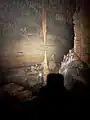 Large dripstone with caver for scale
 A rimstone with odd color
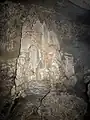 Cave column "Gigantis" with caver for scale
- A close up of a soda straw stalactite
 Rimstone pool with subaqueous coralloids and aragonite
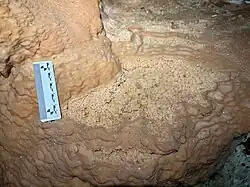 Pool spar with 10cm scale
 Cave Bacon with sawtooth pattern (10cm scale)
Fauna
 Cave salamander with 10cm scale
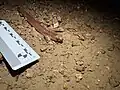 Spring salamander with 10cm scale
 Northern slimy salamander
 Sculpen
 Tricolor bat in cave
Bones
 Deer bones (likely fib-tib) with makeshift 10cm scale
 Bat bones under 365nm UV
 Finger bone of a bat (likely distal finger) with a 1cm scale
 Mouse bones in Bristol Caverns, pencil for scale
Historic documents
- 1941 photo of Samuel Sesler, Jr.
 Samuel Sesler, Jr. back side
 Old Bristol Caverns Admission tickets
 Old Bristol Caverns Billboard on Hwy 412
 1968 photo of the tour entrance to Bristol Caverns
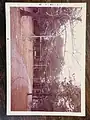 1968 photo of pathway from gift shop to cave entrance
 1968 photo of the sinkhole connected to Bristol Caverns
 The Wishing Stone
 Bristol Caverns Bridge
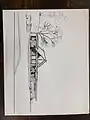 1963 drawing of the Bristol Caverns gift shop
- Fallout shelter license or privileges of Bristol Caverns
 Fallout shelter license or privileges of Bristol Caverns (back)
References
- ↑ "Bristol Caverns sold for $19,750". September 1, 1956. Bristol Herald Courier, p. 2.
- ↑ Sadler, Kyleigh (2018-04-03). "Cumberland Caverns Founder, Roy A. Davis, Jr. Passes Away". Cumberland Caverns. Retrieved 2026-08-05.
- ↑ Halliday, William (1966). Depths of the Earth. Harper & Row, Publishers. ISBN 0060117486.
- ↑ "Bristol Caverns gets new lights". April 28, 1963. Bristol Herald Courier.
- ↑ Hatchers take over caverns. (1965, October 6). Bristol Herald Courier, p. 6.
- ↑ Barnetts purchase caverns. (1982, May 9). Bristol Herald Courier, p. 23.
- ↑ "'I'm hoping someone will love it as much as we did': Co-owner of Bristol Caverns discusses decision to sell". WJHL. 2021-09-21. Archived from the original on 2021-10-31. Retrieved 2026-08-07.
- ↑ "Bristol Caverns offers eons of entertainment for adventurers". WJHL. 2023-05-24. Archived from the original on 2023-06-08. Retrieved 2026-08-07.
- ↑ City to host Louisiana kids today. (1962, August 17). Bristol Herald Courier, p. 13.
- ↑ Taylor, Howard (1963-02-03). "Fallout Shelters Here are Marked". Bristol Herald Courier. p. 9.
- ↑ Davis, Amber (2024-01-30). "The history of fallout shelters in the United States". ORAU: Then & Now. Retrieved 2026-08-07.
- ↑ Johnson, Becky (2017-08-01). "Through the Depths of Time". Smoky Mountain Living. Retrieved 2026-08-07.
- ↑ Scrimpshire, B. (1962, June 3). "There's room at the bottom, and it's cool all year round". Bristol Herald Courier.
- 1 2 "Underground Legends: Local caverns have their share of stories, history". Bristol Herald Courier. 2008-03-13. p. 11. Retrieved 2026-08-07.
- ↑ Show caves of the United States of America: Bristol Caverns. Show Caves of the World. (n.d.).
- ↑ Barr, T. C. (1972). Caves of Tennessee. State of Tennessee, Department of Conservation and Commerce, Division of Geology.
- ↑ "Bristol Caverns May Be Developed". Bristol Herald Courier. 1936-08-12. p. 9. Retrieved 2026-08-07.
- ↑ Nicholas, G., & Barr, T. C. (1962). "Caves of Tennessee". American Midland Naturalist, 67(2), 510.
- ↑ Baker, A. & Fairchild, I. J. (2012) Drip Water Hydrology and Speleothems. Nature Education Knowledge 3(10):16
- ↑ Speleothems - Caves and Karst (U.S. National Park Service). National Park Service. (2022, April 27).
- ↑ Rodgers, J. (n.d.). "Geologic Map of East Tennessee with explanatory text". Tn.gov.
- 1 2 Hardeman, William (1966). Geologic map of Tennessee. Nashville: State of Tennessee, Department of Conservation, Division of Geology.
- ↑ Holt, Perry C.. 1973. "Branchiobdellids (Annelida: Clitellata) from some eastern North American caves, with descriptions of new species of the genus Cambarincola". International Journal of Speleology, 5: 219–255. Available at: https://digitalcommons.usf.edu/ijs/vol5/iss3/3
External links
