Brenda Lee (1960 album)
| Brenda Lee | ||||
|---|---|---|---|---|
 | ||||
| Studio album by | ||||
| Released | July 1960 | |||
| Genres | ||||
| Label | Decca | |||
| Producer | Owen Bradley | |||
| Brenda Lee chronology | ||||
| ||||
| Singles from Brenda Lee | ||||
| ||||
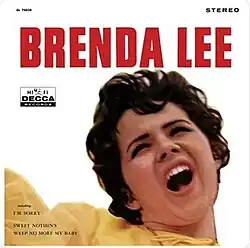
Brenda Lee is an eponymous studio album by American singer, Brenda Lee. It was released in July 1960 by Decca Records and was her second studio album. The disc featured a total of four singles: "Let's Jump the Broomstick", "Sweet Nothin's" and "That's All You Gotta Do". The latter featured "I'm Sorry" on the B-side, which reached number one on the US chart. The album was given a positive reception from critics for its rock performances.
Background, recording and content
Brenda Lee was signed to Decca Records as a child performer at age 11 and recorded music ranging in style from pop to rockabilly. In 1959, the rock-flavored "Sweet Nothin's" became a top five US pop single, followed her first chart-topper in 1960 titled "I'm Sorry". The latter releases (along with a string of future songs) made Lee one of the best-selling music artists of the 1960s.[3] Her hit songs from 1959 and 1960 were featured on Lee's second album which was titled as an eponymous collection.[2] Produced by Owen Bradley and featuring background vocals from The Anita Kerr Singers, the album consisted of 12 selections.[4] Examples of Rockabilly tunes on the disc included "Dynamite" and the Hank Williams-penned "Jambalaya (On the Bayou)".[2]
Critical reception
Brenda Lee was met with favorable reviews from music publications and critics. Billboard found the album had "exciting renditions" of popular songs and also wrote, "The 15-year-old' miss has a style and full-voiced attack that belie her age and have won her a large following via previous disks and national radio-TV exposure."[1] Cash Box described Lee as both "energetic" and "exuberant" on the disc, crediting Owen Bradley for her performance and then concluded, "The album adds up to good teen entertainment."[5] William K. Trosene of The Pittsburgh Press positively compared Lee to Elvis Presley, finding her singing to be "sweet and shooting" while also being "raucous and rocking".[6] Joe Viglione of AllMusic gave it four out of five stars, crediting the album with influencing future recordings by teen performers like Tanya Tucker, Debbie Gibson and Britney Spears, writing, "Brenda Lee is the ultimate in a teen female performer writing the rules and retaining the crown."[2]
Release, chart performance and singles
Brenda Lee was originally scheduled for an August 1960 release, however, Decca decided to rush-release the album after her 1960 singles became popular.[7] The album was instead released in July 1960 and was offered in two vinyl LP formats: mono or stereo.[4] It was her first disc to make the US Billboard 200 chart, rising into the number five position, becoming her second highest-charting LP on the Billboard 200.[8] A total of four singles were included on the disc. Its earliest single release was "Let's Jump the Broomstick" (first issued by Decca in April 1959),[9] reaching number 12 on the UK Singles Chart.[10] It was followed in September 1959 by "Sweet Nothin's",[11] which notably rose to number four on both the US Hot 100[12] and UK Singles chart.[10] The last single to be included on the album was the double-sided hit, "That's All You Gotta Do"/"I'm Sorry".[13] The A-side made the top-10 in both the US[12] and Australia,[14] while the B-side reached number one in the US,[12] number six in Australia[14] and number 19 in the UK.[10]
Track listing
| No. | Title | Writer(s) | Length |
|---|---|---|---|
| 1. | "Dynamite" | 1:57 | |
| 2. | "Weep No More Baby" | 3:00 | |
| 3. | "Jambalaya (On the Bayou)" | Hank Williams | 2:42 |
| 4. | "(If I'm Dreaming) Just Let Me Dream" | Charles Singleton | 2:49 |
| 5. | "Be My Love Again" | Chuck Taylor | 2:37 |
| 6. | "My Baby Likes Western Guys" | Jackie Dee | 2:13 |
| No. | Title | Writer(s) | Length |
|---|---|---|---|
| 1. | "Sweet Nothin's" | Ronnie Self | 2:24 |
| 2. | "I'm Sorry" |
| 2:40 |
| 3. | "That's All You Gotta Do" | Jerry Reed | 2:27 |
| 4. | "Heading Home" | Buck Ram | 2:40 |
| 5. | "Wee Wee Willies" | Self | 2:06 |
| 6. | "Let's Jump the Broomstick" | Charles Robbins | 2:25 |
Personnel
All credits are adapted from the liner notes of Brenda Lee.[4]
- Owen Bradley – Director/producer
- The Anita Kerr Singers – Choir
- Charles Lamb – Sleeve notes
Chart performance
| Chart (1960) | Peak position |
|---|---|
| US Billboard 200[15] | 5 |
Release history
| Region | Date | Format | Label | Ref. |
|---|---|---|---|---|
| Various | July 1960 |
|
[4][16] | |
| 1961–2025 |
|
[17] | ||
| 2011–2015 | Compact disc (CD) | [18] | ||
| Circa 2020 |
|
MCA Nashville | [19] | |
References
- 1 2 "Reviews of This Week's LP's" (PDF). Billboard: 23. July 4, 1960. Retrieved July 14, 2026.
- 1 2 3 4 Viglione, Joe. "Brenda Lee [1960]: Tracks & Allmusic". AllMusic. Retrieved July 14, 2026.
- ↑ Roy, Don. "Brenda Lee". Country Music Hall of Fame and Museum. Retrieved June 27, 2025.
- 1 2 3 4 Lee, Brenda (July 1960). "Brenda Lee (Liner Notes)". Decca Records. US. DL-4039 (LP mono); DL-74039 (LP stereo).
- ↑ "Album Reviews: Popular Picks of the Week" (PDF). Cash Box. July 9, 1960. p. 42. Retrieved July 14, 2026.
- ↑ Trosene, William K. (August 21, 1960). "New Trio Spices Old Songs". The Pittsburgh Press. Retrieved July 14, 2026.
- ↑ "Decca Rushes Lee LP" (PDF). Cash Box. July 2, 1960. p. 35. Retrieved July 14, 2026.
- ↑ Whitburn, Joel (2006). The Billboard Albums Includes Every Album that Made the Billboard 200 Chart : 50 Year History of the Rock Era. Record Research, Inc. p. 591. ISBN 978-0898201666.
- ↑ Lee, Brenda (April 1959). ""Let's Jump the Broomstick"/"Some of These Days" (7" vinyl single)". Decca Records. 9-30885.
- 1 2 3 "BRENDA LEE songs and albums". Official Charts Company. Retrieved December 17, 2023.
- ↑ Lee, Brenda (September 1959). ""Sweet Nothin's"/"Weep No More My Baby" (7" vinyl single)". Decca Records. 9-30967.
- 1 2 3 "Brenda Lee Chart History (The Hot 100)". Billboard. Retrieved December 25, 2018.
- Whitburn, Joel (2011). Top Pop Singles 1955–2010. Record Research, Inc. ISBN 978-0-89820-188-8.
- Whitburn, Joel (1982). Joel Whitburn's Bubbling under the hot 100, 1959-1981. Menomonee Falls, Wis: Record Research. p. 98. ISBN 978-0-8982-0047-8.
- ↑ Lee, Brenda (May 1960). ""That's All You Gotta Do"/"I'm Sorry" (7" vinyl single)". Decca Records. 9-31093.
- 1 2 Kent, David (1993). Australian Chart Book 1970–1992 (illustrated ed.). St Ives, N.S.W.: Australian Chart Book. ISBN 0-646-11917-6.
- ↑ "Brenda Lee Chart History (Billboard 200)". Billboard. Retrieved July 14, 2026.
- ↑ Lee, Brenda (July 1960). "Brenda Lee (1960 international releases)". Brunswick Records/Decca Records/Festival Records. Argentina/Japan/Uruguay/Hong Kong/Japan/South Africa. LTM-9396 (Decca); FL-7208 (Festival; DL 74039, MG 7-7635 (Decca); LAT 8347 (Brunswick).
- ↑ Lee, Brenda. "Brenda Lee (international LP re-releases from 1961-2025)". Bear Family Records/Brunswick Records/Coral Records/Decca Records/DOL/Hallmark Records/Jugoton/Oldays/Rumble. Yugoslavia/Spain/Europe. 267-039, SLBM267039 (1961); LP-BR-V-199 (1962); DL-74039 (1966); S-21155 (1969); RUM2011085 (2014); BAF-11016 (2018); DOL-1254FC (2025).
- ↑ Lee, Brenda. "Brenda Lee (international CD re-releases from 2011-2015)". Hallmark Records/Magic Records/Oldays Records. Europe/Japan. 710712 (2011); 3930860 (2011); ODR6084 (2015).
- ↑ "Brenda Lee - Album by Brenda Lee". Apple Music. Retrieved July 14, 2026.