Brazilian drug war
| Brazilian drug war | ||||||||
|---|---|---|---|---|---|---|---|---|
| Part of violent crime and Illegal drug trade in Brazil during the war on drugs | ||||||||
Clockwise from top left:
| ||||||||
| ||||||||
| Belligerents | ||||||||
| ||||||||
| Commanders and leaders | ||||||||
|
Full list:
|
Full list:
|
Full list:
| ||||||
| Casualties and losses | ||||||||
| 50,000+ killed[20][21][22][23][24][25][26] | ||||||||




The Brazilian drug war is an ongoing conflict fought mainly between police militias, drug cartels and federal (or state) security forces in Brazil.
Background

Organized crime is heavily intertwined with the geography of the largest cities in Brazil, particularly in their poorest neighborhoods, commonly known as favelas. Many Brazilian cities have their wealthiest and most tourist-driven communities located close to informal neighborhoods that face high rates of poverty, drug addiction, unemployment, violence and homelessness; This extreme economic inequality and lack of proper social services in these areas facilitates the formation and survival of organized crime, which is present in every Brazilian state.[27] Residents of these neighborhoods frequently face social stigma, which is commonly intertwined with racism, social segregation and class discrimination; The lack of both proper education and formal job opportunities caused by this social discrimination also causes organized crime to grow even further.[28][29][30][31]
Criminal organizations often rely heavily on relationships with both political and state actors, including inside many government institutions, such as the police and judiciary; Security forces, particularly the Military Police, are also known to form their own criminal organizations.[32] Relations between criminal organizations and state institutions usually involve large-scale corruption, such as bribery and the use of informal favours or personal connections to advance their influence.[33] Large businesses, particularly in the finance, real estate and oil sectors, are also known to be heavily intertwined with organized crime in Brazil.[34][35][36]
Despite these known links between state forces and organized crime, public opinion, especially among the upper and upper middle classes, is largely in favour of the state using armed force to combat these criminal organizations.[37] This is also exacerbated by many sensationalist TV programs, which use explicit and violent imagery to amplify these sentiments throughout the country.[38] Despite their own links to criminal organizations, many far-right political candidates have also taken advantage of this situation to be elected into public office.[39][35][32][40]
Rio de Janeiro
Beginning with rackets such as Jogo do Bicho, Rio de Janeiro has had many incidents of collusion among criminal organizations and social and political institutions. Following the military dictatorship, political tools originally used by the regime, such as the Cândido Mendes prison complex, created the first prison gangs in Rio in the late 1970s.[41] With the subsequent cocaine boom in South America,[42] these gangs would go on to dominate the drug market and capitalize off it within favela communities. Heightened tensions for control of these neighborhoods contributed to turf wars and new factions of organized crime forming.
Criminal organizations
Drug cartels
Comando Vermelho
Comando Vermelho (Red Command), often abbreviated as "CV", is Brazil's oldest active criminal organization, which engages primarily in drug trafficking and arms smuggling, as well as truck hijacking, loan sharking, pimping, racketeering and bank robberies, among other criminal activities. Considered the biggest faction in Greater Rio de Janeiro, it has also spread to the rest of the state, as well as nearby Espírito Santo and into the north/northeastern regions of Brazil.
The formation of the organization dates back to the late 1970s (during the military dictatorship), on the Cândido Mendes prison (located on Ilha Grande), this penitentiary complex housed both ideological enemies of the regime (such as opposition politicians, journalists, unionists and intellectuals), as well as armed guerrilla fighters (such as members of MR-8 and ALN) and high-profile criminals, which, after a series of massacres and general mistreatment by the prison guards, formed an "self-protective" alliance.[43]
Through the transfer of major gang leaders by the Brazilian government, the organization was able to gain control of other prisons and establish itself on the ground in most of the state of Rio, gaining much influence within the ever-growing favela complexes. Later, during the cocaine boom of the 1980s, the gang's focus shifted from petty crime to that of drug and arms trafficking, which proved to be less dangerous than bank robberies and also allowed for larger profits and control of many city municipalities.[44]
Ever since the appearance and spread of rival organizations during the late 80s to the early 90s (both in Rio and other states), CV has waged major turf wars against other cartels and street gangs. In recent years it has been involved in a series of prison riots, massacres and territorial conflicts thorough the entire country, which resulted in dozens (or sometimes even hundreds) of casualties, mostly involving police militias (which have grown considerably in the past decade) and rival gangs such as ADA, GDE and TCP.[45][46]
After negotiations for an "alliance" with São Paulo–based PCC broke down in 2016 (mainly due to disputes between shared drugs and arms trafficking routes in Paraguay, Bolivia and Colombia), a series of retaliations (which included mass shootings, executions and invasions of rival favelas) broke out between both groups and their allies, which have resulted in severe casualties, including not only gang members but also many innocent civilians and security officials who have been caught in the crossfire.[47]
However, despite years of violent conflicts with the Brazilian police and other criminal organizations, as well as deterrent efforts such as the Police Pacifying Unit (UPP) and the occupation of several favelas, the CV maintains significant power and governance in many of Rio de Janeiro's favelas, and, like many other organizations, has increasingly been portrayed as a "cultural icon" in some genres of Brazilian music (such as in the Proibidão, Ostentação and Automotivo sub-genres of Brazilian funk, Trap and Hip-Hop).[48] Current issues for the CV reside in outbreaks of violence with criminal organizations for control of drug routes and turf wars with militias over territories, such as the Complexo do Alemão (which is sometimes considered the "headquarters" of the organization).[43]
Primeiro Comando da Capital
The Primeiro Comando da Capital (PCC) is one of Latin America's largest drug cartels. The organization primarily deals with drugs/arms trafficking, bank robberies and hijacking of armored trucks, as well as illegal gambling and smuggling (especially alcohol, tobacco, gold and timber). It is the biggest faction in Brazil, while also having a significant presence through the rest of South America, Portugal and the United States (mostly through the Brazilian-American community).[49]
In recent years, the organization has been reported to operate in many other countries as well, mostly through its alliances with foreign criminal groups (such as 'Ndrangheta in Italy, Group America in Serbia, Tren de Aragua in Venezuela, the Triads in China and the Jalisco Cartel in Mexico) and paramilitary groups (such as the FARC in Colombia and EPP in Paraguay).[50][51] In recent years, there has even been reported activities of the group in West Africa (mostly aligned with local groups such as the Nigerian Mafia), Eastern Europe (through the Russian and Albanian mafias) and the Middle East (through the Turkish and Lebanese mafias).[52][53] The group has also been alleged to have ties to the Yakuza in Japan and Hezbollah in Lebanon.[54]
PCC was originally founded on August 31, 1993, by eight prisoners at Taubaté Penitentiary, called "Piranhão" ("Big Piranha"), in the state of São Paulo. The group initially got together during a football game, where they founded a team called "Comando Capital" (Capital Command). The prisoners had been transferred from the city of São Paulo to the Piranhão as punishment for bad behavior. The game famously ended in widespread fights and chaos, which led to the brutal killing and decapitation of both the deputy director and a prisoner with special privileges, with the head of the latter being put on a stake.[55] The group has the slogan "Peace, Justice and Freedom",[56] and makes use of the Chinese taijitu (the yin and yang symbol) as their emblem, claiming that it represents a "way to balance good and evil with wisdom".[57]
In February 2001, Idemir "Sombra" Carlos Ambrósio became the most prominent leader of the organization when he coordinated, by cell phone, simultaneous rebellions in 29 São Paulo state prisons, in which 16 prisoners were killed. "Sombra", also referred to as "father", was beaten to death in the Piranhão five months later by five PCC members in an internal struggle for the general command of the group. The PCC was initially led by César "Césinha" Augusto Roris da Silva and José "Geleião" Márcio Felício, who were responsible for a short-lived alliance with the Comando Vermelho (CV). At the time, the group adopted CV's far-left beliefs and began advocating for revolution and the destruction of Brazil's capitalist system.[58]
Geleião and Cesinha, from the Bangu Penitentiary where they were held, went on to coordinate violent attacks against public buildings. Considered radicals by another moderate current of the PCC, they used terrorism to intimidate authorities of the prison system and were withdrawn from leadership in November 2002, when the leadership was taken over by the current leader of the organization, Marcos "Marcola" Willians Herbas Camacho. Marcola would eventually order the deaths of Geleião and Cesinha for having testified to the police, as well as for allegedly leaving the faction and creating a splinter group called the "Terceiro Comando da Capital" (Third Capital Command, TCC), which is now considered to be defunct.[55][58]
Amigos dos Amigos

Amigos dos Amigos (Literally "Friends of Friends"), known as "ADA", is one of Rio de Janeiro's most prominent drug gangs, historically having strongholds in Rocinha -- the largest of the favelas in greater Rio de Janeiro. The criminal organization formed in the late 1990s by ex-members of Comando Vermelho -- who were expelled due to the killing of another member -- in order to compete for territorial dominance.[59] CV is still ADA's biggest rival, along with the Terceiro Comando Puro (Third Pure Command, TCP).
in 2004, after the death of the previous "owner" of the Rocinha favela (Luciano Barbosa da Silva, known as "Lulu", one of the "bosses" of the CV faction), ADA drug lord Antônio Bonfim Lopes (also known as "Nem" or "Nem da Rocinha") took control of the region and became the biggest leader in the faction. Under his control, the favela experienced an era of relative calm and peace,[60] while continuously strengthening ADA's drug trafficking schemes and the consolidation of power over political networks and social projects.[61] This included financial and social support for "friendly" political candidates, provision of lacking basic services and the distribution of food baskets to families living in the slums.[61]
Large portions of money were also destined to holding massive parties, "bailes funk" and celebrations, which, according to the police, have been used as important ways to generate not only local entertainment, but also income to these groups, mostly through the illegal commerce of drugs, tobacco and liquor, as well as prostitution, extortion and robberies.[59] Nem's eventual arrest in 2011 led to years of incessant turf wars for control of Rocinha among ADA and CV, which are still ongoing. Although unconfirmed, it is generally thought that Nem still leads ADA operations from within prison.[62]
Terceiro Comando Puro
Terceiro Comando Puro (Pure Third Command) or TCP is yet another of Rio de Janeiro's most powerful organized crime groups, participating in the drug market and extortion. Originating in 2002, the group began as an off-shoot of the Terceiro Comando (Third Command),[63] which no longer operates and was originally a faction formed off of Comando Vermelho.
Although enemies now, Terceiro Comando and Amigos dos Amigos formed an alliance in the late 1990s to overtake territory held by their mutual enemy, CV.[63] Several years later, this alliance crumbled and led to the degradation of the Terceiro Comando, until former leader Nei da Conceição Cruz, alias “Facão, reformed the group in 2002 under the new name Terceiro Comando Puro.
Since then, TCP has maintained territorial control of the northern and western zones of Rio de Janeiro, although they may be attempting to expand their territory through an alliance with São Paulo's PCC, especially following the breakdown of the alliance between PCC and CV in 2016.[63] TCP also engages in continual turf wars with ADA and CV, but have recently gained allies in the form of militias, such as the Liga da Justiça faction.
TCP has also been historically allied with a series of other criminal organizations in the northeast, such as the Guardiões do Estado and the Bonde do Maluco, which has expanded the group's reach beyond Rio, into Espirito Santo, the Northeast and even Pará.[64][65]
The gang has persecuted adherents of the Afro-Brazilian religions and Catholics.[66][67] Drug packages belonging to the organization have been marked with the Star of David, Israeli flags were raised and religious symbols (such as the Star of David) were displayed on the walls in several locations alongside the faction's initials.[68][69]
Illegal gambling groups
Jogo do bicho (Animal game) is an illegal gambling game in Brazil, which is still incredibly popular and sought out despite its federal prohibition in 1946. The game is played all around the country, with lottery-style drawings in every state occurring daily in its headquarters in Greater Rio de Janeiro.[70] The game is controlled by bosses, called bicheiros or banqueiros ("bankers").
Jogo do Bicho is a longstanding staple in Brazilian culture, with thousands participating in the game daily. Because of its potential to circulate and raise large sums of money, control of Jogo do Bicho is lucrative and largely contributes to corruption, with politicians, judicial personnel, and members of the police force all monetarily and politically benefitting from it.[70] Bicheiros also contribute funding to social programs, such as samba schools, which play a critical role in cultural festivities such as Brazilian Carnival.[70] Because of this, Jogo do Bicho, and in turn its bicheiros, are deeply ingrained in Brazilian culture, especially in Rio de Janeiro, and contribute to the landscape of organized crime and corruption.
Militias
Brazilian milicias (militias), or paramilitary groups, consisting of current and retired police officers, prison guards, and military members, control much of the western territory of Rio de Janeiro[71] and continue to expand their territory through turf wars with ADA, TCP and CV, both in Rio and in other states, such as São Paulo and the northeast.[72] Militia groups have grown in size and power rapidly, originating in the early 2000s and growing to control highly populated areas since. Founded as vigilante groups, they've amassed enough power as to dominate and extort entire territories of Rio de Janeiro. Along with extortion methods, the groups have gained political influence and have even been previously supported by high-profile politicians, such as former president Jair Bolsonaro.[73]
Unlike the other criminal organizations such as CV and ADA, who have always highly invested in the drug market, militias positioned themselves against drug trafficking in order to gain community approval and trust, with some favela residents seeing them as the "lesser evil" of crime as compared to drug gangs.[71] Instead of drug trafficking, the groups participate in extortion, controlling civilian access to gas, land, and cable television.[74] Recently, some groups have decided to expand to allowing drug dealing within their territories or are doing so themselves, leveraging profit and control of important territories from drug gangs.[75]
Major events
Rio drug war
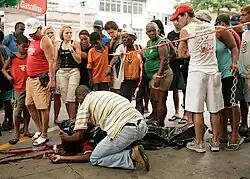
The militias emerged in the mid-late 1990s,[1] being composed mainly of off-duty police officers and ex-military, in many cases also receiving assistance from local businessmen and residents looking for protection from criminal groups.[76] The Comando Vermelho, as a response, began carrying out terrorist attacks against civilian targets between 27 and 31 December 2006, during these attacks, 19 people died, being 10 civilians, 2 policemen and 7 gang members. As retaliation, the militias conducted several raids against the Comando Vermelho, killing more than 100 gang members.[23][25] These groups launched several attacks between January 2007 and March 2008 against Comando Vermelho, conquering the Cidade Alta favela on 4 February, three days later it was recaptured by the Comando Vermelho commanded by Gilberto Martins da Silva (known as "Mineiro da Cidade Alta"), with at least 20 gang members being killed in subsequent clashes.[77] The militias obtained a "Caveirão" (an armored vehicle used by the Battalion of Special Police Operations (BOPE) for high-risk operations) in January of the same year.[77]
According to some investigations, the militias mainly finance their armed struggle with illegal activities, such as extortion, kidnapping, loan sharking, racketeering, gambling, pimping, contract killing and arms trafficking.[78][79][80] In May 2008, the militias, commanded by Coronel Jairo, kidnapped and tortured a group of journalists from the Brazilian newspaper O Dia who were reporting the criminal activities perpetrated by the militiamen. After 7 hours of torture, they were released.[81] In that same month, in clashes between the Comando Vermelho and the militias, 10 people were killed. Residents were threatened by the fighting groups and the president of an association for local residents was kidnapped and subsequently disappeared.[82] On 5 August, one of the leaders of the militia, Carlos Alexandre Silva Cavalcante, known as "Gaguinho", was killed.[83] On 20 August 2008, the militias carried out a massacre which resulted in the death of 7 people in the Carobinha favela in a false flag operation aiming to frame the Comando Vermelho for the massacre. There was also an attempt to enforce the political candidacy of Carminha Jerominho, daughter of Jerônimo Guimarães Filho, alias "Jerominho", the leader of a militia faction.[84]
On 5 October, "Mineiro da Cidade Alta" was killed by the militias for the murder of several militia members. From 2007 to 2008, three politicians were arrested for providing support to the militias: Josinaldo Francisco da Cruz (known as "Nadinho de Rio das Pedras"), Natalino José Guimarães and his brother Jerônimo Guimarães.[85][86] On 9 June 2009, Josinaldo Francisco da Cruz was killed.[87] Despite initially being opposed to drug trafficking, many militia groups (such as the "Liga da Justiça" faction) have allied themselves with cartels like the TCP, while also recruiting many former drug traffickers, informants and ex-convicts into their ranks, sometimes through coercion.[88]
Police helicopter downed on Morro dos Macacos
The Morro dos Macacos is one of the most violent favelas in Rio de Janeiro, the community was invaded by CV on 17 October 2009, while it was still under the control of ADA, who clashed with Comando Vermelho members to contend for territory, 5 gang members were killed in the clashes from 11 to 17 October. In order to stop the clashes between the two groups, about 150 assault troops of the Special Operations Department of the Polícia Militar were dispatched for security purposes. In an attempt to prevent the intervention of the police in the ongoing feud, criminals built makeshift barricades at several key points and subsequently set them on fire.[89]
On 17 October, in the morning, the rear propeller of a Fenix helicopter patrolling above the community was shot and severely damaged by drug traffickers of Amigos dos Amigos.[90] According to some sources, the weapons used in the attack were a bazooka and several machine guns. The helicopter crashed, killing 2 soldiers on impact, with another soldier later dying of his wounds.[91] This attack sparked widespread retaliations by police and militias against drug cartels and civilians in the region, with massacres occurring from 17 to 25 October 2009, resulting in at least 45 deaths. During these attacks, Brazilian authorities admitted to corruption and brutality among the police force, including the illegal release of two narcos perpetrated by some policemen; confirming also the existence of these armed militias who compete against drug traffickers and gangs for control of the drug market.[92]
Formation of the UPP
The Unidade de Polícia Pacificadora (Pacifying Police Units) or UPP was a security program in Rio de Janeiro that aimed to reclaim favelas from criminal organizations, such as CV, ADA, and TCP, through community policing. The strategy worked in two parts: deployment of the Military Police of Rio (PMERJ) into the favelas, and then increasing the amount of police officers who were meant to interact with the community through units,[93] in hopes of creating a healthier relationship between favela residents and law enforcement than what existed in years prior. For decades, interactions with police in Rio de Janeiro were abrasive; violent conflicts between drug traffickers and the police led to widespread civilian casualties, and numerous instances of abuses of power by the police led to a general distrust by favela residents.[94] The creation of the UPP aimed to both restructure the police force and its interactions with civilians, while also deterring criminal activity leading up to the 2014 World Cup and 2016 Summer Olympics. A secondary component of the UPP plan was the creation of UPP Social, which aimed to address the social welfare needs of the favelas by UPP units. This included improvements to sanitation, education, and healthcare, among other social issues.
In 2008, the first UPP was set up in the Santa Marta favela, with more quickly following -- coalescing in 32 units overall, spanning all of Rio de Janeiro's zones (though most were located in Zona Norte). Despite urges for increased financial support, the UPP units amassed praise in their early years for evident decreases in both visible crime and violence within the favelas they were operating in.[95] Because military presence was a precursor to actual UPP units, many drug traffickers fled occupied favelas to avoid persecution or capture by the Military Police tactical unit, BOPE. Because of this, crime rates significantly dropped for a couple years. In interviews with residents, details of the freedoms they were allowed once UPP units were installed continued to highlight the successes of the project.[95]
Amarildo Souza, UPP abuses and backsliding
Despite early success, some of the main hinderances of the UPP project were police abuses and disappearances that occurred. One of the most prominent cases of this was the disappearance of Amarildo Souza, a bricklayer from the Rocinha favela.[96] Souza, 42, had been fishing the morning of his disappearance and decided to go into the favela to get produce when he was confronted by UPP officers.[97] Souza was taken for questioning and subsequently never returned home.[97]
Souza was well known throughout Rocinha, leading to public outcry at his disappearance and a lack of response by the UPP unit. After more than two months of public outcry, an investigation was opened into his disappearance, where twenty-four UPP officers and the UPP commander were found accused of torture, concealing a body, procedural fraud, and conspiracy.[98] In the subsequent trial, twelve officers would be found guilty of torture, procedural fraud, and concealing a body.[99]
Despite the investigation and criminal case, the UPP suffered weakened support from favela residents, who felt both anger and fear at the actions of the local UPP unit. Coupled with insufficient training[100] and poorly strategized growth of the units, the UPP continued to fail as insignificant funding heavily derailed the project, which could not perform what it was intended to.[101] With the weakening of the UPP, criminal organizations could again attempt to reclaim their territories through shootouts and confrontations, but were this time more successful.[94]
2010–present


After the battle, there were other several clashes between militiamen and gang members. Throughout the 2010s there were several arrests and convictions against militiamen and drug traffickers involved in the massacres. The militias managed to conquer several territories under the control of the Comando Vermelho, although some of them later returned to the gang's control after being reconquered during clashes. In November 2010, another massacre occurred between the military police and the CV, resulting in the deaths of 41 people.[102] On 1 February 2012, during a raid conducted by the Polícia Militar (PM), a "Caveirão" was destroyed by the Comando Vermelho in the favela of Jacarezinho, no injuries were reported.[103] During the course of the massacre, the CV and the militias began recruiting child soldiers.[104][105] On 19 November 2016, during an operation of the PM, a military police helicopter was shot down by Comando Vermelho in the favela of Cidade de Deus, in the crash four policemen died.[106][107] On 9 February 2020, a prominent militia faction leader, Adriano Magalhães da Nóbrega, also known as "Capitão Adriano" or "Gordinho", was seriously injured in a police operation and later died in a hospital.[108] On 15 October, in one of the deadliest operations against militias, the PM clash with a convoy of the militias killing 12 paramilitaries on Itaguaí, also a policeman was injured.[109] In the Morro do Fubá favela, the residents were forced to pay a monthly fee of 50 brazilian reals as part of a protection racket. On 17 May 2022, militias attacked a civilian helicopter that was flying over the Rio area with rifles. No injuries were recorded but the helicopter suffered slight damage.[110] On 20 August of the same year, Delson Lima Neto, brother of one of the leader of the militias, Tandera Danilo Dias Lima, was killed alongside 3 paramilitaries soldiers by the Polícia Militar on Nova Iguaçu, in Baixada Fluminense, after his death the Comando Vermelho conquered the favela of Grão-Pará, in Nova Iguaçu.[111] After the raid, on 23 August, the police found and seized an improvised fighting vehicle (similar to a Caveirão) used by the militias to fight against Comando Vermelho in Nova Iguaçu.[112]
According to law student Carlos Gilberto Martins Junior of Brazil in 2023, with emphasis on the State of Rio de Janeiro, there has been an arbitrary use of these powers and attributions, conferred on police institutions, to satisfy the patrimonial aspirations of some of its agents, through territorial domination and violence, to the detriment of the peripheral communities and under the pretext of saving them from the "greater evil" represented by drug trafficking, corroborating the emergence of criminals organizations what conventionally called the "militia".[113]
On 6 May 2021, at least 29 people were killed in a shootout between gangsters of Comando Vermelho and police. On May 24 2022, the BOPE raided the Vila Cruzeiro favela in Penha Complex, killing 26 people between civilians and gangsters of Comando Vermelho. On March 23 2023, Brazilian police raided the Salgueiro favela in São Gonçalo, Rio de Janeiro, killing Leonardo Costa Araujo, the head of CV in Para, and other 12 gangsters.[114] On September 4 2025, eight members of the Terceiro Comando Puro were killed in a shootout with police in Rio de Janeiro.[115] Later, on October 28, 2025, against the backdrop of COP30, Brazilian police launched Operation Containment on Comando Vermelho spots in Rio de Janeiro, arresting at least 81 suspected gang members while resulting in the deaths of more than 132 people, including four police officers and at least 17 residents without prior criminal records.[116][117] On 14 January 2026, four people were killed in a police operation against the Comando Vermelho in the Salgueiro favela of Rio de Janeiro.[118] On 18 March, eight people, including Comando Vermelho commander Claudio Augusto dos Santos, were killed in police raids across Rio de Janeiro.[119]
PCC-CV war

In 2016, the breakdown of a 20-year truce between the PCC and the Red Command (CV) led to a massive uptick in violence across Brazil, with the PCC embarking on an aggressive expansion campaign by absorbing less organized gangs and financing local groups to operate as proxies against the CV across the country, such as the B13 gang in Acre and the CV's rivals in Rio de Janeiro.[120][121] Between 2016 and 2020, a series of gruesome prison riots made headlines worldwide as the PCC fought for control of the North Region against the Família do Norte, allies with the Comando Vermelho. On January 1, dozens of PCC prisoners were massacred at the Anísio Jobim Penitentiary Complex in Manaus after a prison riot, with the PCC retaliating in prison riots in Boa Vista and in Natal in the same week. Dismemberments, beheadings and prisoners being burned alive were commonplace during all three prison riots.[122][123] Between 2015 and 2018, the Familia do Norte and the Comando Vermelho (CV) formed an alliance to prevent the advance of the Primeiro Comando da Capital (PCC) in Amazonas.[124] In 2018, the alliance dissolved, generating a confrontation between the CV and Familia do Norte, weakening the faction.[125] 33 prisoners were killed in the Agricultural Penitentiary of Monte Cristo riot, located in the rural area of Boa Vista, Roraima, also in the North. According to Folha de S.Paulo, the massacre in Roraima was a response of the PCC to the rebellion commanded by the FDN in the Amazon.[126] Even more people were killed later on in the month.[127] More than 106 were the fatalities during those prison riots.[128] Additionally, a cartel battle for control of the Amazon region has intensified between rival gangs including the CV, seeking access to the valuable trafficking routes in the Colombia-Brazil-Peru tri-border region, the CV, PCC, Familia do Norte, and Colombian militia groups including the Border Command and the Carolina Ramirez Front have violently fought, contributing to a significant uptick in regional fatalities.[129] In 2023, sources consistently reported frequent violent clashes between the CV and the PCC as well as other rival gang groups.[129][130] The worst PCC linked-proxy war was between Guardiões do Estado and Comando Vermelho, with more than 10.000 killed in gang battles in Ceará state.[131] During this proxy war, GDE displaced hundreds of civilians, burned houses, buses, perpetred massacres and mostly homicides in the state of Ceará,[132] the most notable being the Cajazeiras massacre with 14 killed and 9 injured.[133] [134]
Violence outbreak in Espírito Santo

Due to the mutiny of the Military Police of Espírito Santo State in which the agents demanded the correction of the remuneration for inflation, along with retroactive payments, criminal gangs and drug traffickers took advantage of the situation and a crime wave of violence, carjacking and looting spread across Espírito Santo, with most public services and businesses being closed.[135] The Espírito Santo state government called in assistance from the National Public Security Force and the Brazilian Armed Forces to restore law and order in Vitória and other cities until military policemen began to return to their duties after two weeks of strike action. By 25 February, all military policemen in Espírito Santo had ended their strikes. At least 215 people were killed in the violence.[136]
See also
Notes
- ↑ Other sources mention the cocaine boom of the mid-late 1980s[1] or the founding of the Comando Vermelho (1979)[2] and Primeiro Comando da Capital (1993) factions as the breaking point for the spread of organized crime in Brazil.[3]
- ↑ With occasional spillover into other states such as Argentina,[4][5] Uruguay,[6] Paraguay,[7][8][9] Bolivia,[9][10] Peru,[11] Colombia,[12][13] Venezuela,[9] Portugal[14] and the Guyanas[15]
- ↑ President of Brazil and Commander-in-chief of the Armed Forces (2003–2011, 2023-present)
- ↑ Vice President of Brazil (2023-present)
- ↑ Minister of Defence (2023-present)
- ↑ Chief of Staff of the Armed Forces (2023-present)
- ↑ Commander of the Armed Forces (2023-present)
- ↑ Minister of Justice (2026-present)
References
- 1 2 "Mães de Acari: 33 anos após chacina, Estado reconhece só 4 das 11 mortes". 9 October 2023.
- ↑ Jański, Kamil (7 June 2022). "Primeiro Comando da Capital and Comando Vermelho: Genesis, Evolution and Their Impact through Narco-culture". Ad Americam. 23: 5–27. doi:10.12797/AdAmericam.23.2022.23.01. ISSN 2449-8661.
- ↑ "Carandiru: 30 anos da maior chacina numa prisão brasileira". dw.com (in Portuguese). Retrieved 5 April 2026.
- ↑ "Argentina detecta 28 membros do PCC no país e práticas da facção em prisões". CNN Brasil (in Brazilian Portuguese). 6 August 2025. Retrieved 5 April 2026.
- ↑ "Argentina declara CV e PCC como organizações narcoterroristas". G1 (in Brazilian Portuguese). 29 October 2025. Retrieved 5 April 2026.
- ↑ "Primer Cartel Uruguayo, la banda creada por Marset para traficar drogas y armas como el PCC" (in Spanish). El Deber. 3 August 2023. Archived from the original on 4 August 2023. Retrieved 4 December 2023.
- ↑ "Paraguai segue Argentina e vai classificar CV e PCC como terroristas". UOL (in Brazilian Portuguese). Archived from the original on 31 October 2025. Retrieved 5 April 2026.
- ↑ "Como PCC fez Paraguai virar um dos países com maior presença de crime organizado no mundo". BBC News Brasil (in Brazilian Portuguese). 4 November 2023. Retrieved 5 April 2026.
- 1 2 3 "Qual é o tamanho do 'exército' do PCC no Paraguai, na Venezuela e na Bolívia?". Estadão (in Brazilian Portuguese). Retrieved 5 April 2026.
- ↑ "Como região da Bolívia virou refúgio para o PCC e por que é difícil desmantelar facções criminosas no país". BBC News Brasil (in Brazilian Portuguese). 4 April 2026. Retrieved 5 April 2026.
- ↑ Cabanillas, Diego (3 June 2025). "El Primer Comando Capital, la mafia de Brasil más sangrienta que estaría protegiendo a 'El Monstruo': ¿cómo se originó?". larepublica.pe (in Spanish). Retrieved 5 April 2026.
- ↑ "Abin aponta crescimento do CV e PCC na fronteira com Colômbia em sete anos". CNN Brasil (in Brazilian Portuguese). 29 October 2025. Retrieved 5 April 2026.
- ↑ "Colombianos que abrigaram Beira-Mar se aliam a PCC e CV em rota amazônica". UOL (in Brazilian Portuguese). Archived from the original on 11 August 2025. Retrieved 5 April 2026.
- ↑ "Crime organizado: relatório da secreta aponta para 1000 elementos do PCC a atuar em Portugal". CNN Portugal (in Portuguese). Retrieved 5 April 2026.
- ↑ "Garimpo e tráfico são foco de viagem de Macron à Guiana Francesa, onde Comando Vermelho e PCC ganham terreno". UOL (in Brazilian Portuguese). Archived from the original on 9 June 2024. Retrieved 5 April 2026.
- ↑ "Balkan cartel, main supplier of cocaine in Europe". KOHA.net. 10 May 2024. Retrieved 19 July 2026.
- ↑ "Brazilian police arrest 25 people in a crackdown on Venezuela's Tren de Aragua gang". Associated Press. 17 June 2026. Retrieved 25 June 2026.
- ↑ Rodrigues, Artur; Vassallo, Luiz; Vogado, Milena (17 February 2025). "Máfia chinesa se alia ao PCC na droga do sexo e usa hotéis e fintechs". Metrópoles (in Brazilian Portuguese). Retrieved 19 July 2026.
- ↑ "Mafioso italiano que foi preso no Brasil decide contar às autoridades de seu país segredos do PCC". G1 (in Brazilian Portuguese). 25 July 2024. Retrieved 19 July 2026.
- ↑ "1.870 policiais mortos (entre 2015-2020), 30.188 civis mortos, incluindo criminosos (entre 2015 e 2020)". revista.forumseguranca.org.br. Retrieved 11 December 2020.
- ↑ "UCDP – Uppsala Conflict Data Program". ucdp.uu.se. Retrieved 11 December 2020.
- ↑ "Polícia atualiza para 121 o número de mortos em megaoperação no Rio". CNN Brasil (in Brazilian Portuguese). 30 October 2025. Retrieved 30 October 2025.
- 1 2 "Ataques no Rio deixam 18 mortos; secretaria retifica número de vítimas". www1.folha.uol.com.br. Retrieved 1 June 2022.
- ↑ "UCDP – Uppsala Conflict Data Program". ucdp.uu.se. Retrieved 28 July 2022.
- 1 2 "Brasil 'Entre o ônibus em chamas e o caveirão': em busca da segurança cidadã" (PDF). www.ovp-sp.org. Archived from the original (PDF) on 15 July 2022. Retrieved 1 June 2022.
- ↑ "UCDP - Uppsala Conflict Data Program". ucdp.uu.se. Retrieved 1 June 2022.
- ↑ Uribe, Andres; Lessing, Benjamin; Schouela, Noah; Stecher, Elayne (12 August 2025). "Criminal Governance in Latin America: Prevalence and Correlates". Cambridge University Press. doi:10.1017/S1537592725101849. Retrieved 5 July 2026.
- ↑ Sinimbu Portugal, Fernando Luz (16 August 2024). "THE STIGMATISATION OF POOR CITIZENS LIVING IN SLUMS IN BRAZIL: THE RIO DE JANEIRO SCENARIO AS A STUDY PARADIGM". Revista de Gestão Social e Ambiental. doi:10.24857/rgsa.v18n10-115. ISSN 1981-982X. Retrieved 5 July 2026.
- ↑ Fahlberg, Anjuli; J. Vicino, Thomas; Fernandes, Ricardo; Potiguara, Viviane (7 February 2020). Chelleri, Lorenzo; Sharifi, Ayyoob; Therrien, Marie-Christine; Coaffee, Jon (eds.). "Confronting chronic shocks: Social resilience in Rio de Janeiro's poor neighborhoods". Cities. 99 (Re-framing Urban Resilience Implementation: bridging the gap between theories and practices). Retrieved 5 July 2026.
- ↑ "Quase 80% dos brasileiros consideram o país muito desigual, diz pesquisa". CNN Brasil (in Brazilian Portuguese). 9 September 2025. Retrieved 20 April 2026.
- ↑ Mendonça, Mario Jorge Cardoso de; Loureiro, Paulo Roberto Amorim; Sachsida, Adolfo (1 July 2003). "Criminalidade e desigualdade social". Instituto de Pesquisa Econômica Aplicada (in Brazilian Portuguese).
- 1 2 Hernández, Anabel (9 April 2019). "Brazil's dangerous militias". Deutsche Welle. Retrieved 5 July 2026.
- ↑ Motta, Rayssa (2 July 2026). "Lista de políticos apreendida com bicheiro está na origem de operação da PF no Rio" [List of politicians with illegal gambler is the origin of a Federal Police operation in Rio] (in Brazilian Portuguese). Veja. Retrieved 5 July 2026.
- ↑ "Organized crime infiltrates Brazilian fuel market". Valor International. 28 August 2025. Retrieved 5 July 2026.
- 1 2 Arias, Enrique Desmond (2006). "The Dynamics of Criminal Governance: Networks and Social Order in Rio de Janeiro". Journal of Latin American Studies. 38 (2): 293–325. doi:10.1017/S0022216X06000721. ISSN 0022-216X. JSTOR 3875501. S2CID 145537676.
- ↑ Teixeira, Fabio; Brito, Ricardo (23 April 2026). "Advent-owned firm investigated in Brazil for alleged links to organized crime". Reuters. Retrieved 5 July 2026.
- ↑ J. Peters, Danya (May 2006). Public Acquiescence of Police Brutality and Extrajudicial Killings in São Paulo, Brazil (PDF) (PhD thesis). University of Nevada, Reno. Retrieved 5 July 2026.
- ↑ Lopes, Marina (27 May 2019). "Brazil's newest morning TV sensation: Lurid true-crime shows". Washington Post. Retrieved 5 July 2026.
- ↑ Platt, Damian (October 2023). "Marielle Franco, Militias, Jogo do Bicho, and the Bolsonaros: State-Embedded Organized Crime and the Far Right in Brazil" (PDF). The LASA Forum. 54 (4): 50–56. Retrieved 5 July 2026.
- ↑ Meyerfeld, Bruno (21 November 2025). "In Brazil, the far right passes a highly repressive law targeting armed factions". Le Monde. Retrieved 5 July 2026.
- ↑ Crime, InSight (17 July 2022). "Red Command". InSight Crime. Retrieved 14 December 2023.
- ↑ Lessing, Benjamin (7 December 2017). Making Peace in Drug Wars: Crackdowns and Cartels in Latin America (1 ed.). Cambridge University Press. doi:10.1017/9781108185837. ISBN 978-1-107-19963-7.
- 1 2 Crime, InSight (17 July 2022). "Red Command". InSight Crime. Retrieved 14 December 2023.
- ↑ Lessing, Benjamin (7 December 2017). Making Peace in Drug Wars: Crackdowns and Cartels in Latin America (1 ed.). Cambridge University Press. doi:10.1017/9781108185837. ISBN 978-1-107-19963-7.
- ↑ "Rebelião em prisão de Manaus deixa 56 mortos". dw.com (in Portuguese). Retrieved 15 May 2026.
- ↑ "Chacina deixa 31 mortos em prisão de Roraima". dw.com (in Portuguese). Retrieved 15 May 2026.
- ↑ "Ruptura entre PCC e Comando Vermelho pode gerar 'carnificina', diz pesquisadora". BBC News Brasil (in Brazilian Portuguese). Retrieved 15 May 2026.
- ↑ "PROIBIDÃO C.V: Forbidden Gang Funk From Rio de Janeiro". SublimeFrequencies. Retrieved 15 May 2026.
- ↑ Ryan C Berg (March 2020). "Breaking Out - Brazil's First Capital Command and the emerging prison-based threat" (PDF). p. 13. Archived (PDF) from the original on 10 April 2022. Retrieved 4 December 2023.
- ↑ "PCC é mapeado em 28 países, se infiltra em presídios no exterior para recrutar novos membros e expande tráfico de drogas e armas". G1 (in Brazilian Portuguese). 24 June 2025. Retrieved 6 April 2026.
- ↑ "The Expansion and Diversification of Mexican Cartels: Dynamic New Actors and Markets". IISS. 12 December 2024.
- ↑ "PCC tem ligação com máfias africanas e as FARC, diz promotor". CNN Brasil (in Brazilian Portuguese). 10 April 2024. Retrieved 6 April 2026.
- ↑ Aline Ribeiro, Hyndara Freitas, Rafael Garcia (9 June 2024). "PCC já atua em 24 países, soma mais de 40 mil membros e envia drogas aos cinco continentes" (in Portuguese). O Globo. Retrieved 10 June 2024.
{{cite web}}: CS1 maint: multiple names: authors list (link) - ↑ Marcelo Godoy (4 December 2023). "As novas ligações do PCC e da máfia 'Ndrangheta com o Hezbollah no tráfico internacional de drogas" (in Portuguese). O Estado de S. Paulo. Archived from the original on 4 December 2023. Retrieved 4 December 2023.
- 1 2 Galarraga Gortázar, Naiara; Alessi, Gil (13 June 2020). "PCC, la hermandad de los criminales" (in Spanish). El País. Archived from the original on 14 June 2020. Retrieved 13 June 2020.
- ↑ Alfredo Henrique e Felipe Resk (30 August 2023). "de 8 a 100 mil" (in Portuguese). Metrópoles. Archived from the original on 29 March 2024. Retrieved 29 March 2024.
- ↑ "O Primeiro Comando da Capital - PCC" (in Portuguese). International Police Association. 16 August 2018. Archived from the original on 1 November 2023. Retrieved 4 December 2023.
- 1 2 "First Capital Command – PCC". InSight Crime. 9 July 2018. Archived from the original on 2 May 2020. Retrieved 2 May 2020.
- 1 2 Crime, InSight (30 March 2018). "Amigos dos Amigos". InSight Crime. Retrieved 19 December 2023.
- ↑ Robertson, Cerianne (2 April 2018). "'I Don't Regret Being a Drug Trafficker. What Would You Do In My Place?' - Rocinha's Nem". RioOnWatch. Retrieved 19 December 2023.
- 1 2 Arias, Enrique Desmond (1 September 2013). "The Impacts of Differential Armed Dominance of Politics in Rio de Janeiro, Brazil". Studies in Comparative International Development. 48 (3): 263–284. doi:10.1007/s12116-013-9137-8. ISSN 0039-3606. S2CID 255513185.
- ↑ Asmann, Parker (26 September 2017). "'Classic Rio Gangster Battle' Leaves Brazil Favela in State of Siege". InSight Crime. Retrieved 19 December 2023.
- 1 2 3 Crime, InSight (26 April 2018). "Pure Third Command". InSight Crime. Retrieved 19 December 2023.
- ↑ Guedes, Letícia (17 September 2025). "Facções se unem ao TCP para aniquilar CV do Ceará: "Raça imunda"". www.metropoles.com (in Brazilian Portuguese). Retrieved 15 May 2026.
- ↑ Brasil, Camilla Veras Mota-De Fortaleza para a BBC News (8 December 2025). "A facção 'evangélica' que emerge como terceira força do crime organizado do Brasil". Estado de Minas (in Brazilian Portuguese). Retrieved 15 May 2026.
- ↑ "Narcopentecostales: las peligrosas pandillas de Río de Janeiro que se ven a sí mismas como los "soldados del crimen" de Dios". BBC News Mundo (in Spanish). 24 December 2024. Retrieved 30 January 2025.
- ↑ "Narcos de Río de Janeiro asedian las iglesias católicas en busca de mayor control territorial". France 24. 20 August 2024. Retrieved 30 January 2025.
- ↑ "Saiba quem é o traficante Peixão, chefe do Complexo de Israel que mistura assistencialismo com violência". G1 (in Brazilian Portuguese). 31 October 2021. Retrieved 15 March 2023.
- ↑ Alessi, Gil (26 March 2021). "A ascensão do 'narcopentecostalismo' no Rio de Janeiro" [The ascension of 'Narco-Pentecostalism' in Rio de Janeiro] (in Brazilian Portuguese). El País. Retrieved 2 July 2023.
- 1 2 3 Rohter, Larry (7 June 2007). "Brazilian Numbers Game Ties Officials to Mobsters". The New York Times. ISSN 0362-4331. Retrieved 19 December 2023.
- 1 2 Phillips, Dom (12 July 2018). "'Lesser evil': how Brazil's militias wield terror to seize power from gangs". The Guardian. ISSN 0261-3077. Retrieved 19 December 2023.
- ↑ "PCC matou 5 integrantes da milícia 'Pés de Pato' em SP, diz polícia". noticias.uol.com.br.
- ↑ Phillips, Tom (18 October 2022). "Brazil's fearsome militias: mafia boom increases threat to democracy | Brazil | The Guardian". amp.theguardian.com. Retrieved 19 December 2023.
- ↑ "Brazil's dangerous militias – DW – 09/04/2019". dw.com. Retrieved 19 December 2023.
- ↑ Magaloni, Beatriz; Franco-Vivanco, Edgar; Melo, Vanessa (1 May 2020). "Killing in the Slums: Social Order, Criminal Governance, and Police Violence in Rio de Janeiro". American Political Science Review. 114 (2): 552–572. doi:10.1017/S0003055419000856. ISSN 0003-0554. S2CID 85519663.
- ↑ "In Brazil's Belem, rogue cop-run militias 'make their own laws'".
- 1 2 "Milícias - Política do Terror: Elas já comandam 78 comunidades no Rio". odia.terra.com.br. Archived from the original on 3 June 2008. Retrieved 1 June 2022.
- ↑ Polícia Civil do Rio investiga atuação de milícias em comunidades do município Archived 2007-05-03 at the Wayback Machine - Agência Brasil, 5 febbraio 2007
- ↑ "Secretário vai golpear milícias". O Globo. 11 February 2007.
- ↑ "Beltrame diz saber nomes de policiais envolvidos com milícias". O Globo. 13 February 2007. Archived from the original on 28 June 2009. Retrieved 16 July 2022.
- ↑ "Minha dor não sai no jornal". www.observatoriodaimprensa.com.br. 31 August 2011. Retrieved 1 June 2022.
- ↑ "Milícia cobra mais que IPTU". odia.terra.com.br. Archived from the original on 11 December 2008. Retrieved 1 June 2022.
- ↑ "Polícia descobre plano da Liga da Justiça para assassinar milicianos de Rio das Pedras". extra.globo.com. 6 August 2008. Retrieved 1 June 2022.
- ↑ "Beltrame confirma que filho de Jerominho comandou chacina na Favela do Barbante". odia.terra.com.br. Archived from the original on 25 August 2008. Retrieved 1 June 2022.
- ↑ "Polícia prende deputado Natalino Guimarães na zona oeste do Rio". Archived from the original on 24 October 2016. Retrieved 3 August 2022.
- ↑ "Natalino e Jerominho, condenados por chefiar milícia, trocam presídio federal por Bangu, no Rio". g1.globo.com. 16 March 2017. Retrieved 3 August 2022.
- ↑ "Ex vereador Nadinho de Rio das Pedras assassinado em condominio da barra". oglobo.globo.com. Retrieved 3 August 2022.
- ↑ "Milícia do Rio se une ao tráfico em guerra contra o Comando Vermelho". noticias.uol.com.br. 22 January 2019. Retrieved 19 September 2022.
- ↑ ""Shell-shocked" Brazil demands an end to violence in "Olympic City" Rio". en.mercopress.com. Retrieved 1 June 2022.
- ↑ "Amigos dos Amigos". InSight Crime. 30 March 2018. Retrieved 5 November 2018.
- ↑ "Twelve dead and helicopter downed as Rio de Janeiro drug gangs go to war". www.theguardian.com. 17 October 2009. Retrieved 1 June 2022.
- ↑ "Violence In Rio Raises Olympic Security Concerns". NPR. 23 October 2009.
- ↑ Clavel, Tristan (1 August 2017). "What LatAm Cities Can Learn From the Failures of Brazil's UPP Policing Model". InSight Crime. Retrieved 19 December 2023.
- 1 2 "The Dilemmas of Pacification: News of War and Peace in the 'Marvelous City'". Stability: International Journal of Security & Development. 3 (1): 22. 22 May 2014. doi:10.5334/sta.dt. ISSN 2165-2627.
- 1 2 Michaels, Julia (8 August 2012). "New Rio de Janeiro Police Force Reduces Favela Violence: Study". InSight Crime. Retrieved 19 December 2023.
- ↑ "Missing in Rio on the rise; Brazil police accused". AP News. 8 October 2013. Retrieved 19 December 2023.
- 1 2 "Amarildo: The disappearance that has rocked Rio". BBC News. 18 September 2013. Retrieved 19 December 2023.
- ↑ Reporter, Contributing (22 February 2014). "Rio Court Hears from Police Accused in Amarildo Case: Daily". The Rio Times. Retrieved 19 December 2023.
- ↑ "Good News! - Brazil: 12 Military Police Officers Held Accountable in the Enforced Disappearance of Amarildo de Souza (UA: 202/13)". Amnesty International USA. Retrieved 19 December 2023.
- ↑ Clavel, Tristan (1 August 2017). "What LatAm Cities Can Learn From the Failures of Brazil's UPP Policing Model". InSight Crime. Retrieved 19 December 2023.
- ↑ Froio, Nicole (30 March 2015). "The Death of UPP Social: Failing to Make Participation Work". RioOnWatch. Retrieved 19 December 2023.
- ↑ "Mais de 21 mil policiais militares estão trabalhando na Região Metropolitana do Rio" (in Portuguese). Globo.com. 26 November 2010. Retrieved 27 November 2010.
- ↑ "'Caveirão' da PM pega fogo durante operação em favela do Rio". coturnocarioca.blogspot.com. Retrieved 20 August 2022.
- ↑ "Como formar crianças-soldados para o crime". outraspalavras.net. Retrieved 1 July 2022.
- ↑ "Adolescente recrutado da milícia é morto após nova investida do CV no Morro do Fubá". odia.ig.com.br. 7 February 2022. Retrieved 29 June 2022.
- ↑ "Brazil: Four dead after police helicopter 'shot down by gang'". www.bbc.com. 20 November 2016. Retrieved 29 June 2022.
- ↑ "Brazilian police probe military chopper crash" on YouTube
- ↑ "Miliciano Adriano Nóbrega morre em confronto com policiais na Bahia". g1.globo.com. 9 February 2020. Retrieved 1 June 2022.
- ↑ "Polícia mata 12 suspeitos em operação contra a milícia em Itaguaí". g1.globo.com. 15 October 2020.
- ↑ "Traficantes atiram de fuzil e atingem helicóptero civil no Rio de Janeiro". aeroin.net. 18 May 2022. Retrieved 11 July 2022.
- ↑ "Irmão de Tandera tinha prazer em torturar, apontam vídeos". odia.ig.com.br. 29 August 2022. Retrieved 31 August 2022.
- ↑ "Polícia apreende 'Caveirão da milícia' em Nova Iguaçu". g1.globo.com. 29 August 2022.
- ↑ "A Atuação das Milícias e o Impacto à Segurança Pública No Estado do Rio de Janeiro: Uma Análise Crítica do Atual Modelo de Segurança à Luz da Cidadania" [The Operation of Militias and Its Impacts on Rio de Janeiro State's Public Safety: A Critical Analysis About the Present Model of Security According to Citizenship] (PDF). repositorio.ufsc.br. Archived (PDF) from the original on 13 March 2023.
- ↑ swissinfo.ch, S. W. I. (23 March 2023). "Operação policial em São Gonçalo (RJ) deixa 13 mortos". SWI swissinfo.ch (in European Portuguese). Retrieved 31 January 2025.
- ↑ "Police in Rio de Janeiro raid a drug trafficking ring and kill 8 gang members". AP News. 5 September 2025.
- ↑ HUGHES, ELÉONORE; RODRIGUES, DIARLEI (28 October 2025). "Huge Brazilian raid on Rio gang leaves at least 64 people dead and 81 under arrest". Associated Press. Retrieved 29 October 2025.
- ↑ Viga Gaier, Rodrigo (29 October 2025). "At least 64 killed in RIo police raids ahead of climate conference". Reuters. Retrieved 29 October 2025.
- ↑ "Brazilian police kill 4 in Rio favela in operation to contain Red Command criminal gang". AP News. 15 January 2026. Retrieved 15 January 2026.
- ↑ "At least eight killed as Brazilian police carry out lethal favela raid". Al Jazeera. Retrieved 19 March 2026.
- ↑ Ryan C. Berg (March 2020). "Breaking Out - Brazil's First Capital Command and the emerging prison-based threat" (PDF). American Enterprise Institute. p. 11. Archived (PDF) from the original on 10 April 2022. Retrieved 4 December 2023.
- ↑ Ryan C. Berg (October 2021). "Tussle for the Amazon: New Frontiers in Brazil's Organized Crime Landscape". Jack D. Gordon Institute for Public Policy. pp. 4, 10. Archived from the original on 4 July 2022. Retrieved 4 December 2023.
- ↑ Dom Phillips (10 January 2017). "Trail of slaughter in prisons shocks Brazilians as gang war explodes". The Guardian. Archived from the original on 11 June 2022. Retrieved 2 December 2023.
- ↑ Cite error: The named reference
ascensaowas invoked but never defined (see the help page). - ↑ A, G. (1 November 2016). "Família do Norte, a facção que fez a guerra entre o PCC e o Comando Vermelho". El País Brasil (in Brazilian Portuguese). Retrieved 20 December 2021.
- ↑ "Rompimento entre FDN e Comando Vermelho pode deixar rastro de mortes em Manaus". www.portaldoholanda.com.br (in Brazilian Portuguese). Retrieved 20 December 2021.
- ↑ Phillips, Dom (10 January 2017). "Trail of slaughter in prisons shocks Brazilians as gang war explodes". The Guardian – via www.theguardian.com.
- ↑ "At least 30 inmates killed in Brazil prison riot as gang war death toll rises". The Guardian. 15 January 2017 – via www.theguardian.com.
- ↑ "Brazil prison riot: Dozens on the run after deadly clashes". BBC News. 2 January 2018. Retrieved 18 January 2023.
- 1 2 Pierre, Eduardo; Martins, Marco Antônio (2 April 2023). "Tráfico x milícia: por que a guerra de facções no Rio piorou desde janeiro e quem é quem no conflito" [Trafficking x militia: why the faction war in Rio has worsened since January and who is who in the conflict]. G1 (in Brazilian Portuguese). Archived from the original on 5 July 2023. Retrieved 27 April 2023.
- ↑ "Comandos de la Frontera". Insight Crime. 2014. Archived from the original on 24 March 2024. Retrieved 20 April 2024.
- ↑ "UCDP – Uppsala Conflict Data Program". ucdp.uu.se. Retrieved 11 December 2020.
- ↑ Sisnando, Jéssika (May 30, 2017). "Ação de facções extrapola presídios e afeta comunidades" [Action by factions goes beyond prisons and affects communities]. O POVO+ (www.opovo.com.br) (in Brazilian Portuguese). OP+. Archived from the original on May 30, 2017. Retrieved February 8, 2022.
- ↑ "Facção assume autoria de Chacina das Cajazeiras; Facção rival promete revanche" [Faction assumes authorship of Chacina das Cajazeiras; Rival faction promises revenge]. Tribuna do Ceará (tribunadoceara.uol.com.br) (in Brazilian Portuguese). Tribuna do Ceará. January 28, 2018. Archived from the original on January 28, 2018. Retrieved February 8, 2022.
- ↑ Rizzo, Marcel (February 5, 2018). "Grupo que aterroriza CE tem exército de jovens e poder descentralizado" [Group that terrorizes CE has an army of young people and decentralized power]. Folha (www1.folha.uol.com.br) (in Brazilian Portuguese). UOL. Archived from the original on February 5, 2018. Retrieved February 8, 2022.
- ↑ "Sem policiamento, Vitória suspende aulas e atendimento de saúde". G1. 6 February 2017. Retrieved 9 February 2017.
- ↑ "Após reunião com governo, mulheres de PMs desocupam quartéis no ES". G1.com. 25 February 2017. Retrieved 8 March 2017.
External links
- 1990s conflicts
- 2000s conflicts
- 2000s in Brazil
- 2000s in Rio de Janeiro (city)
- 2010s conflicts
- 2010s in Brazil
- 2010s in Rio de Janeiro (city)
- 2020s conflicts
- 2020s in Brazil
- 2020s in Rio de Janeiro (city)
- 21st century in São Paulo
- Favelas
- Massacres in Brazil
- Organized crime conflicts in Brazil
- Police brutality in Brazil
- Terrorism in Brazil
- Drug wars