Brashear (lunar crater)
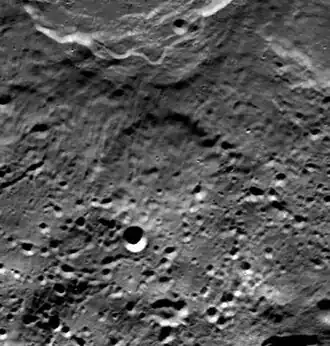 Clementine photo | |
| Coordinates | 73°30′S 171°36′W / 73.5°S 171.6°W |
|---|---|
| Diameter | 60.16 km (37.38 mi)[1] |
| Colongitude | 174° at sunrise |
| Eponym | John A. Brashear |

Brashear is a lunar impact crater on the far side of the Moon,[2] in the southern hemisphere in the vicinity of the south pole. It lies just to the south of the walled plain designated Antoniadi, within the larger crater's outer rampart of ejecta. To the northeast besides Antoniadi is the crater Numerov, and southeast lies the younger De Forest.[3]
This formation is little more than a shallow depression in the lunar surface, its features eroded and blanketed by the ejecta from the relatively fresh crater Antoniadi just to the north.[4]: 141–142
The satellite crater Brashear P lies to the south-southwest. It is a heavily worn crater with features that have been almost completely worn away by subsequent impacts. Connected to the southern rim of this crater is a series of valleys and impact craters leading a couple of hundred kilometres to the east.
This crater is named after the American astronomer John A. Brashear (1840–1920).[5] Its designation was formally adopted by the International Astronomical Union in 1970.[1]
Satellite craters
By convention these features are identified on lunar maps by placing the letter on the side of the crater midpoint that is closest to Brashear.[6]
| Brashear[4]: 294 | Latitude | Longitude | Diameter |
|---|---|---|---|
| P | 76.8° S | 175.7° W | 71 km |
References
- 1 2 "Brashear". Gazetteer of Planetary Nomenclature. USGS Astrogeology Research Program.
- ↑ Moore, Patrick (2000). The Data Book of Astronomy. CRC Press. p. 66. ISBN 978-1-4200-3344-1.
- ↑ This crater lies across two map charts:
- 1 2 Bussey, B.; Spudis, P. (2004). The Clementine Atlas of the Moon. New York: Cambridge University Press. ISBN 978-0-521-81528-4.
- ↑ Menzel, D. H.; et al. (1971). "Report on Lunar Nomenclature by the Working Group of Commission 17 of the IAU". Space Science Reviews. 12 (2): 136–186. Bibcode:1971SSRv...12..136M. doi:10.1007/BF00171763. S2CID 122125855.
- ↑ Grego, P. (2015). "Satellite Crater". In Hargitai, H.; Kereszturi, Á. (eds.). Encyclopedia of Planetary Landforms. New York, NY: Springer. doi:10.1007/978-1-4614-3134-3_328.
Sources
- Price, Fred W. (1988). The Moon Observer's Handbook. Cambridge University Press. ISBN 978-0-521-33500-3.
- Rükl, Antonín (1990). Atlas of the Moon. Kalmbach Books. ISBN 978-0-913135-17-4.
- Wlasuk, Peter T. (2000). Observing the Moon. Springer. ISBN 978-1-85233-193-1.
External links
 Media related to Brashear (crater) at Wikimedia Commons
| Physical properties |  | |
|---|---|---|
| Orbit | ||
| Surface and features | ||
| Science | ||
| Exploration | ||
| Time-telling and navigation | ||
| Phases and names | ||
| Daily phenomena | ||
| Related |
| |
