Borstal Boy (film)
| Borstal Boy | |
|---|---|
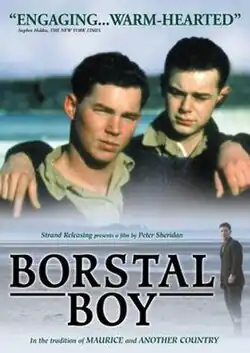 Theatrical release poster | |
| Directed by | Peter Sheridan |
| Screenplay by |
|
| Based on | |
| Produced by |
|
| Starring | |
| Cinematography | Ciarán Tanham |
| Edited by | Stephen O'Connell |
| Music by | Stephen McKeon |
| Distributed by | Strand Releasing |
Release date |
|
Running time | 93 minutes |
| Countries | United Kingdom Ireland |
| Language | English |
| Budget | $100,000 |
| Box office | $87,400 |
Borstal Boy is a 2000 romantic drama film directed by Peter Sheridan, based on the 1958 autobiographical novel of the same name by Irish writer Brendan Behan.
Plot
In 1941, 16-year-old IRA volunteer Brendan Behan is going on a bombing mission from Republic of Ireland to Liverpool during the Second World War. His mission is thwarted when he is apprehended, charged and imprisoned in a borstal, a reform institution for young offenders in East Anglia, England. At borstal, Brendan is forced to live face-to-face with those he regarded as his enemies, a confrontation that reveals a deep inner conflict in the young Brendan and forces a self-examination that is both traumatic and revealing. Events take an unexpected turn and Brendan is thrown into a complete spin. In the emotional vortex, he finally faces up to the truth.
Cast
- Shawn Hatosy as Brendan Behan
- Danny Dyer as Charlie Millwall
- Lee Ingleby as Dale
- Michael York as Joyce
- Eva Birthistle as Liz Joyce
- Mark Huberman as Mac
- Ian McElhinney as Verreker
- Ronnie Drew as Customs
Adaptation
The director, Sheridan, said "there was a very specific aspect of Behan's story I was interested in -- his Republicanism contrasted with his sexuality" and that he "took huge liberties in order to make the film I wanted to make".[1] It depicts Behan as attracted to his male best friend as well as the warden's daughter.[2] Much of the film's narrative is very different from the novel, including adding the romances, an escape attempt, and a student play.[3]
Reception
Roger Ebert gave Borstal Boys two out of four stars, lacking the "gusto and rudeness" of the source material.[4] He found the depictions of the borstal softened and unrealistic.[4] Film critic Stephen Holden described the film as "a likable rites-of-passage memory piece doused in period nostalgia".[2] Reviewer Scott Tobias, writing for the A.V. Club, also noted the nostalgic softening of Behan's story, including that the film "disingenuously suggests that the borstal years cured Behan of his aggression, when in reality, he shot a police officer shortly after returning to Dublin."[5] A reviewer for The Advocate described the film as entertaining and manipulative.[6]
See also
References
- ↑ Walsh, Alison (24 February 2008). "Why the fat kid doesn't always stay in the picture". Irish Independent. Archived from the original on 18 August 2022. Retrieved 5 June 2026.
- 1 2 Holden, Stephen (1 March 2002). "Film Review; Brendan Behan, a Gifted Boy Reform School Failed to Reform". The New York Times. ISSN 0362-4331. Retrieved 5 June 2026.
- ↑ Connelly, Mark (10 January 2014). The IRA on Film and Television: A History. McFarland. pp. 97–99. ISBN 978-0-7864-8961-9.
- 1 2 Ebert, Roger (22 March 2002). "Borstal Boy". RogerEbert.com. Retrieved 5 June 2026.
- ↑ Tobias, Scott (29 March 2002). "Borstal Boy". A.V. Club. Retrieved 5 June 2026.
- ↑ Stuart, Jan (2 April 2002). "Reform school romance". The Advocate. Here Publishing. p. 57.
External links
- 2000 films
- 2000 biographical films
- 2000 independent films
- 2000 LGBTQ-related films
- 2000 romantic drama films
- 2000 teen drama films
- 2000s teen romance films
- British biographical drama films
- British coming-of-age drama films
- British independent films
- British prison drama films
- British romantic drama films
- British teen drama films
- British teen romance films
- 2000s coming-of-age romance films
- 2000 coming-of-age films
- Drama films based on actual events
- Films about the Irish Republican Army
- Films based on autobiographical novels
- Films based on Irish novels
- American gay-related films
- Irish biographical drama films
- Irish coming-of-age drama films
- Irish independent films
- Irish gay-related films
- Irish romantic drama films
- Irish teen films
- LGBTQ-related romantic drama films
- LGBTQ-related coming-of-age drama films
- LGBTQ-related films based on actual events
- Romance films based on actual events
- British teen LGBTQ-related films
- 2000 English-language films
- 2000 British films
- Films scored by Stephen McKeon
- LGBTQ-related crime drama films
- English-language biographical drama films
- English-language independent films
- English-language romantic drama films
- Films distributed by Strand Releasing
- 2000s romantic drama film stubs
- LGBTQ-related romantic drama film stubs
- 2000s LGBTQ-related drama film stubs