Boltonia caroliniana
| Boltonia caroliniana | |
|---|---|
 | |
| Boltonia caroliniana in bloom | |
Scientific classification  | |
| Kingdom: | Plantae |
| Clade: | Embryophytes |
| Clade: | Tracheophytes |
| Clade: | Angiosperms |
| Clade: | Eudicots |
| Clade: | Asterids |
| Order: | Asterales |
| Family: | Asteraceae |
| Genus: | Boltonia |
| Species: | B. caroliniana |
| Binomial name | |
| Boltonia caroliniana | |
| Synonyms[1] | |
| |

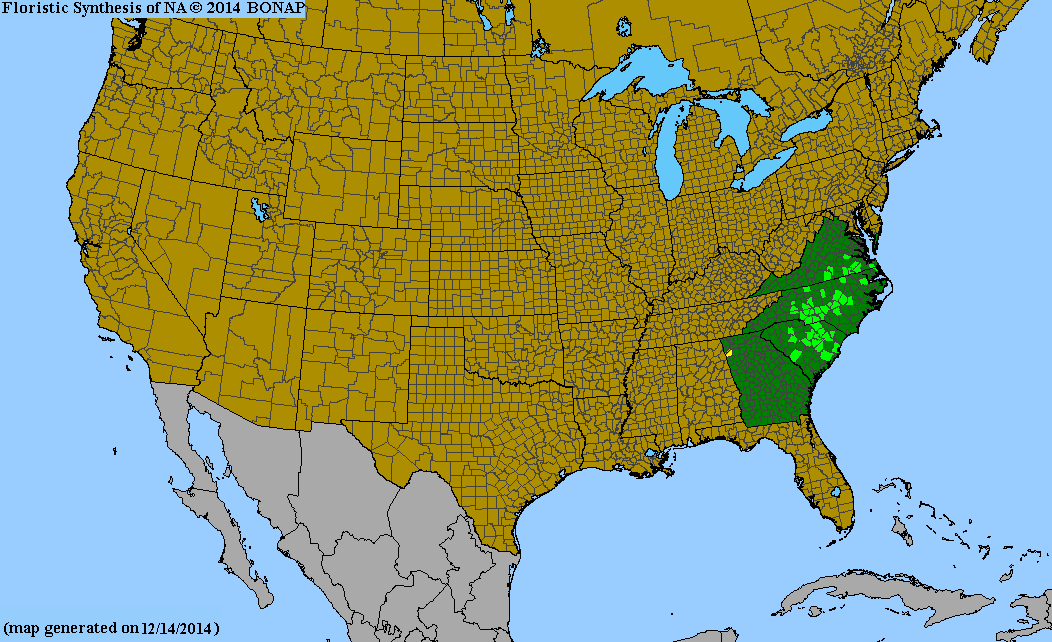
Boltonia caroliniana, common name Carolina doll's-daisy, is a North American species of plants in the family Asteraceae. It is found only in the southeastern United States, primarily in the states of North Carolina, South Carolina, and Virginia with a few isolated populations in western Georgia.[2]
Description
Boltonia caroliniana is a perennial herb up to 200 cm (80 inches) tall. It has many daisy-like flower heads with white or lilac ray florets and yellow disc florets.[3][4][5]
The Carolina doll's-daisy can grow to 4–6 feet tall, with a waxy smooth stem and leaves. Tends to be bushier than B. asteroides. It lacks wings on the seeds, unlike B. diffusa.[6]
Conservation
NatureServe assigns Boltonia caroliniana a global conservation rank of G4?, indicating that the species is probably apparently secure, although some uncertainty remains. Its rounded global rank is G4. The global assessment was last reviewed on 19 March 1994 and is identified by NatureServe as needing review.[7]
NatureServe has not assigned the species a national conservation rank in the United States. State ranks include S1? in Georgia, S3? in North Carolina, and S4 in Virginia. It is unranked in Alabama, Mississippi, and South Carolina. The question marks attached to the Georgia and North Carolina ranks indicate uncertainty in those assessments. The species has no status under the United States Endangered Species Act.[7]
NatureServe estimates that there may be between 6 and 20 occurrences, although this estimate is complicated by unresolved taxonomic questions. The assessment notes that some classifications include Boltonia diffusa within B. caroliniana; when the two are treated as separate species, B. caroliniana may be a considerably rarer plant restricted mainly to North Carolina, South Carolina, and Virginia.[7]
The species occurs in moist lowlands. NatureServe states that it is unknown whether any occurrences are adequately protected and managed and recommends additional surveys in every state where it has been reported. Further taxonomic research is also needed to clarify its distribution, abundance, and conservation status.[7]
References
- ↑ The Plant List, Boltonia caroliniana (Walter) Fernald
- ↑ Biota of North America Program, 2014 county distribution map
- ↑ Flora of North America, Carolina doll’s-daisy, Boltonia caroliniana (Walter) Fernald
- ↑ Fernald, Merritt Lyndon 1940. Rhodora 42(503): pages 487–488 description + commentary in English
- ↑ Fernald, Merritt Lyndon 1940. Rhodora 42(503): plate 642 photos of herbarium specimen
- ↑ "Vascular Plants of North Carolina". auth1.dpr.ncparks.gov. Retrieved 2023-06-21.
- 1 2 3 4 "Boltonia caroliniana". NatureServe Explorer. NatureServe. Retrieved 16 July 2026.