Bolboschoenus novae-angliae
| New England bulrush | |
|---|---|
 | |
Scientific classification  | |
| Kingdom: | Plantae |
| Clade: | Embryophytes |
| Clade: | Tracheophytes |
| Clade: | Angiosperms |
| Clade: | Monocots |
| Clade: | Commelinids |
| Order: | Poales |
| Family: | Cyperaceae |
| Genus: | Bolboschoenus |
| Species: | B. novae-angliae |
| Binomial name | |
| Bolboschoenus novae-angliae (Britton) S.G.Sm. | |
| Synonyms[3][4] | |
| |


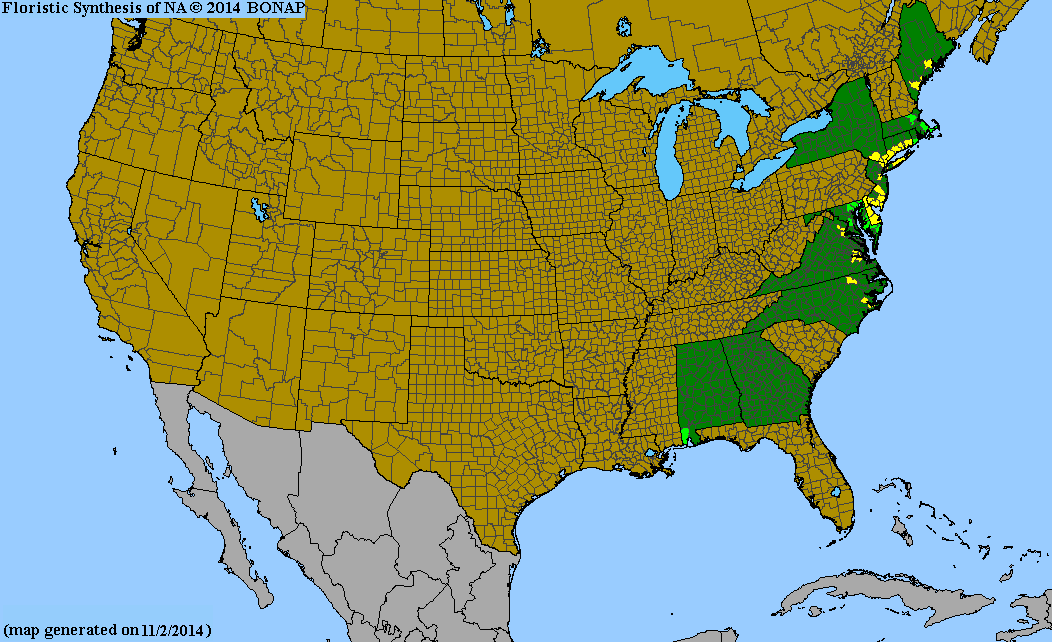
Bolboschoenus novae-angliae, common names New England bulrush[5] and Salt marsh bulrush,[6] is a plant species found along the Atlantic seacoast of the United States from Alabama to Maine (although there are no records of the plant from South Carolina, and reports from Alabama, Georgia, and North Carolina remain unconfirmed). It grows in brackish and salt-water marshes and estuaries along the coast.[7][8]
Bolboschoenus novae-angliae is a perennial herb up to 150 cm (80 inches) tall, spreading by means of underground rhizomes. Culms are triangular in cross-section. Flowers and fruits are borne in spikelets at the tip of the culm. Achenes are variable in shape, sometimes compressed, sometimes trigonous, the two shapes sometimes present on the same plant.[7][9][10][11][12]
It is listed as a special concern species in Connecticut.[6]
References
- ↑ Lansdown, R.V. (2016). "Bolboschoenus novae-angliae". IUCN Red List of Threatened Species. 2016 e.T64264486A67728593. doi:10.2305/IUCN.UK.2016-1.RLTS.T64264486A67728593.en. Retrieved 1 July 2026.
- ↑ "Bolboschoenus novae-angliae". NatureSere Explorer. The Nature Conservancy. Retrieved 1 July 2026.
- ↑ "Tropicos". Tropicos.org. Retrieved 17 March 2022.
- ↑ "Bolboschoenus novae-angliae (Britton) S.G.Sm". The Plant List.
- ↑ NRCS. "Schoenoplectus novae-angliae". PLANTS Database. United States Department of Agriculture (USDA). Retrieved 7 November 2015.
- 1 2 "Connecticut's Endangered, Threatened and Special Concern Species 2015" (PDF). Archived from the original (PDF) on 2018-06-12. Retrieved 2017-10-13.
- 1 2 "Bolboschoenus novae-angliae in Flora of North America". Efloras.org. Retrieved 17 March 2022.
- ↑ "Biota of North America Program 2014 county distribution map, Schoenoplectus novae-angliae". Retrieved 17 March 2022.
- ↑ Browning, J.; K. D. Gordon-Gray; S. G. Smith (1995). "Achene structure and taxonomy of North American Bolboschoenus (Cyperaceae)". Brittonia. 47 (4): 433–445. Bibcode:1995Britt..47..433B. doi:10.2307/2807575. JSTOR 2807575.: 434
- ↑ Britton, Nathaniel Lord; Brown, Addison (17 March 1898). An illustrated flora of the northern United States, Canada and the British possessions from Newfoundland to the parallel of the southern boundary of Virginia and from the Atlantic Ocean westward to the 102d meridian. Vol. 3, Apocynaceae to Compositae, dogbane to thistle. Vol. 3. C. Scribner. Retrieved 17 March 2022.
- ↑ Robinson, Benjamin Lincoln; Fernald, Merritt Lyndon; Club, New England Botanical (17 March 1906). "Rhodora". New England Botanical Club [etc.] Retrieved 17 March 2022.
- ↑ Beetle, Alan Ackerman (1942). "About New England Bulrush". American Journal of Botany. 29 (1): 87.