Bohnenberger (crater)
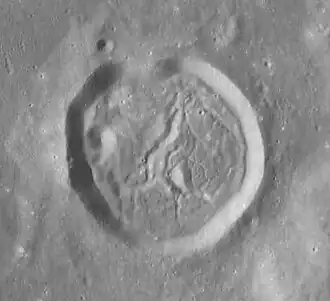 LRO image | |
| Coordinates | 16°14′S 40°04′E / 16.24°S 40.06°E |
|---|---|
| Diameter | 31.74 km (19.72 mi)[1] |
| Depth | 2.4 km (1.5 mi)[2] |
| Colongitude | 320° at sunrise |
| Eponym | Johann von Bohnenberger |


Bohnenberger is a lunar impact crater that lies near the east edge of the Mare Nectaris, in the foothills of the Montes Pyrenaeus mountain range that forms the perimeter of the mare. To the east beyond the mountains is the larger crater Colombo.[3]: 79, 97
The crater has a low rim along the north wall,[4] and the floor is somewhat irregular with a set of fractures crossing the floor.[5][6] A shallow, v-shaped moat separates the wall from the floor.[7] Satellite crater Bohnenberger A is also somewhat fractured. The infrared spectrum of pure crystalline plagioclase has been identified on the northeast floor and rim, southeast wall, and ejecta to the southwest.[8]
This crater is named after German astronomer Johann von Bohnenberger.[1] Its name was incorporated into lunar nomenclature by German astronomer J. H. von Mädler during the 19th century.[9] The crater designation was formally adopted by the International Astronomical Union in 1935.[1]
Satellite craters
By convention these features are identified on lunar maps by placing the letter on the side of the crater midpoint that is closest to Bohnenberger.[10]
| Bohnenberger[3]: 293 | Latitude | Longitude | Diameter |
|---|---|---|---|
| A | 17.8° S | 40.1° E | 30 km |
| C | 18.5° S | 41.1° E | 16 km |
| D | 18.3° S | 42.6° E | 14 km |
| E | 17.4° S | 42.1° E | 13 km |
| F | 14.7° S | 39.6° E | 10 km |
| G | 17.2° S | 40.1° E | 12 km |
| J | 14.8° S | 40.3° E | 5 km |
| N | 17.9° S | 41.9° E | 6 km |
| P | 19.1° S | 41.4° E | 11 km |
| W | 18.2° S | 41.1° E | 10 km |
References
- 1 2 3 "Bohnenberger". Gazetteer of Planetary Nomenclature. USGS Astrogeology Research Program.
- ↑ Pike, R. J. (September 1976). "Crater Dimensions from Apollo Data and Supplemental Sources". The Moon. 15 (3–4): 463–477. Bibcode:1976Moon...15..463P. doi:10.1007/BF00562253.
- 1 2 Bussey, B.; Spudis, P. (2004). The Clementine Atlas of the Moon. New York: Cambridge University Press. ISBN 978-0-521-81528-4.
- ↑ Moore, Patrick (2001). On the Moon. Sterling Publishing Co. p. 219. ISBN 978-0-304-35469-6.
- ↑ Grego, Peter (2005). The Moon and How to Observe It. Astronomers' Observing Guides Series. London: Springer-Verlag. p. 220. ISBN 1-85233-748-6.
- ↑ Wilhelms, Don E.; McCauley, John F.; Trask, Newell J. (1987). The geologic history of the Moon. USGS Professional Paper 1348. Washington: U.S. Government Printing Office. doi:10.3133/pp1348.
- ↑ Jozwiak, Lauren M.; et al. (November 2012). "Lunar floor-fractured craters: Classification, distribution, origin and implications for magmatism and shallow crustal structure". Journal of Geophysical Research. 117 (E11) E11005. Bibcode:2012JGRE..11711005J. doi:10.1029/2012JE004134. hdl:1721.1/85651.
- ↑ Donaldson Hanna, K. L.; et al. (July 2014). "Global assessment of pure crystalline plagioclase across the Moon and implications for the evolution of the primary crust". Journal of Geophysical Research: Planets. 119 (7): 1516–1545. Bibcode:2014JGRE..119.1516D. doi:10.1002/2013JE004476.
- ↑ Whitaker, Ewen A. (1999). Mapping and Naming the Moon. Cambridge University Press. pp. 120, 219. ISBN 978-0-521-62248-6.
- ↑ Grego, P. (2015). "Satellite Crater". In Hargitai, H.; Kereszturi, Á. (eds.). Encyclopedia of Planetary Landforms. New York, NY: Springer. doi:10.1007/978-1-4614-3134-3_328.
External links
 Media related to Bohnenberger (crater) at Wikimedia Commons
| Physical properties |  | |
|---|---|---|
| Orbit | ||
| Surface and features | ||
| Science | ||
| Exploration | ||
| Time-telling and navigation | ||
| Phases and names | ||
| Daily phenomena | ||
| Related |
| |
