Robert Parent (scientist)
Robert J. Parent | |
|---|---|
| Born | March 8th, 1917 Menominee, Wisconsin |
| Died | June 23, 1978 (aged 61)[1] |
| Known for | Co-founder of SSEC, co-developer of the Spin-Scan Cloud Camera |
| Scientific career | |
| Fields | Electrical engineering, satellite meteorology |
| Workplaces | University of Wisconsin–Madison |
Robert J. Parent was an American electrical engineer and professor at the University of Wisconsin–Madison.[1] He co-founded the Space Science and Engineering Center (SSEC) and worked alongside Verner E. Suomi to develop the spin-scan cloud camera, a technology utilized for early geostationary meteorological satellites.[2][3]
Academic career
Parent was a faculty member in the Department of Electrical Engineering at the University of Wisconsin–Madison.[2] His academic work focused on the development of instrumentation for atmospheric and space research, collaborating with Suomi to design sensors for satellite missions.[4]
Scientific contributions
Explorer VII radiation experiment
In the late 1950s, Parent and Suomi designed a flat-plate radiometer to measure the Earth's radiation budget.[5] The instrument was launched on the Explorer 7 satellite on October 13, 1959. The experiment provided early quantitative measurements of the Earth's solar absorption and infrared emission, contributing data to early climate models.[3][5]
Space Science and Engineering Center
In 1965, Parent and Suomi co-founded the Space Science and Engineering Center (SSEC) at UW-Madison with funding from NASA and the National Science Foundation.[2] The center was established to research the geophysical properties of the atmosphere and to construct satellite-based instrumentation.[4]
Spin-scan cloud cameras (ATS-1 and ATS-3)
During the mid-1960s, Parent and Suomi designed camera systems that utilized the spin of geostationary satellites to capture images of the Earth.[6] Prior to this, meteorological satellites in polar orbits could only capture narrow, non-continuous views. The spin-scan system used the 100-rpm rotation of the spacecraft to scan the Earth line-by-line, creating a full image of the disk in approximately 20 minutes.[7][8]
- ATS-1 (1966): The Spin-Scan Cloud Camera (SSCC) was launched on NASA's ATS-1 satellite on December 6, 1966. It transmitted continuous black-and-white, full-disk images of Earth, which allowed researchers to calculate wind vectors and monitor weather patterns over time.[7][9]
- ATS-3 (1967): Parent and Suomi developed the Multicolor Spin-Scan Cloudc Camera (MSSCC), which launched on the ATS-3 satellite on November 5, 1967. This instrument recorded images through red, green, and blue spectral bands, which were processed on the ground to create the first full-color image of the complete Earth disk on November 10, 1967.[10] The color contrast provided clearer distinctions between ground surface, water, and cloud systems, and the design served as a baseline for the development of subsequent geostationary operational environmental satellites (GOES).[10][9]
Historic satellite imagery
The following images were captured by the camera systems designed by Parent and Suomi:
- Earth Imagery from ATS-1 and ATS-3
 The first full-disk image of Earth captured from geostationary orbit by the ATS-1 Spin-Scan Cloud Camera on December 11, 1966.
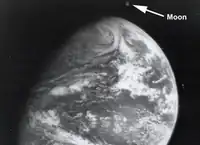 The first image depicting both the Earth and Moon together, captured by ATS-1 on December 11, 1966.
 The first full-color image of the complete Earth disk, captured by the ATS-3 Multicolor Spin-Scan Cloud Camera on November 10, 1967.
References
- 1 2 "Obituary for Robert Parent (Aged 61)". Wisconsin State Journal. June 25, 1978. Retrieved July 2, 2026.
- 1 2 3 NASA Earth Observatory. "Verner Suomi (1915 - 1995)". Retrieved July 2, 2026.
- 1 2 NOAA NESDIS (December 31, 2015). "Celebrating Verner Suomi, the Father of Satellite Meteorology". Retrieved July 2, 2026.
- 1 2 "Our History". Space Science and Engineering Center (SSEC). Retrieved July 2, 2026.
- 1 2 "UW's 175th: Five ways UW–Madison ideas have changed the world". University of Wisconsin-Madison. Retrieved July 2, 2026.
- ↑ "ATS Image Collection". Atmospheric, Oceanic and Space Sciences Library, UW-Madison. Retrieved July 2, 2026.
- 1 2 "ATS". NASA Science. Retrieved July 2, 2026.
- ↑ Menzel, W. Paul (2006). Remote Sensing Applications with Meteorological Satellites (PDF). NOAA Satellite and Information Service / University of Wisconsin-Madison. Retrieved July 2, 2026.
- 1 2 "The 50th Anniversary of ATS-1". NOAA NESDIS. Retrieved July 2, 2026.
- 1 2 Suomi, V. E.; Parent, R. J. (1968). "A color view of planet earth". Bulletin of the American Meteorological Society. 49 (2): 74–75. Retrieved July 2, 2026.