Tegillarca granosa
| Tegillarca granosa | |
|---|---|
 | |
| Shell of Tegillarca granosa (specimen at MNHN, Paris) | |
Scientific classification  | |
| Kingdom: | Animalia |
| Phylum: | Mollusca |
| Class: | Bivalvia |
| Order: | Arcida |
| Family: | Arcidae |
| Genus: | Tegillarca |
| Species: | T. granosa |
| Binomial name | |
| Tegillarca granosa | |
| Synonyms | |
| |
Tegillarca granosa (also known as Anadara granosa)[2] is a species of ark clam commonly known as the blood cockle or blood clam due to the red haemoglobin liquid inside the soft tissues. It is found throughout the Indo-Pacific region from the eastern coast of South Africa northwards and eastwards to Southeast Asia, Australia, Polynesia, and up to northern Japan. It lives mainly in the intertidal zone at one to two metres water depth, burrowed down into sand or mud. Adult size is about 5 to 6 cm long and 4 to 5 cm wide.[3]
Anatomy
The shell of the blood cockle is adapted for its burrowing lifestyle.[4]
- Shape and Size: The shell is equivalved (both valves are the same size), thick, solid, and strongly inflated, giving it a rounded, ovate shape. Adults typically reach 5-6 cm in length .
- Ornamentation: A key identifying feature is the presence of 15 to 20 broad, radial ribs on each valve. These ribs are often covered with distinct, small knobs or beads (giving it the common name "blood cockle" in some regions) .
- Coloration: The shell is covered by a dark brown or blackish periostracum (the organic outer layer). A characteristic feature is a diamond-shaped, dark brown or black patch located just below the umbones (the beak-like projections). The inside of the shell is white, sometimes with a purple hue.
- Hinge and Margin: The hinge area (where the two valves meet) is long and straight, containing a row of numerous small, interlocking "teeth" (taxodont dentition). T. granosa can have about 35 of these small teeth. The inner margin of the shell has small crenulations or notches (around 18) that correspond with the external radial ribs.
- Right and left valve of the same specimen:
 Right valve
 Left valve
Human use
Aquaculture


It has a high economic value as food, and it is aquacultured. On the coast of Zhejiang Province alone, blood cockle plantations occupy around 145,000 mu (about 100 km2) of mudflats.[7] These clams are raised in the river estuaries of the neighboring Fujian Province as well.[5]
Culinary use
China
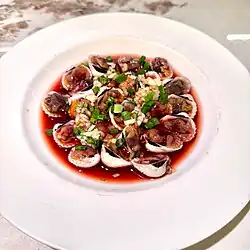
Blood cockles are commonly consumed in coastal China particularly in the Yangtze River region.[8]
Korea
In Korea, blood cockles are called kkomak (꼬막) and are cooked and seasoned with soy sauce, chili powder, and sesame oil.[9]
- Preparations of Kkomak
 Unprepared kkomak (blood cockles)
 Prepared kkomak (blood cockles)
 Kkomak-muchim (seasoned blood cockles)
Indonesia
In Indonesia, blood cockles (local: kerang darah) are quite popular food and are served as various dishes including boiled, deep fried or sauteed.[10]
Thailand
In Thailand, they are known as hoi kraeng (Thai: หอยแครง), presumably a corruption of the common Indonesian name. In Thai cuisine, they are usually boiled and eaten with a spicy and sour dipping sauce like other types of seafood.[11]
Safety
Some sources of blood cockle may not undergo the depuration process. Therefore, certain styles of preparation, such as the poaching commonly carried out in Shanghai, can leave many pathogens present.[12] A 2014 study found that blood cockles collected from the Sabang River in Asajaya, Sarawak, Malaysia, contained cadmium and lead levels exceeding Malaysian food safety regulations, indicating potential health risks from long-term consumption.[13]
References
- ↑ "Tegillarca granosa (Linnaeus, 1758)". World Register of Marine Species. Retrieved 24 January 2016.
- ↑ (pata de mula)SPECIES: Tegillarca granosa (Malaysian cockle)(Anadara granosa)
- ↑ Pathansali, D. (1966). Notes on the biology of the cockle, Anadara granosa L. Proc. Indo-Pacific Fish. Counc. 11:84-98
- ↑ "Tegillarca granosa (Linnaeus, 1758)". 臺灣生命大百科 (in Traditional Chinese). Archived from the original on 2025-04-20. Retrieved 2026-05-22.
- 1 2 Ruǎn Jīnshān; Li Xiùzhū; Lín Kèbīng; Luō Dōnglián; Zhōu Chén; Cài Qīnghǎi (阮金山;李秀珠;林克冰;罗冬莲;周宸;蔡清海), 安海湾南岸滩涂养殖贝类死亡原因调查分析 (Analysis of the causes of death of farmed shellfish on the mudflats in the southern part of Anhai Bay), 《福建水产》 (Fujian Aquaculture), 2005-04
- ↑ "Fisheries and Aquaculture - Global Production". Food and Agriculture Organization of the United Nations (FAO). Retrieved 2024-05-06.
- ↑ 泥蚶抗高氨氮、高硫化物家系选育 (Breeding mud cockle varieties resistant to high-nitrogen, high-sulfide environment). (The numbers are as of 2009)
- ↑ "Easy Chinese cockles recipe Chiu Chow style". SCMP Cooking | South China Morning Post. Retrieved 2025-04-29.
- ↑ Chung, Da-young (December 2015). "Cockles". KOREA. Vol. 11, no. 12. Korean Culture and Information Service. ISSN 2005-2162. Retrieved 13 April 2017.
- ↑ "8 Resep olahan kerang dara paling enak, sehat, sederhana, dan praktis". 16 July 2020.
- ↑ Patamakanthin, Jom (2012). Fan Hoi Pan Tae (in Thai). Nonthaburi: Chaba-ngeon Publishing Company Limited. p. 108. ISBN 978-616904682-0.
- ↑ "Shanghai getting tougher on blood clam ban - People's Daily Online".
- ↑ Hossen, Md. Faruk; Hamdan, Sinin; Rahman, Md. Rezaur (2014). "Cadmium and Lead in Blood Cockle ( Anadara granosa ) from Asajaya, Sarawak, Malaysia". The Scientific World Journal. 2014: 1–4. doi:10.1155/2014/924360. ISSN 2356-6140. PMC 4236887. PMID 25538965.
- Leung KF. & Morton B. (2003). Effects of long-term anthropogenic perturbations on three subtidal epibenthic molluscan communities in Hong Kong. In: Morton B, editor. Proceedings of an International Workshop Reunion Conference, Hong Kong: Perspectives on Marine Environment Change in Hong Kong and Southern China, 1977–2001. Hong Kong University Press, Hong Kong. pp 655–717
- Liu, J.Y. [Ruiyu] (ed.). (2008). Checklist of marine biota of China seas. China Science Press. 1267 pp.
- Huber, M. (2010). Compendium of bivalves. A full-color guide to 3,300 of the world's marine bivalves. A status on Bivalvia after 250 years of research. Hackenheim: ConchBooks. 901 pp., 1 CD-ROM
External links

- Linnaeus, C. (1758). Systema Naturae per regna tria naturae, secundum classes, ordines, genera, species, cum characteribus, differentiis, synonymis, locis. Editio decima, reformata [10th revised edition], vol. 1: 824 pp. Laurentius Salvius: Holmiae
- Gmelin J.F. (1791). Vermes. In: Gmelin J.F. (Ed.) Caroli a Linnaei Systema Naturae per Regna Tria Naturae, Ed. 13. Tome 1(6). G.E. Beer, Lipsiae [Leipzig]. pp. 3021–3910
- Lightfoot, J. (1786). A Catalogue of the Portland Museum, lately the property of the Dutchess Dowager of Portland, deceased; which will be sold by auction by Mr. Skinner & Co. (book). London. viii + 194 pp
- Iredale, T. (1939). Mollusca. Part I. Scientific Reports of the Great Barrier Reef Expedition 1928-1929. 5(6): 209-425, pls 1-7
- FAO Profile, including production figures and range