Bengal Provincial Congress Party
Bengal Provincial Congress Party Bengal Provincial Congress | |
|---|---|
| Former provincial branch of the Indian National Congress | |
 | |
| Leader | Chittaranjan Das (first leader) |
| President | Chittaranjan Das (1921), Jatindra Mohan Sengupta (1925), Subhas Chandra Bose (1927), Surendra Mohan Ghose (1939) |
| General Secretary | Birendranath Sasmal (1921), Kamalakrishna Ray (1937), Ashrafuddin Ahmad Chowdhury (1937) |
| Founded | 1920 (reorganized 2 July 1921) |
| Dissolved | 1947 |
| Split from |
|
| Succeeded by |
|
| Headquarters | 33 Forbes Mansion, Calcutta |
| Student wing | Nikhil Banga Chhatra Samiti |
| Membership (1936) | ~49,040 (1936)[1]: 635 |
| Ideology | Indian nationalism Swaraj Secularism |
| Political position | Big tent |
| National affiliation | Indian National Congress |
| Colours | |
| Seats in the Bengal Legislative Assembly | 54 (1937)[1]: 643 |
Bengal Provincial Congress Party (BPCP) was a provincial branch of the Indian National Congress in the Bengal province of British India. The party's early leadership played an important role in organizing political programmes against the British Raj, such as the Non-Cooperation Movement and the Civil Disobedience Movement.
According to historian Joya Chatterji, after the 1937 election the party emerged as the largest single party in the Bengal Legislative Assembly and became the main opposition force.[2]: 103–104 In the 1937 Bengal Legislative Assembly election, the party won 54 seats in the legislature,[1]: 643 but having failed to form a coalition with the Krishak Praja Party, it was unable to form a government.[2]: 104–105
Several leaders of this party later emerged as statesmen of independent India, among them Bidhan Chandra Roy (the first Chief Minister of West Bengal) and Sarat Chandra Bose (who played an important role in the final negotiations preceding the 1947 partition of Bengal).
Background
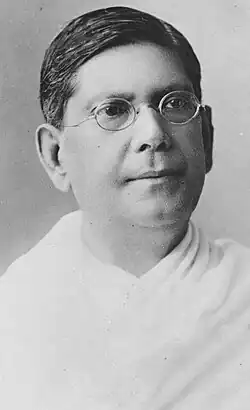
When the party was founded in 1920, British India was undergoing major constitutional change, particularly through the reforms of the Government of India Act 1919 and, later, the Government of India Act 1935, which brought a number of powers at the provincial level into Indian hands.[3][1]: 589 Although initially little more than a collection of a few elite groups, the new constitution adopted at the 1920 Nagpur session set out to transform it into a party of the masses at every level.[4]: 167 As a result, on 2 July 1921 the party was formally reorganized with Chittaranjan Das as its first president and Birendranath Sasmal as secretary.[4]: 9
According to historian Gordon Johnson, the party was dominated by the educated Hindu Bhadralok class, made up mainly of upper-caste Brahmins, Baidyas and Kayasthas, who wielded influence over the professional and social life of the province.[5]: 534 Under Chittaranjan Das's leadership, the party took a reform-minded stance. In order to oppose Mahatma Gandhi's policy of total boycott and instead contest legislative council elections, they formed the Swarajya Party in 1923.[3]
To secure communal cooperation, Das concluded the Bengal Pact of 1923. However, the party was frequently marked by factional conflict, particularly between the camps led by Jatindra Mohan Sengupta and Subhas Chandra Bose.[1]: 610 Alongside open politics, the party also maintained notable contact with revolutionary organizations such as Jugantar and the Anushilan Samiti.[2]: 122 [6] : 144
Anti-British Movements
Various movements against the British Raj took place across India. The party played the leading role in organizing these movements in Bengal.[3]
Non-Cooperation and Khilafat Movement
In 1920, under the leadership of Chittaranjan Das, the party joined the Non-Cooperation Movement. The Khilafat Movement united both Hindu and Muslim communities during this period, further strengthening the overall movement.[1]: 593 Chittaranjan Das and his associates called for a boycott of British legislative councils, educational institutions and courts. During this period, around 170 national schools were established in Bengal, and students left government schools to join the movement.[1]: 594
As part of the movement, huge hartals were observed in Calcutta and various district towns, and widespread discontent spread among railway workers and tea-garden labourers.[1]: 592 From late 1921 until March 1922, peasants stopped paying rent and taxes in Tippera (Comilla), Rangpur and Noakhali districts.[1]: 609 In Midnapore, an anti-tax movement against the Union Boards took a strong form, laying the foundation for later agitation.[1]: 592
Civil Disobedience Movement
In 1930, Mahatma Gandhi launched the Civil Disobedience Movement, which had a wide impact in Bengal. However, there was disagreement among leaders over strategy, resulting in the formation of two separate 'Civil Disobedience Councils' in Bengal.[1]: 608 A defining feature of this movement was defiance of the salt laws (Salt Satyagraha), which mainly occurred in coastal districts.
In Midnapore district the movement took on an intense character. The British government's Home Secretary remarked that nowhere else had the government's prestige been damaged as much as in Midnapore.[1]: 609 In the Kanthi and Tamluk subdivisions of Midnapore it became a mass movement — 64 of Kanthi subdivision's 76 union boards refused to pay the chowkidari tax.[1]: 613 British police arrested many agitators; between January and June 1932, 5,900 people were arrested in Tamluk and 4,343 in Kanthi.[1]: 614 The tax-refusal campaign also achieved considerable success in the Arambagh subdivision of Hooghly and the Mahishbathan area of 24 Parganas.[1]: 609 However, in the Muslim-majority districts of East Bengal (Dhaka, Faridpur, Mymensingh), the movement did not achieve the hoped-for success, as a large section of Muslims stayed away from it.[1]: 608
Quit India Movement (1942)
The party's role in the 1942 Quit India Movement was extremely important. During the Second World War, most of the party's top leaders were in jail, but grassroots leaders continued the movement. In the Tamluk and Kanthi subdivisions of Midnapore district, it achieved considerable success.[2]: 134
During this period, local leaders in Midnapore built their own administration, known as the Tamralipta Jatiya Sarkar, which operated independently alongside the British.[2]: 134 The party had already been weakened following Subhas Chandra Bose's expulsion in 1939; from 1942 to 1945 it had almost no formal activity. Even so, the British had extreme difficulty suppressing the local uprising, and it was the scale of this movement that later helped force the British to leave India.[3]
Language
The Bengal Provincial Congress Party conducted most of its activities mainly in Bengali and English, reflecting both the party's elite political character and its dual role as a mass movement. After the 1920 Nagpur session, the Indian National Congress reorganized its provincial branches along linguistic lines, allowing the Bengal branch to focus specifically on the Bengali-speaking population within its jurisdiction.[4]: 167
Although the primary language of the party's elite leadership — particularly the Western-educated Hindu Bhadralok of Calcutta — was English, the party gradually increased its use of the vernacular (Bengali) in order to organize ordinary people.[4]: 169
In the national schools established by the party, the curriculum was deliberately arranged so that the mother tongue was taught as the first language, with English only as a second language.[4]: 104
The party's political ideology was widely supported by the press; its major English-language mouthpieces included Forward, Liberty and Advance, while influential Bengali-language papers such as Anandabazar Patrika and Basumati also supported the party's aims.[4]: 169
To reach rural peasants and Muslim cultivators in the mofussil, the party used vernacular media during its outreach campaigns, including Bengali songs, folk songs and pamphlets.[4]: 169
Organization
All of the party's activities were run from its permanent headquarters at 33 Forbes Mansion, Calcutta. A council and an executive committee controlled the party's organizational affairs.
The party's initial structure was formed in 1921–22, when 268 representatives were elected from 28 districts based on population.[4]: 170 In the first half of the 1920s, the organization's activities spread to 32 districts: 26 districts of the Presidency, 4 separate committees in Calcutta, and two Bengali-speaking districts of Assam (Cachar and Sylhet).[1]: 593
Factionalism and Splits

Historically, the party was marked by continuous internal conflict, which intensified after Chittaranjan Das's death on 16 June 1925.[1]: 595
Two major factions formed within the organization: one led by Jatindra Mohan Sengupta, who had the full support of Mahatma Gandhi and the central Congress leadership, and the other by Subhas Chandra Bose.[1]: 595
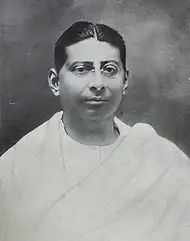
Bose was frequently either imprisoned or abroad; during those times, control of the party often passed to a group of influential Calcutta politicians known as the "Big Five" — Tulsi Charan Goswami, Sarat Chandra Bose, Nirmal Chandra Chunder, Bidhan Chandra Roy and Nalini Ranjan Sarkar.[1]: 597
In August 1931 the All India Congress Committee intervened in the provincial dispute. Its representative, M. R. Jayakar (Ane), investigated the party's affairs strictly, after which he installed Sengupta's faction as the official leadership of the provincial committee.[1]: 610
The party's deepest rupture came in 1939, when Subhas Chandra Bose was re-elected Congress president against the wishes of the Congress high command. He subsequently resigned and was expelled, the official provincial committee was suspended, and a parallel "Congress" loyal to the Bose brothers was later formed in Bengal.[2]: 125
Internal disagreement, ideological difference and leadership conflict repeatedly produced new factions within the Bengal Provincial Congress, with many leaders leaving to form new political platforms, notably:
- Swarajya Party (1923): Formed within Congress itself by Chittaranjan Das and Motilal Nehru after disagreeing with Mahatma Gandhi over entering the legislature. It was extremely strong in Bengal and did well in the 1923 elections.
- Sengupta faction: Emerged after Chittaranjan Das's death under the leadership of Jatindra Mohan Sengupta, fully loyal to the Congress central high command and Gandhi's non-violent policy, with close contact with a section of the revolutionary organization Anushilan Samiti.
- Bose faction: Led by Subhas Chandra Bose and drawn from the party's youth, students and radicals; favoured uncompromising struggle and was backed by the revolutionary organization Jugantar.
- Pro-Praja movement section: After Chittaranjan Das's death, when the Bengal Provincial Congress abandoned the Bengal Pact, A. K. Fazlul Huq and other Muslim leaders left Congress. They later formed the Nikhil Banga Praja Samiti (later the Krishak Praja Party) to pursue rural peasants' rights.
- Parallel Congress and Forward Bloc (1939): After Subhas Chandra Bose was elected president at the 1939 Tripuri Congress, an extreme conflict arose with the high command. Bose was forced to resign and was temporarily expelled from Congress. In protest, his Bengal loyalists formed a parallel Congress or rebel committee, which later became the basis of his new political party, the Forward Bloc.
Provincial Autonomy (1937–1947)
The era of Provincial Autonomy began under the Government of India Act 1935. This era fundamentally transformed the political landscape of Bengal. It ended the system of dyarchy and placed the provincial government entirely in Indian hands. The franchise was also significantly widened. The number of eligible voters increased from 1.3 million to approximately eight million.[1]: 634 For the Bengal Provincial Congress Party, this period presented both a prospect of self-rule and a severe strategic crisis.
1937 Elections and Coalition Failure
In the 1937 elections, the Congress emerged as the largest single party in the Bengal Legislative Assembly. They secured 54 seats, which included general, scheduled caste, and labour seats.[1]: 643 Despite this success, the party failed to form a government.
A. K. Fazlul Huq, leader of the Krishak Praja Party (KPP), initially sought a coalition with the Congress. However, the Congress central leadership refused to permit this alliance.[4]: 104 The central leadership demanded that the release of political prisoners be the first priority. Meanwhile, Huq's party prioritized agrarian reform and peasant welfare. This deadlock forced Huq into a coalition with the All-India Muslim League. As a result, the Congress was relegated to long-term opposition.[4]: 104
Legislative Challenges to Bhadralok Interests
During the era of autonomous rule, the Muslim-led coalition ministries introduced several new laws. These measures targeted the traditional dominance of the Hindu bhadralok:
- Bengal Tenancy (Amendment) Bill (1937–38): This bill abolished the salami (landlord's transfer fee) and the right of pre-emption. It severely undermined the power of Zamindars to control their tenants.[4]: 104
- Moneylenders Act (1940): This act regulated professional moneylenders and shopkeepers, who were mostly Hindus. The law fixed maximum interest rates and required trade licenses.[4]: 107
- Secondary Education Bill (1940): This bill sought to remove the control of higher education from the Calcutta University. It vested this control in a new board with greater Muslim representation. This directly challenged the perceived "cultural superiority" of the bhadralok.[4]: 107
- Administrative Reforms: New rules mandated that 60% of all government appointments and 50% of police recruits be reserved for Muslims.[4]: 107
The "Left Initiative" and Internal Factionalism
In opposition, Sarat Chandra Bose attempted to radicalize the party. His goal was to appeal to the rural masses and counter the KPP's influence. He adopted a more secular and populist platform, which included the abolition of the Permanent Settlement.[4]: 107 This "left initiative" brought an influx of young socialists and communists into the party. They launched "mass contact" campaigns to recruit Muslim cultivators.[4]: 110
However, this strategy faced severe internal constraints:
- Bhadralok Conservatism: Many rural zamindars within the party were alarmed by "no-rent" campaigns. They viewed the new radicalism as a threat to Hinduism and property rights.[4]: 107
- Communal Polarization: Efforts to win over Muslim peasants were often met with hostility from local Muslim leaders. They openly denounced the Congress as a "Hindu" organization.[4]: 110
The 1939 Split and Central Control
The tension between the Bengal branch and the central leadership culminated in the 1939 split. Subhas Chandra Bose was forced to resign as Congress President and was subsequently expelled. After this, the provincial committee was divided into "regular" and "suspended" factions.[3]
The Congress central leadership intervened to control the unruly Bengal branch. They formed an Election Tribunal led by Satish Chandra Dasgupta. Through this tribunal, they purged Bose loyalists and radical dissidents.[4]: 126–127 By 1940, the Bengal Provincial Congress Committee was transformed into a disciplined client of the centre. They identified more closely with dominant Hindu interests to effectively compete with the Hindu Mahasabha.[4]: 127
Crisis and Partition
In the 1937 election, the Bengal Congress won 54 seats, emerging as the largest party. But the Congress's top leadership held an inflexible position, and it failed to form a coalition with A. K. Fazlul Huq's Krishak Praja Party. Fazlul Huq was eventually forced to form a coalition government with the Muslim League instead, and Congress in Bengal sat in opposition for a long period as a result.[2]: 104
In 1939, Subhas Chandra Bose was re-elected Congress president against the will of the top leadership, bringing internal party conflict to a head. He was subsequently forced to resign and was expelled from the party. Following this, the Bengal Provincial Congress suffered a severe split: two separate committees were formed in Bengal — a 'suspended' committee made up of followers of the Bose brothers, and a 'regular' committee led by Surendra Mohan Ghose with the support of the central leadership.[3]
During this crisis, the central top leadership took firm control of the Bengal Congress, led by Sardar Vallabhbhai Patel and Rajendra Prasad. An 'election tribunal' under Satish Chandra Dasgupta purged Bose-supporting and left-wing dissidents from the party, turning the organization entirely into an instrument of the centre.[2]: 126–127
In the 1940s the party became increasingly Hindu-centred, adopting a conservative stance. In the 1945–46 election, Congress drew away most of the Hindu Mahasabha's support, winning 77% of the vote on the general seats and achieving a sweeping victory.[2]: 147 However, the party's position on Muslim seats remained extremely poor.
Before the 1947 partition, Sarat Chandra Bose and Huseyn Shaheed Suhrawardy put forward a new proposal for an undivided, independent, sovereign Bengal, but both the central Congress and the Muslim League rejected it.[3] India was partitioned in 1947, bringing about the dissolution of the Bengal Provincial Congress. It was transformed into the West Bengal Pradesh Congress Committee, and in 1947 Dr. Prafulla Chandra Ghosh took office as the first Chief Minister of West Bengal.[3]
Social Composition
The Bengal Provincial Congress Party was mainly an organization of urban Hindu Bhadralok — an educated, middle-class elite that included upper-caste Brahmins, Baidyas and Kayasthas.[5]: 534
The party focused mainly on urban areas, creating a wide gulf with rural peasant (mofussil) society and cutting it off from the wider Muslim population. By 1928 the organization's influence in the villages had greatly diminished; the committee secretary submitted a report noting that very few village-level Congress committees were functioning.[1]: 598
Party membership was heavily concentrated in certain districts — of roughly 49,040 total members in 1936, more than 18% were from Tippera (Tripura) district alone.[1]: 635
The party maintained notable contact with revolutionary organizations, among them Jugantar and Anushilan Samiti. Nevertheless, its social base was comparatively narrow, and this isolation weakened the organization by the late 1930s, when the Krishak Praja Party formed an alliance with the Muslim League and pushed tenancy and education reforms that struck directly at Hindu Bhadralok interests.[2]: 107
Notable Leadership
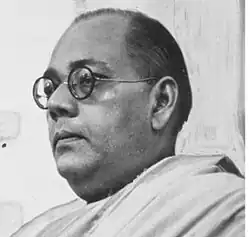
A list of presidents and general secretaries of the Bengal Provincial Congress Committee (BPCC):
Presidents
- Chittaranjan Das (C. R. Das): Led the party after its 1920 founding; formally elected first president when the party was reorganized on 2 July 1921.[4]: 9
- Jatindra Mohan Sengupta: Became president after C. R. Das's death on 16 June 1925, with the full support of Mahatma Gandhi and central Congress leaders.[1]: 595
- Subhas Chandra Bose: Displaced J. M. Sengupta and took control of the provincial organization in 1927; later resigned the presidency of the Indian National Congress, then again took charge of the provincial party's ("suspended" committee) leadership in 1939.[1]: 595 [3]
- Nirmal Chandra Chunder: Appointed acting president in August 1931 after the All India Congress Committee's inquiry into the provincial dispute; resigned the post in December 1931.[1]: 610–611
- Surendra Mohan Ghose: Served as president of the high-command-recognized "regular" provincial committee after the Bose-led committee was suspended in 1939.[3]
General Secretaries
- Birendranath Sasmal: Elected first general secretary at the party's reorganization on 2 July 1921; served again as secretary in 1927, but was forced to resign due to opposition from Calcutta-based leaders.[4]: 9 [1]: 596
- Kamalakrishna Ray: Appointed secretary in 1937 under a committee formed under Sarat Chandra Bose's leadership.[2]: 107
- Ashrafuddin Ahmed Chowdhury: Took over as general secretary in 1937 after Kamalakrishna Ray; a leading figure in the party's mass-contact campaigns of the late 1930s.[2]: 110
In the 1930s Subhas Bose was often absent, in prison or occupied elsewhere with party work, and during those times party affairs were generally run by the group of leaders known as the "Big Five" — Nirmal Chandra Chunder, Nalini Ranjan Sarkar, Tulsi Charan Goswami, Dr. Bidhan Chandra Roy and Sarat Chandra Bose.[1]: 597
Electoral History
From 1923 to 1946, the electoral politics of the Bengal Provincial Congress showed a picture of continuous rise and fall. In this period the party achieved great success through the Swarajya Party, while also facing electoral setbacks on complex issues such as the Communal Award.
| Year | Election | Seats (won / total) | Result & remarks |
|---|---|---|---|
| 1923 | Bengal Legislative Council | — | Domination by the Swarajya Party (a Congress faction) and victory in the Calcutta Corporation |
| 1934 | Central Legislature (Bengal seats) | 0 / 7 | Defeat in all general seats over a "neutral" stance on the 'Communal Award' |
| 1937 | Bengal Legislative Assembly | 54 / 250 | Emerged as the single largest party, but failed to form a coalition government |
| 1945–46 | Bengal Legislative Assembly | — | Won 77% of the vote on general seats, defeating the Hindu Mahasabha to recover its strength |
1923 election: In the 1923 election, Chittaranjan Das's Swarajya Party (operating as a faction within Congress) achieved striking success, coming to dominate the Bengal Legislative Council formed after the 1919 reforms.[1]: 593 The same year, Congress candidates also won the elections for the newly formed and empowered Calcutta Municipal Corporation, and Chittaranjan Das was elected Calcutta's first mayor.[1]: 597
1934 election: In the 1934 Central Legislature elections, Congress suffered a significant setback in Bengal over its 'neutral' stance on the Communal Award. The Congress Nationalist Party, led by Madan Mohan Malaviya and M. S. Aney, campaigned on a clear rejection of the Award.[1]: 623 As a result, the Nationalist Party won all seven of Bengal's general seats, and Congress failed to win a single one.[1]: 625
1937 election: Held in January 1937 under the Government of India Act 1935, with suffrage widely expanded so that around 8 million people in Bengal gained the right to vote.[1]: 634 In this election, Congress won 54 of Bengal's 250 seats, emerging as the single largest party; these 54 seats included 43 general, 6 Scheduled Caste, and 5 labour seats.[1]: 643 A. K. Fazlul Huq's Krishak Praja Party proposed forming a coalition government, but the Congress high command's rigid stance ultimately made this impossible.[2]: 104
1945–46 election: In the post-Second World War election of 1945–46, Congress recovered its earlier strength in Bengal, winning 77% of the vote on general seats and decisively defeating the Hindu Mahasabha.[2]: 147 Notably, among the reserved landholder and business seats, Congress won 4 of the 5 landholder seats and all 4 Hindu business seats.[2]: 148
See also
References
- 1 2 3 4 5 6 7 8 9 10 11 12 13 14 15 16 17 18 19 20 21 22 23 24 25 26 27 28 29 30 31 32 33 34 35 36 Gallagher, John (1973). "Congress in Decline: Bengal, 1930 to 1939". Modern Asian Studies. 7 (3). Cambridge University Press: 589–645. ISSN 0026-749X.
- 1 2 3 4 5 6 7 8 9 10 11 12 13 14 15 Chatterji, Joya (1994). "The Reorientation of the Bengal Congress, 1937–45". Bengal Divided: Hindu Communalism and Partition, 1932–1947. Cambridge South Asian Studies. Cambridge: Cambridge University Press. ISBN 0521411289.
- 1 2 3 4 5 6 7 8 9 10 "Bengal Provincial Congress". Banglapedia. Asiatic Society of Bangladesh.
- 1 2 3 4 5 6 7 8 9 10 11 12 13 14 15 16 17 18 19 20 21 22 Chatterjee, Srilata (2002). Congress Politics in Bengal, 1919–1939. London: Anthem Press. ISBN 1843310635.
- 1 2 Johnson, Gordon (1973). "Partition, Agitation and Congress: Bengal 1904 to 1908". Modern Asian Studies. 7 (3). Cambridge University Press: 533–588.
- ↑ Chatterjee, Srilata (2002). "Congress in the Post Non-Cooperation Period, 1922–29". Congress Politics in Bengal, 1919–1939. London: Anthem Press. pp. 107–140. ISBN 1843310635.