Beatrice Morrow Cannady
Beatrice Morrow Cannady | |
|---|---|
 | |
| Born | Beatrice Hulon Morrow January 9, 1890 Littig, Texas, United States |
| Died | August 19, 1974 (aged 84) Los Angeles, California, United States |
| Alma mater | Northwestern College of Law |
| Occupations | Publisher, civil rights activist |
| Spouse | Edward Daniel Cannady |
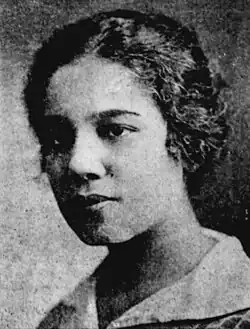
Beatrice Morrow Cannady (January 9, 1890 – August 19, 1974)[1] born Beatrice Hulon Morrow,[1] was a renowned civil rights advocate in early 20th-century Oregon, United States. She was editor of the Advocate, the state's largest African-American newspaper.[2] She also co-founded the Portland, Oregon chapter of the NAACP[3][4] in 1913,[5] where she served as vice-president.
Early life
Cannady was born Beatrice Hulon Morrow in Littig, Texas in 1890.[6] She was the second-oldest daughter of George Morrow and Mary Francis Carter Morrow, farmers who raised their children to value education.[6] They had twelve surviving children; eleven daughters and one son.[6] Morrow enjoyed singing from an early age. Beatrice graduated from Wiley College.[7] As a young woman, she moved to Chicago to study music with conductor David Clippinger.
Career and civil rights

In June 1912, Beatrice Morrow married Edward Daniel Cannady.[7][8] He was the co-founder of The Advocate, one of Portland, Oregon's first black-owned newspapers.[8] The two had written to each other while Morrow was living in Chicago.[8] Upon moving to Portland, Cannady became associate editor of The Advocate.[8] Her work through the newspaper drew attention to racial violence during the early 1920s and prompted a statement from Governor Ben W. Olcott decrying the actions of the Ku Klux Klan, which was spreading through Oregon at the time.
In addition to her editorial work, Cannady helped to establish the Portland chapter of the NAACP in 1913. This organization marked the first such branch of the organization formed west of the Mississippi River[9] and continues to actively participate in the Portland community. Acting as the chapter's secretary, Cannady worked with the group to remove racist, exclusionary language from Oregon's constitution, a mission which succeeded in 1926 and 1927 when the changes were ratified.[10] Cannady also led protests against Ku Klux Klan propaganda film The Birth of a Nation.[2]
Cannady also worked towards reforms in prisons and the justice system as well as speaking out against war and militarism.[11]
Cannady's involvement with the Bahá'í Faith can be dated to 1914/1915,[12] though the Mangun biography dates her official affiliation to 1928, apparently the earliest available membership list of the Portland community.[8]: pp116, 261
Cannady graduated from Northwestern College of Law, now known as Lewis and Clark Law School,[13] in 1922, making her the first black woman to graduate from law school in Oregon.[14] She went on to become the first black woman to practice law in Oregon.[15] A Republican, she was the first black woman to run for state representative.[14] Cannady successfully advocated for the passage of civil rights bills by the Oregon state legislature. Her efforts helped integrate public schools in Longview, Washington and Vernonia, Oregon.[2]
Nationwide trip
In 1927, Cannady represented Oregon at the 4th annual Pan-African Congress in New York City, a major trip,[16] for which she wrote a series of 9 columns of her trip to the east and her visits along the way as well as the conference itself:
- She begins with visits and receptions before she left, then going north by train and boat, visiting in Seattle and Vancouver, across the Canadian Rockies, and then stopping in Minneapolis, Minnesota, before arriving in Chicago.[17]
- She stayed a few days in Chicago with some receptions, mentioning previous stays and friends in the city, visiting the Chicago Bee, and The Chicago Defender, meeting its publisher, Robert Abbott, and other establishments, before leaving for Detroit.[18] The Defender offered its own article on her visit.[19]
- She arrived unannounced in Detroit, but connected with friends and then to others for receptions, visiting the National Medical Association conference just starting, and a chance to interview Ossian Sweet, who told of the violence against his home, before setting off to the environs of the Niagara Falls.[20]
- She arrived in the early morning to see the Falls, before going into Buffalo to visit American activist Mary B. Talbert and family, and various institutions and monuments, before going to Portsmouth, NH, where she was greeted by Louis G. Gregory and others coming from Green Acre Bahá'í School.[21]
- There was a peace conference going on at the school upon arrival, where she spoke on the Pan-African Congress, and was asked to extend her comments in a second talk, which inspired some like Sadie and Mabry Oglesby to go to the congress. At the school, she also had a chance to visit with Mrs. Gregory (the Gregorys were an inter-racial marriage), Horace Holley, May Maxwell and her daughter, before heading to Boston.[22] There was extended coverage of the peace conference in the previous week's Advocate not under any by-line,[23] as well as recommendation of its magazine, an issue of which arrived at the offices of the newspaper.[24]
- She picks up her series arriving in New York August 21, where she was greeted by peace advocates and others, was urgent to see Harlem, and was there to hear the formal greetings at the Pan-African Congress on its first events.[25] The next day started with a talk by Coralie Franklin Cook, followed by many others including Dantès Bellegarde from Haiti. Her own message to the conference was read to the audience, as well as that of her Oregon Governor, Isaac Patterson; she saw an exhibit by the Schomburg Center, and there was a session given by educator Leslie Pinckney Hill, among many others. Coverage in The Advocate continued the next week.[26] Coverage began with W. E. B. DuBois's talk followed by many others. She mentions that various journalists sought her out to interview because of her inter-racial "Tea" gatherings in Portland, and later comments on visiting a mixed-race audience at a Black cabaret.
- She picks up in a third part of just the conference in the next edition of The Advocate.[27] She visited many places again, including Greenwich Village, the offices of The Crisis, with more receptions and opportunities.
- The next part of her series was published the second week of November.[28] She devotes almost the whole 9th column with meeting up with Roy Wilhelm, again, from two years previous in San Francisco, and going to his log cabin, itself working as a retreat for another Bahá'í meeting, this time hosting one on "Race Amity", at which she spoke, which she presents as quoted through another newspaper. Another local paper also noted it, though misspelling her name.[29] She intended a 10th part of the series but was too busy with a Portland-hosted local "Pan-African" conference.[30]
Personal life
Beatrice Morrow Cannady married Edward Cannady in Portland, Oregon in June 1912. The couple had two sons, George Cannady and Ivan Caldwell Cannady.[31] They divorced in 1930 after 18 years of marriage.[31] A year later, Mrs. Cannady married Jerome Yancy Franklin, a typist at The Advocate.[31]
Cannady and Franklin left Oregon in about 1938[14] for Los Angeles, California. They divorced about 1942. Cannady married Reuben Taylor on December 17, 1946. Cannady worked for the Precinct Reporter,[14] a Southern California newspaper founded in 1965 that served the black community. Mr. Taylor died in June 1972.[32]
Legacy
Cannady paved the way for the second generation of civil rights activists in Oregon with her nearly 25-year fight as a leading activist.[33][34] To honor her history in the area, a new school in the North Clackamas School District bears her name as the Beatrice Morrow Cannady Elementary School.[35] An affordable housing project in North Portland is named the Beatrice Morrow Building in her honor.[36]
See also
References
- 1 2 Kimberley Mangun, "A Force for Change: Beatrice Morrow Cannady's Program for Race Relations in Oregon, 1912-1936," Pacific Northwest Quarterly 96(2)(Spring 2005):
- 1 2 3 "Beatrice Morrow Cannady". The Oregon Encyclopedia.
- ↑ Prince, Tracy J.; Schaffer, Zadie (2017). Notable women of Portland. Charleston, South Carolina. ISBN 9781467125055. OCLC 972387080.
{{cite book}}: CS1 maint: location missing publisher (link) - ↑ Shirley, Gayle C. (2010). More than Petticoats: Remarkable Oregon Women (2nd ed.). Guilford, Conn.: Globe Pequot Press. ISBN 978-0762758661.
- ↑ Boddie, Ken (7 November 2022). "'Say her name': The legacy of Beatrice Morrow Cannady". KOIN 6 News. Archived from the original on 7 February 2025. Retrieved 17 April 2026.
- 1 2 3 Mangun, Kimberly (2010). A Force For Change. Corvallis, Oregon: Oregon State University Press. p. 5. ISBN 978-0-87071-580-8.
- 1 2 "Wedding Bells". The Editor and Publisher. July 13, 1912.
- 1 2 3 4 5 Mangun, Kimberly (2010). A Force For Change. Corvallis, Oregon: Oregon State University Press. pp. 11–12. ISBN 978-0-87071-580-8.
- ↑ Millner, Darrell. "Blacks in Oregon". The Oregon Encyclopedia.
- ↑ Unknown. "Portland Chapter NAACP 50th Anniversary". Oregon History Project. Archived from the original on 2019-02-09. Retrieved 2019-02-09.
- ↑ "State of Oregon: Woman Suffrage - Beatrice Morrow Cannady (1889-1974)". sos.oregon.gov. Retrieved 2026-04-17.
- ↑ Christopher Buck (4 December 2018). "The Baha'i 'Pupil of the Eye' metaphor". In Loni Bramson (ed.). The Bahá'í Faith and African American History: Creating Racial and Religious Diversity. Lexington Books. pp. 20, 47. ISBN 978-1-4985-7003-9. OCLC 1098186570. Archived from the original on 4 April 2023. Retrieved 25 May 2022.
- ↑ "A voice for the people: Beatrice Morrow Cannady's impact as a pioneering journalist in Oregon". kgw.com. 2024-02-13. Retrieved 2026-04-17.
- 1 2 3 4 Mangun, Kimberley (2011-09-10). "Beatrice Morrow Cannady and the Struggle for Civil Rights in Oregon, 1912-1936". BlackPast. Archived from the original on 2020-03-01. Retrieved 2020-03-01.
- ↑ Mangun, Kimberley Ann (2010). Beatrice Morrow Cannady & the Struggle for Civil Rights in Oregon, 1912-1936. Corvallis, Or. : Oregon State University Press. ISBN 9780870715808.
- ↑ Wagner, MaryJo (1984). Women In History Week. Salem, OR: Oregon Department of Education. p. 101.
- ↑ Cannady, Mrs E. D. (September 24, 1927). "The Associate Editor; Tells of Her Trip East (part 1)". The Advocate. Portland, OR. p. 2. Retrieved Aug 15, 2026 – via Oregon Digital Newspaper Program, University of Oregon Libraries.
- ↑ Cannady, Mrs E. D. (October 1, 1927). "The Associate Editor; Tells of Her Trip East (part 2)". The Advocate. Portland, OR. p. 3. Retrieved Aug 15, 2026 – via Oregon Digital Newspaper Program, University of Oregon Libraries.
- ↑ "Mrs. Cannady Sees End of Race Trouble". The Chicago Defender. Chicago, IL. Aug 20, 1927. p. 2. Retrieved Aug 15, 2026 – via Newspapers.com.
- ↑ Cannady, Mrs E. D. (October 8, 1927). "The Associate Editor; Tells of Her Trip East (part 3)". The Advocate. Portland, OR. p. 3. Retrieved Aug 15, 2026 – via Oregon Digital Newspaper Program, University of Oregon Libraries.
- ↑ Cannady, Mrs E. D. (October 15, 1927). "The Associate Editor; Tells of Her Trip East (part 4)". The Advocate. Portland, OR. p. 2. Retrieved Aug 15, 2026 – via Oregon Digital Newspaper Program, University of Oregon Libraries.
- ↑ Cannady, Mrs E. D. (October 22, 1927). "The Associate Editor; Tells of Her Trip East (part 5)". The Advocate. Portland, OR. p. 4. Retrieved Aug 15, 2026 – via Oregon Digital Newspaper Program, University of Oregon Libraries.
- ↑ "Make World Unity Inst. Permanent School". The Advocate. Portland, OR. October 15, 1927. pp. 1, 3. Retrieved Aug 15, 2026 – via Oregon Digital Newspaper Program, University of Oregon Libraries.
- ↑ "World Unity". The Advocate. Portland, OR. October 22, 1927. p. 3. Retrieved Aug 15, 2026 – via Oregon Digital Newspaper Program, University of Oregon Libraries.
- ↑ Cannady, Mrs E. D. (October 22, 1927). "The Associate Editor; Tells of Her Trip East (part 6)". The Advocate. Portland, OR. p. 4. Retrieved Aug 15, 2026 – via Oregon Digital Newspaper Program, University of Oregon Libraries.
- ↑ Cannady, Mrs E. D. (November 5, 1927). "The Associate Editor; Tells of Her Trip East (part 7)". The Advocate. Portland, OR. p. 4. Retrieved Aug 15, 2026 – via Oregon Digital Newspaper Program, University of Oregon Libraries.
- ↑ Cannady, Mrs E. D. (November 19, 1927). "The Associate Editor; Tells of Her Trip East (part 8)". The Advocate. Portland, OR. p. 4. Retrieved Aug 15, 2026 – via Oregon Digital Newspaper Program, University of Oregon Libraries.
- ↑ Cannady, Mrs E. D. (November 19, 1927). "The Associate Editor; Tells of Her Trip East (part 9)". The Advocate. Portland, OR. p. 4. Retrieved Aug 15, 2026 – via Oregon Digital Newspaper Program, University of Oregon Libraries.
- ↑ "Interesting Session of Baha'i Members". The Record. Hackensack, NJ. Aug 29, 1927. p. 6. Retrieved Aug 16, 2026 – via Newspapers.com.
- ↑ "Associate Editor Thanks". The Advocate. Portland, OR. November 26, 1927. p. 3. Retrieved Aug 15, 2026 – via Oregon Digital Newspaper Program, University of Oregon Libraries.
- 1 2 3 Mangun, Kimberly (2010). A Force For Change. Corvallis, Oregon: Oregon State University Press. pp. 30–35. ISBN 978-0-87071-580-8.
- ↑ "About". Precinct Reporter Group News. Retrieved 2020-03-01.
- ↑ Mangun, Kimberley (2010). A Force for Change. Corvallis, Oregon: Oregon State University Press. p. 194. ISBN 978-0-87071-580-8.
- ↑ Mangun, Kimberley (2010). A Force for Change. Corvallis, Oregon: Oregon State University Press. p. 142. ISBN 978-0-87071-580-8.
- ↑ Gutierrez, Simon. "North Clackamas School District struggles to name new high school in Happy Valley". Fox 12 Oregon. Archived from the original on 2019-01-29. Retrieved 2019-02-09.
- ↑ Basalyga, Stephanie (23 November 2018). "Beatrice building offers 80 units of affordable housing". Portland Tribune. Archived from the original on 12 April 2019. Retrieved 12 April 2019.
External links
- Oregon Experience television episode about Beatrice Morrow Cannady
- A Force for Change a book about Beatrice Morrow Cannady
External links
- Beatrice Morrow Cannady Archived 2017-09-16 at the Wayback Machine Documentary produced by Oregon Public Broadcasting
- "First Colored Woman Lawyer in the Northwest". The Oregon Daily Journal. June 5, 1922.
- 1889 births
- 1964 deaths
- American women civil rights activists
- 20th-century African-American women politicians
- 20th-century African-American politicians
- 20th-century American women politicians
- American women in World War I
- African-American people in Oregon politics
- Activists for African-American civil rights
- Civil rights activists from Oregon
- Lawyers from Portland, Oregon
- Activists from Portland, Oregon
- People from Travis County, Texas
- African-American history in Portland, Oregon
- African-American history of Oregon
- 20th-century American lawyers
- 20th-century American women lawyers
- 20th-century African-American lawyers
- African-American women lawyers