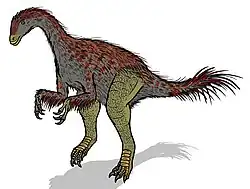
Fossil content
|
|
|
Color key
|
|
Notes
Uncertain or tentative taxa are in small text; crossed out taxa are discredited. |
References
- ↑ Xu, Xing; Tan, Qingwei; Gao, Yilong; Bao, Zhiqiang; Yin, Zhigang; Guo, Bin; Wang, Junyou; Tan, Lin; Zhang, Yuguang; Xing, Hai (2018). "A large-sized basal ankylopollexian from East Asia, shedding light on early biogeographic history of Iguanodontia". Science Bulletin. 63 (9): 556–563. Bibcode:2018SciBu..63..556X. doi:10.1016/j.scib.2018.03.016. PMID 36658842. S2CID 104031324.
- ↑ Godefroit, P.; Li, H.; Shang, C.-Y. (2005). "A new primitive hadrosauroid dinosaur from the Early Cretaceous of Inner Mongolia (P.R. China)". Comptes Rendus Palevol. 4 (8): 697–705. Bibcode:2005CRPal...4..697G. doi:10.1016/j.crpv.2005.07.004.
- ↑ Sereno, P. C.; Xijin, Z.; Lin, T. (2009). "A new psittacosaur from Inner Mongolia and the parrot-like structure and function of the psittacosaur skull". Proceedings of the Royal Society B. 277 (1679): 199–209. doi:10.1098/rspb.2009.0691. PMC 2842669. PMID 19535376.
- ↑ Russell, D. A.; Dong, Z. (1993). "The affinities of a new theropod from the Alxa Desert, Inner Mongolia, People's Republic of China". Canadian Journal of Earth Sciences. 30 (10): 2107−2127. Bibcode:1993CaJES..30.2107R. doi:10.1139/e93-183.
- ↑ Xu, Xing; Choiniere, Jonah; Tan, Qingwei; Benson, Roger B.J; Clark, James; Sullivan, Corwin; Zhao, Qi; Han, Fenglu; Ma, Qingyu; He, Yiming; Wang, Shuo; Xing, Hai; Tan, Lin (2018). "Two Early Cretaceous Fossils Document Transitional Stages in Alvarezsaurian Dinosaur Evolution". Current Biology. 28 (17): 2853–2860. doi:10.1016/j.cub.2018.07.057. PMID 30146153.
- ↑ Pittman, M.; Pei, R.; Tan, Q.; Xu, X. (2015). "The first dromaeosaurid (Dinosauria: Theropoda) from the Lower Cretaceous Bayan Gobi Formation of Nei Mongol, China". PeerJ. 3 e1480. doi:10.7717/peerj.1480. PMC 4675113. PMID 26664809.