Battōtai (song)
| English: Drawn-Sword Regiment | |
|---|---|
March of the Japan Ground Self-Defense Force (as the "Army March") | |
| Lyrics | Toyama Masakazu, 1882 |
| Music | Charles Leroux, 1887 |
| Published | 1887 |
| Audio sample | |
Recording made on August 8, 1939, by the Imperial Japanese Army Band conducted by Ōnuma Satoru. The B and C sections of the march use the "Battōtai" melody.
| |
"Battōtai" (抜刀隊; lit. 'Drawn-Sword Regiment') is a Japanese gunka whose lyrics come from a poem written by Toyama Masakazu in 1882 and whose melody was composed by the bandmaster of the Imperial Japanese Army Band, Charles Leroux, in 1887. The song was based on the Battle of Tabaruzaka,[1] and the poem that made up the lyrics was inspired by the 1854 English poem "The Charge of the Light Brigade".[2] A variation of the song, titled "Army March," has served as the march of the Japan Ground Self-Defense Force (JGSDF) since 2007.[3]
Background
The song references the Battōtai, who fought in the Battle of Tabaruzaka during the 1877 Satsuma Rebellion. Due to supply problems and heavy rain, the Satsuma rebels were forced to engage with the Imperial Japanese Army (IJA) in hand-to-hand combat. The Satsuma rebels inflicted heavy casualties against Imperial forces, who were mostly conscripts with no experience in wielding swords. Lieutenant General Yamagata Aritomo selected and deployed men from the surrounding area who were proficient with swords. He named this unit the Battōtai, or "Drawn-Sword regiment."[4]
History


The song's lyrics were originally a poem[5] written by Toyama Masakazu.[6] Toyama had been inspired by the English poem "The Charge of the Light Brigade" by Alfred, Lord Tennyson, which he had translated.[2] He published "Poem of the Battōtai" in book Selection of Poetry in the New Style[7] (『新体詩抄』),[8] published 1882.[8] Despite the name of the book, Toyama's poem was written in the "old style". The poem gained immediate popularity amongst boys and young men.[5] The genre of gunka, the Japanese term for military music, gives a favorable bias towards themes of death.[9]
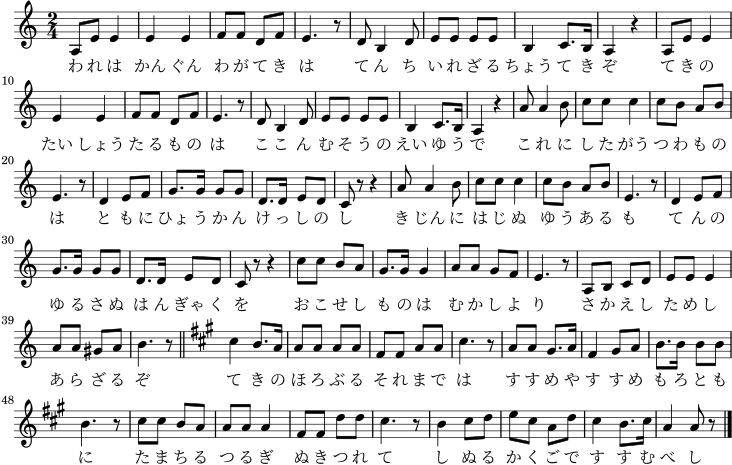
Charles Leroux, a French bandmaster and composer, arrived in Japan in 1876 as part of a French military advisory group.[10] He composed a melody for "Battōtai" in 1887[5] that used both major and minor keys[11] while he served as bandmaster of the Imperial Japanese Army Band.[10]
"Battōtai" was first publicly performed the same year at a concert hosted by the Greater Japan Music Society at the Rokumeikan. It was considered the first Western-style military song in Japan and the first to become popular across the country, although it was initially believed to be difficult to sing for Japanese individuals unaccustomed to modulation.[10][12]
Variations
Army March
Leroux took the tune of "Battōtai" and another one of his songs, "Fusōka", and created an arrangement called the "Army March". It was used as the official march of the IJA and was used to announce military successes during World War II.[13] The march is still part of the repertoire of the military bands of the Japan Self-Defense Forces and the National Police Agency.[14] It has been the march of the JGSDF since 2007.[3]
Others
The song's tune was borrowed for a song titled "The Normanton Sinks Beneath the Waves", written after the English ship Normanton sank off the coast of Japan.[11] The tune was also used for a wide variety of songs, including "The Voice of the Pines," "The Tsingtao Motif," "Naramaru's Chaos," "The Ancient Moon and Flower," and "First Comes Ichinomiya Shrine."[14]
Lyrics
| Japanese[15] | Transliteration into rōmaji[16] |
|---|---|
我は官軍我敵は |
Ware wa kangun waga teki wa |
Score
References
- ↑ Kotō, Masayoshi (1987). 西南戦争警視隊戦記 [The Seinan War Police Chronicles] (in Japanese). 産経新聞データシステム (Sankei Shimbun Data System). pp. 221–222.
- 1 2 Keene, Donald (1999). "Poetry in New Forms". Dawn to the West: Japanese Literature of the Modern Era. Vol. 4. New York: Columbia University Press. p. 197. ISBN 0-231-11438-9. Retrieved 31 October 2025.
- 1 2 "平成19年度 自衛隊観閲式" [FY2007 Self-Defense Forces Review Ceremony]. WAC. Retrieved 3 November 2025.
- ↑ Kotō, Masayoshi (1987). 西南戦争警視隊戦記 [The Seinan War Police Chronicles] (in Japanese). 産経新聞データシステム (Sankei Shimbun Data System). pp. 221–222.
- 1 2 3 Takeshi Kodama. Popular Song of the Meiji Era: A Study of Hayariuta and the Nature of Their Popularity Based on Song Collections in the Kindai Digital Library, thesis for University of New England, 2010, pp. 92—94
- ↑ Shively, Donald H., ed. (1971). "IV. The Sino-Japanese War of 1894-1895 and Its Cultural Effects on Japan". Tradition and Modernization in Japanese Culture. Princeton University Press. p. 134. ISBN 0-691-00020-4. Retrieved October 31, 2025.
- ↑ Takeshi Kodama. Popular Song of the Meiji Era: A Study of Hayariuta and the Nature of Their Popularity Based on Song Collections in the Kindai Digital Library thesis for University of New England, 2010, pp. 92—94
- 1 2 Yon, Grace E. (2014). Creating a New Liter eating a New Literature: Shimazaki Toson's Poetry and the Japanese Literary Reform Movement. ScholarWorks at University of Montana. p. 14. Retrieved 31 October 2025.
- ↑ Paloniemi, Joonas. "Discussion". Nationalism through Song in Postwar Japan (PDF). p. 49. Retrieved 31 October 2025.
- 1 2 3 Kurata, Yoshihiro. 民衆歌謡:近世末期から近代への流れ [Folk Songs: From the Late Early Modern Period to the Modern Era]. 岩波講座 日本の音楽・アジアの音楽 (Iwanami Lectures on Japanese and Asian Music) (in Japanese). Tokyo: Tokyo Shoseki. pp. 153–159. ISBN 4000103628.
- 1 2 May, Elizabeth (1963). The influence of the Meiji period on Japanese children's music. University of California Press. p. 41. Retrieved October 31, 2025.
- ↑ Sugita, Satoshi (1972). Cherry blossoms and rising sun – a systematic and objective analysis of Gunka (Japanese war songs) in five historical periods (1868-1945) (Master of Arts thesis). Ohio State University. pp. 23–24.
- ↑ Ikuro, Anzai (April 2008). 10万人が殺された日 東京大空襲と北海道・東北の空襲 [The Day 100,000 People Were Killed: The Great Tokyo Air Raid and the Air Raids in Hokkaido and Tohoku] (in Japanese). New Japan Publishing. ISBN 9784406051330.
- 1 2 "Баттотай" [Battotai]. www.nihongunka.com (in Russian). Retrieved 2025-11-03.
- ↑ Toyama, Masakazu (August 1882). Shintai Shisho, first edition 新体詩抄 初編 (in Japanese). Maruya Zenshichi. pp. 19–22.
我は官軍我敵は
- ↑ "Japanese Military & Patriotic Songs – 抜刀隊". LyricsTranslate.com. January 26, 2024. Retrieved October 31, 2025.