Bathypterois dubius
| Bathypterois dubius | |
|---|---|
 | |
Scientific classification  | |
| Kingdom: | Animalia |
| Phylum: | Chordata |
| Class: | Actinopterygii |
| Division: | Teleostei |
| Order: | Aulopiformes |
| Family: | Ipnopidae |
| Genus: | Bathypterois |
| Species: | B. dubius |
| Binomial name | |
| Bathypterois dubius Vaillant, 1888 | |

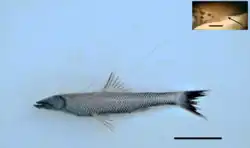
Bathypterois dubius, the Mediterranean spiderfish, a lizardfish of the family Ipnopidae (tripod fishes), is found in the northern Atlantic[2] as well as the Mediterranean.[3] It reaches a length of 20.5 centimetres (8.1 in) SL. Like other species in its family, the Mediterranean spiderfish is hermaphroditic. It is solitary in nature and feeds on mysids and copepods.[2]
Description
Morphology
The Mediterranean spiderfish, like other tripod fish, has an elongate body with an array of detached pectoral fin rays, the top two of which are modified in such a way that they are elongated, parting near the tip. The pelvic fins are long and stiffened, allowing it to sit and wait atop the seafloor, like other members of its genus.
Its coloration has been described as black[4] with fins in preserved specimens being transparent or dusky, though may have been black in life. Its caudal fin is black. It has 15-16 dorsal fin rays, 8-10 anal fin rays, 8 pelvic fin rays, and 11-13 pectoral fin rays.[3]
Its eyes and pineal organs are significantly reduced, which has been compared to the blind cavefish, Typhlichthys subterraneus.[5] In contrast, they have well-developed lateral lines and "voluminous" areas of the brain associated with gustatory functions, which are connected to their pectoral fin rays which may house taste buds.[6]
Behavior
B. dubius inhabits the deep sea akin to its congeners, and has been observed at depths of 2,900 metres (9,500 ft) in the Eastern Mediterranean.[7] Typical of its genus, it is a sit-and-wait predator, "standing" on its elongated fins which form a tripod.[8] In commercial fishing operations the species is occasionally caught as bycatch,[9] but this may not have a significant impact on its populations, at least in the northeast Atlantic.
Taxonomy
Bathypterois mediterraneus is considered to be a junior synonym of Bathypterois dubius. It was named in 1962 by M. L. Bauchot,[10] citing differences in morphology. However, the species status was later rescinded after the differences in morphology were determined to be insufficient for describing a new species.[4]
Common name
The common name "Snoutlet crotchfeeler" was coined by D. E. McAllister in his 1990 book, A List of the Fishes of Canada.[11] McAllister created common names for deep-sea fish, which are unlikely to have day-to-day use, and they subsequently appeared in Encyclopedia of Canadian Fishes (1995) by Brian W. Coad.[12] In a review of Coad's book, Erling Holm criticized some of the deep-sea fish names coined by McAllister, like canopener smoothdream and doormat parkinglotfish, as "unnecessarily complex, easily misspelled, or downright silly" — and wrote that snoutlet crotchfeeler "violates the tenets of good taste".[13][14] Holm noted that many of the names coined by McAllister did not meet the criteria set by the Committee on Names of Fish.[13]
References
- ↑ Russell, B.; Poss, S.; Bannermann, P.; Nunoo, F. (2015). "Bathypterois dubius". IUCN Red List of Threatened Species. 2015 e.T13462751A15603190. doi:10.2305/IUCN.UK.2015-4.RLTS.T13462751A15603190.en. Retrieved 29 May 2026.
- 1 2 Froese, Rainer; Pauly, Daniel (eds.). "Bathypterois dubius". FishBase. January 2026 version.
- 1 2 Sulak, Kenneth J. (January 1977). "The systematics and biology of Bathypterois (Pisces, Chlorophthalmidae) with a revised classification of benthic myctophiform fishes". Galathea Report. 14: 049–108.
- 1 2 Capapé, Christian; Rafrafi-Nouira, Silhem; Reynaud, Christian; Golani, Daniel (15 September 2019). "First record of the Mediterranean spiderfish, Bathypterois dubius (Actinopterygii: Scopeliformes: Ipnopidae), from the Tunisian coast (central Mediterranean Sea)". Acta Ichthyologica et Piscatoria. 49: 283–285. doi:10.3750/AIEP/02627.
- ↑ Wagner, h.-j.; Mattheus, U. (14 November 2001). "Pineal organs in deep demersal fish". Cell and Tissue Research. 307 (1): 115–27. doi:10.1007/s00441-001-0482-y. PMID 11810319.
- ↑ Wagner, H.-J. (June 2001). "Brain areas in abyssal demersal fishes". Brain, Behavior and Evolution. 57 (6): 301–316. doi:10.1159/000047249. PMID 11713385.
- ↑ Danovaro, Roberto; Company, Joan Batista; Corinaldesi, Cinzia; d'Onghia, Gianfranco; Galil, Bella; Gambi, Cristina; Gooday, Andrew J.; Lampadariou, Nikolaos; Luna, Gian Marco; Morigi, Caterina; Olu, Karine; Polymenakou, Paraskevi; Ramirez-Llodra, Eva; Sabbatini, Anna; Sardà, Francesc; Sibuet, Myriam; Tselepides, Anastasios (2 August 2010). "Deep-Sea Biodiversity in the Mediterranean Sea: The Known, the Unknown, and the Unknowable". PLOS ONE. 5 (8) e11832. Bibcode:2010PLoSO...511832D. doi:10.1371/journal.pone.0011832. PMC 2914020. PMID 20689848.
- ↑ Ayma, A.; Aguzzi, J.; Canals, M.; Lastras, G.; Bahamon, N.; Mecho, A.; Company, J.B. (27 May 2016). "Comparison between ROV video and Agassiz trawl methods for sampling deep water fauna of submarine canyons in the Northwestern Mediterranean Sea with observations on behavioural reactions of target species". Deep-Sea Research. 114: 149–159. Bibcode:2016DSRI..114..149A. doi:10.1016/j.dsr.2016.05.013. hdl:2445/101864. Retrieved 30 January 2026.
- ↑ "Discarded Biomass in the Moroccan Mediterranean Trawl Fisheries: Species Composition Dynamics and Spatio-Temporal Analysis" (PDF). Egyptian Journal of Aquatic Biology & Fisheries. 28 (5). 1 September 2024. ISSN 1110-6131. Retrieved 30 January 2026.
- ↑ Bauchot, Marie Louise (21 June 1962). "Description d'un nouveau Bathypterois méditerranéen (Poisson clupéiforme de la famille des Bathypteroidae). Affinités et remarques sur plusieurs espèces du genre" [Description of a new Mediterranean Bathypterois (Culpeiform fish of the Bathypteroidae family). Affinities and remarks on several species of the genus] (PDF). Vie et Milieu (in French).
- ↑ McAllister, D. E. (1990). A list of the fishes of Canada. Ottawa: National Museum of Natural Sciences. ISBN 0-660-13055-6. OL 1956338M.
- ↑ Coad, Brian W. (1995). Encyclopedia of Canadian Fishes. Ottawa: Canadian Museum of Nature & Canadian Sportsfishing Production Inc.
- 1 2 Erling, Holm (1998). "Encyclopedia of Canadian Fishes". The Canadian Field-Naturalist. 112 (1): 174–175. doi:10.5962/p.358375. Retrieved 16 March 2025.
- ↑ Page, Lawrence M.; Bemis, Katherine E.; Dowling, Thomas E.; Espinosa-Pérez, Héctor S.; Findley, Lloyd T.; Gilbert, Carter R.; Hartel, Karsten E.; Lea, Robert N.; Mandrak, Nicholas E.; Neighbors, Margaret A.; Schmitter-Soto, Juan J.; Walker, H. J., eds. (September 27, 2023). Common and Scientific Names of Fishes from the United States, Canada, and Mexico (8th ed.). American Fisheries Society. doi:10.47886/9781934874691. ISBN 978-1-934874-69-1. Retrieved 16 March 2025.