Barnes–Wall lattice


In mathematics, the Barnes–Wall lattice , discovered by Eric Stephen Barnes and G. E. (Tim) Wall,[1] is the 16-dimensional positive-definite even integral lattice of discriminant 28 with no norm-2 vectors. It is the sublattice of the Leech lattice fixed by a certain automorphism of order 2, and is analogous to the Coxeter–Todd lattice.[2]
The automorphism group of the Barnes–Wall lattice has order 89181388800 = 221 35 52 7 and has structure 21+8 PSO8+(F2). There are 4320 vectors of norm 4 in the Barnes–Wall lattice (the shortest nonzero vectors in this lattice).
The genus of the Barnes–Wall lattice was described by Scharlau & Venkov (1994) and contains 24 lattices; all the elements other than the Barnes–Wall lattice have root system of maximal rank 16.[3]
While Λ16 is often referred to as the Barnes-Wall lattice, their original article in fact construct a family of lattices of increasing dimension n=2k for any integer k, and increasing normalized minimal distance, namely n1/4. This is to be compared to the normalized minimal distance of 1 for the trivial lattice , and an upper bound of given by Minkowski's theorem applied to Euclidean balls. This family comes with a polynomial time decoding algorithm.[4]


Generating matrix
The generator matrix for the Barnes-Wall Lattice is given by the following matrix:

For example, the lattice generated by the above generator matrix has the following vectors as its shortest vectors.

The lattice spanned by the following matrix is isomorphic to the above. Indeed, the following generator matrix can be obtained as the dual lattice (up to a suitable scaling factor) of the above generator matrix.
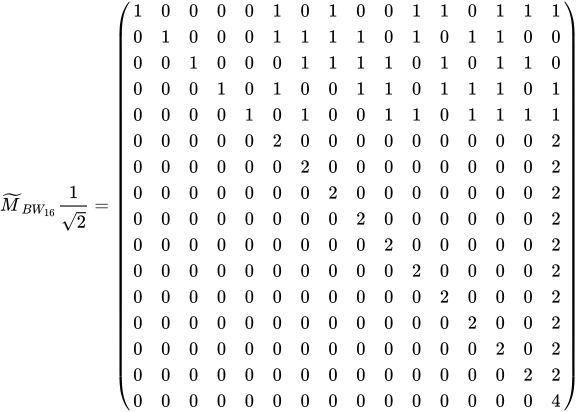
Simple Construction of a Generating Matrix
According to (Nebe, Rains & Sloane 2002), the generator matrix of can be constructed in the following way.[5]
First, define the matrix Next, take its 4th tensor power: Then, apply the homomorphism of Abelian groups entrywise to the matrix . The resulting integer matrix is a generator matrix for the Barnes–Wall lattice .[5]




Lattice theta function
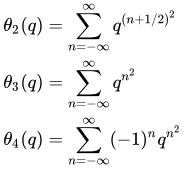
The lattice theta function for the Barnes Wall lattice is known as where the thetas are Jacobi theta functions:

The number of vectors of each norm in the
The number of vectors of norm , as classified by J. H. Conway,[6] is given as follows.


| m | N(m) | m | N(m) |
|---|---|---|---|
| 0 | 1 | 32 | 8593797600 |
| 2 | 0 | 34 | 11585617920 |
| 4 | 4320 | 36 | 19590534240 |
| 6 | 61440 | 38 | 25239859200 |
| 8 | 522720 | 40 | 40979580480 |
| 10 | 2211840 | 42 | 50877235200 |
| 12 | 8960640 | 44 | 79783021440 |
| 14 | 23224320 | 46 | 96134307840 |
| 16 | 67154400 | 48 | 146902369920 |
| 18 | 135168000 | 50 | 172337725440 |
| 20 | 319809600 | 52 | 256900127040 |
| 22 | 550195200 | 54 | 295487692800 |
| 24 | 1147643520 | 56 | 431969276160 |
| 26 | 1771683840 | 58 | 487058227200 |
| 28 | 3371915520 | 60 | 699846624000 |
| 30 | 4826603520 | 62 | 776820326400 |
Notes
- ↑ Barnes & Wall (1959).
- ↑ Conway & Sloane (1999), section 4.10.
- ↑ Scharlau & Venkov (1994).
- ↑ Micciancio & Nicolosi (2008).
- 1 2 Nebe, Rains & Sloane (2002).
- ↑ Conway & Sloane (1999), p. 130.
References
- Barnes, E. S.; Wall, G. E. (1959), "Some extreme forms defined in terms of Abelian groups", J. Austral. Math. Soc., 1 (1): 47–63, doi:10.1017/S1446788700025064, MR 0106893
- Conway, John Horton; Sloane, Neil J. A. (1999), Sphere Packings, Lattices and Groups, Grundlehren der Mathematischen Wissenschaften, vol. 290 (3rd ed.), Berlin, New York: Springer-Verlag, ISBN 978-0-387-98585-5, MR 0920369
- Scharlau, Rudolf; Venkov, Boris B. (1994), "The genus of the Barnes–Wall lattice.", Comment. Math. Helv., 69 (2): 322–333, CiteSeerX 10.1.1.29.9284, doi:10.1007/BF02564490, MR 1282375
{{citation}}: Cite uses deprecated parameter|citeseerx=(help) - Micciancio, Daniele; Nicolosi, Antonio (2008), "Efficient bounded distance decoders for Barnes-Wall lattices", 2008 IEEE International Symposium on Information Theory, pp. 2484–2488, doi:10.1109/ISIT.2008.4595438, ISBN 978-1-4244-2256-2
- Nebe, G.; Rains, E. M.; Sloane, N. J. A. (2002). "A Simple Construction for the Barnes-Wall Lattices". arXiv:math/0207186.
External links
- Barnes–Wall lattice – Sloane's lattice catalog