Bardo, Alberta
Bardo | |
|---|---|
Settlement | |
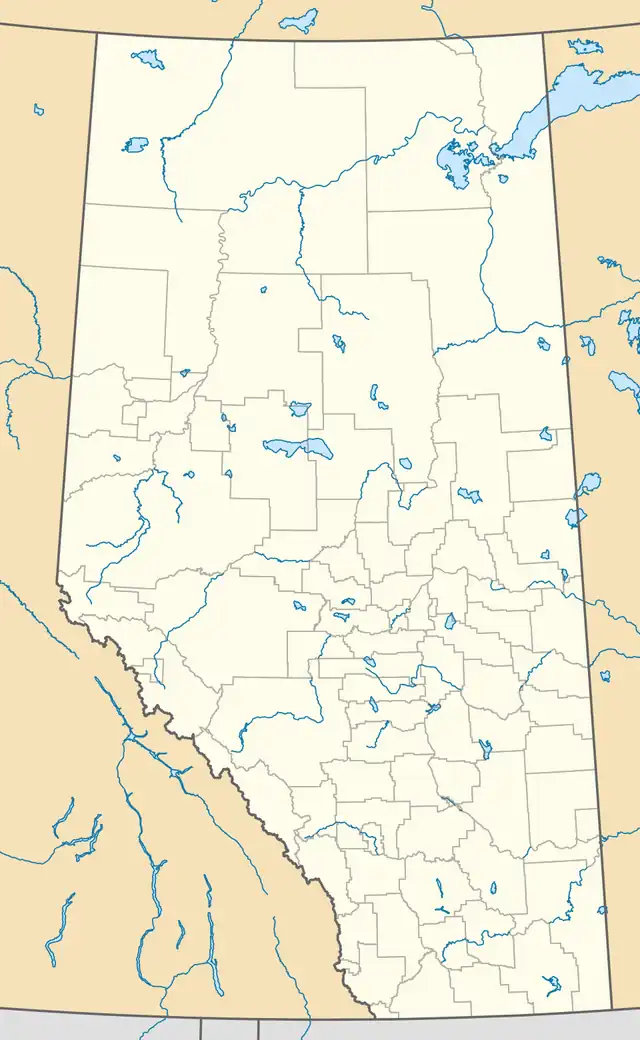  Bardo Location of Bardo in Alberta | |
| Coordinates: 53°18′01″N 112°41′07″W / 53.30014°N 112.68522°W | |
| Country | Canada |
| Province | Alberta |
| Region | Central Alberta |
| Census division | Division No. 10, Alberta |
| County | Beaver County |
| Time zone | MDT |
| Highways | Alberta Highway 834 |
Bardo is a locality in Alberta, Canada.[1] The site is accessible via Range Road 192, two roads removed from Alberta Highway 834.[2][3] It is situated 8 km from Tofield, 10 km from Kingman, and 14 km from Miquelon Lake Provincial Park.[4]
Toponymy
The name was selected by Norwegian residents of the settlement after Bardu Municipality (historically known as Bardo).[5][6]
Topography
Bardo is situated upon gently rolling hills with some slopes.[7] Most of the area's soil is suitable for arable farming, although areas contain natural salt deposits.[7]
History
Pre-settlement
Bardo, as part of the Beaver Hills plain region,[8] served as a hunting ground and rest stop for Indigenous peoples for up to 10,000 years before permanent settlement began.[9][10] Members of the Nakota, Cree, Salteaux, and Blackfoot were among the groups who hunted and accessed water in the area.[9][10]
Founding and development: 1894–1910
Settlement began in 1894, primarily by Norwegian immigrants living in Crookston, Minnesota.[2] In its first year, the locality had 44 residents.[6] In 1895, influential local preacher Reverend Bersvend Anderson formed a Lutheran assembly that would, by 1974, hold the distinction of being the oldest continuing Evangelical Lutheran Church of Canada congregation.[11] In 1896, local families hired an American-born tutor to provide education for children.[12]
In 1898, a post office began serving the community under the name Northern,[13] after English-speaking residents objected to the initial proposed name of 'Norden'.[12] The community built a one-room schoolhouse named Bardo School,[12] so called because a later wave of settlers hailed from Bardo in Norway.[2][6][14] It was also known as Anderson School, after Bersvend Anderson.[12][3][15]
The community also established Bardo Cemetery in 1898,[14] and a general store named the Bardo Store followed in 1902,[6] prompting the Northern post office to change its name to match in 1904.[13][16] By this time, Bardo had a population of at least 113.[6] Bardo Church was built for the area's Lutheran congregation in 1908.[12]
In February 1910, the Grand Trunk Pacific Railway (GTPR) opened a railway station in Bardo as part of the Tofield–Calgary line.[12] The line's opening was attended by Premier Alexander Rutherford, who took a train journey through Bardo.[12] 1910 also saw the establishment of a two-room building for Anderson School,[12] and telephone lines provided by Alberta Government Telephones.[3]
Rest of 20th century: 1911–2000
Bardo post office closed in October 1914, as mail service through nearby Tofield became more convenient.[12][16] The original Bardo Church burned down in 1921 after suffering a lightning strike, and the community built a second the following year.[12] The community received electricity in 1928.[3] After Anderson School closed in 1959, some residents formed the Bardo Recreation Association to purchase the building and repurpose it into a community hall.[3]

Passenger railway services to the locality ended in the mid-1960s due to falling demand.[17] Bardo Church burned down again in 1965, again due to a lightning strike; the church subsequently moved to Tofield.[18][19] By 1969, Bardo's sole remaining "active service", according to Agriculture and Agri-Food Canada, was its Alberta Wheat Pool-operated grain elevator.[20] Bardo received freight rail services to facilitate shipments from the elevator until 1978, when the line was discontinued and its railway tracks removed.[17]
On July 20, 1980, Bardo hosted a reunion for Anderson School, which was attended by over 500 people; of these, 14 were former teachers and 225 were former students.[3] A memorial cairn honouring some of Bardo's earliest settlers was installed near the original townsite in 1989.[3][14] The Bardo Recreation Association organized a committee in 1993 to compile the history of Bardo for the locality's impending centennial.[3] The finished book, Bardo Centennial History, 1894-1994, was published the next year, featuring forewords from Ed Stelmach and Don Mazankowski.[3]
21st century: 2001–present
The Alberta Electric System Operator announced plans in 2015 to increase the transmission capacity of Bardo's substation and its associated transmission lines.[21]
In April 2026, Bardo Recreation Centre received funding from Beaver County to update the building's water and plumbing systems.[22]
Places of interest
As of 2026, Bardo Recreation Centre remains under the management of Bardo Recreation Association.[23] Bardo Cemetery and the Bardo Memorial Cairn can be visited near the original townsite.[14]
Notable residents
- Chester Ronning – teacher and diplomat who lived in Bardo between 1907 and 1913 and attended its school[24][25]
References
- ↑ "Bardo". Geographical Names Data Base. Natural Resources Canada.
- 1 2 3 Alberta Culture (January 2025). "Bardo". Alberta Geographical Names Web Map. Text visible upon selecting yellow circle.
- 1 2 3 4 5 6 7 8 9 Committee, Bardo History Book (1994). Bardo Centennial History, 1894-1994. Bardo History Book Committee. pp. iii–xii, 62–66, 117–118, 125. ISBN 978-1-55056-169-2.
- ↑ Government of Canada, Natural Resources Canada. "Geographical names near Bardo". geonames.nrcan.gc.ca. Retrieved July 15, 2026.
- ↑ Place-names of Alberta. Ottawa: Geographic Board of Canada. 1928. p. 15.
- 1 2 3 4 5 Lovoll, Odd S. (2001). "Canada Fever: The Odyssey of Minnesota's Bardo Norwegians" (PDF). Minnesota History. 57 (7): 356–367. ISSN 0026-5497.
- 1 2 Government of Alberta. "Alberta Soil Information Viewer". soil.agric.gov.ab.ca. Information visible upon searching for "General Information" for "Bardo". Retrieved July 18, 2026.
- ↑ MacDonald, Graham (2009). The Beaver Hills Country: A History of Land and Life (PDF). Athabasca University Press. p. 83. ISBN 978-1-897425-37-4.
- 1 2 Hvenegaard, Glen; Mouat, Jeremy; Marshall, Heather J. (October 16, 2025). Frank Farley and the Birds of Alberta. University of Alberta. p. 44. ISBN 978-1-77212-838-3.
- 1 2 Hood, Glynnis (April 21, 2021). "Where Beavers Go, Surprises Follow - Nature Alberta". Nature Alberta. Retrieved July 18, 2026.
- ↑ Evenson, George O. (1974). Adventuring for Christ: The Story of the Evangelical Lutheran Church of Canada. Foothills Lutheran Press. p. 5.
- 1 2 3 4 5 6 7 8 9 10 Steen, Ragna (1944). Pioneer Days in Bardo, Alberta (1 ed.). Tofield: Historical Society of Beaver Hills Lake. pp. 96–98, 188–196.
- 1 2 Library and Archives Canada (July 10, 2026). "Northern". Archives / Post Offices and Postmasters.
- 1 2 3 4 Scandinavian Connections: A Guide to Sites in Alberta. Scandinavian Trade and Cultural Society. 2007. pp. 206–207.
- ↑ HeRMIS. "Trondhjem Lutheran Church". Alberta Register of Historic Places. Retrieved July 15, 2026.
- 1 2 Library and Archives Canada (July 10, 2026). "Bardo". Archives / Post Offices and Postmasters.
- 1 2 Balan, Jars. "Sinews of Steel - A Railroad History of Kalyna Country". Travel Lakeland. Kalyna Country Ecomuseum. Retrieved July 15, 2026.
- ↑ "Churches". Town of Tofield. Retrieved July 15, 2026.
- ↑ Brunvand, Jan Harold (January 1, 1974). Norwegian settlers in Alberta. University of Ottawa Press. p. 4. ISBN 978-1-77282-317-2.
- ↑ Channon, J. W. (1969). The Camrose-Vegreville Region of Alberta. Economics Branch, Canada Department of Agriculture. p. 1.
- ↑ AESO 2015 Long-term Transmission Plan (PDF). Alberta Electric System Operator. 2015. p. 64.
- ↑ Harcourt, Patricia (April 1, 2026). "County grants support wide range of community projects". The Tofield Mercury. pp. A16.
- ↑ "Rural Amenities". www.beaver.ab.ca. Retrieved July 15, 2026.
- ↑ "Ronning Close". Naming Edmonton. June 27, 2021. Retrieved July 15, 2026.
- ↑ Evans, Brian L. (November 1, 2013). The Remarkable Chester Ronning: Proud Son of China. University of Alberta. pp. 23–25. ISBN 978-0-88864-720-7.