Bard, Aosta Valley
Bard
| |
|---|---|
| Comune di Bard Commune de Bard | |
 Bard in the gorge near Bard Fort. | |
 Coat of arms | |
  Bard Location of Bard in Italy  Bard Bard (Aosta Valley) | |
| Coordinates: 45°36′32.19″N 7°44′43.69″E / 45.6089417°N 7.7454694°E | |
| Country | Italy |
| Region | Aosta Valley |
| Province | Aosta Valley |
| Frazioni | Albard-de-Bard, La Barmaz, Le Bourg, Le Chemin-de-Saint-Jean, Le Chesal, Le Corlet, La Cou, Coudrey, Le Crous, Le Fort, La Fumas, Hors-des-Portes, Jacquemet, Liéron, Lillaz, Nissert, Le Petit-Fort, Sainte-Anne, Saint-Jean, Valsourdaz |
| Area | |
• Total | 3.03 km2 (1.17 sq mi) |
| Elevation | 400 m (1,300 ft) |
| Population (2026)[2] | |
• Total | 99 |
| • Density | 33/km2 (85/sq mi) |
| Demonym | Bardois |
| Time zone | UTC+1 (CET) |
| • Summer (DST) | UTC+2 (CEST) |
| Postal code | 11020 |
| Dialing code | 0125 |
| Patron saint | Assumption of Mary |
| Saint day | 15 August |
| Website | Official website |
Bard (French: [baʁ] ⓘ; Valdôtain: Bar [bar]; Issime Walser: Board) is a village and comune (municipality) in the Aosta Valley region of northwestern Italy. It is part of the Unité des communes valdôtaines du Mont-Rose[3] and has a population of 99.[2] It is one of I Borghi più belli d'Italia ("The most beautiful villages of Italy").[4]
Fort Bard (Italian: Forte di Bard; French: Fort de Bard) is a fortified complex built in the 19th century by the House of Savoy on a rocky prominence above the town. After many years of neglect, it has been completely restored. In 2006 it reopened to tourists as the home for the Museum of the Alps. The fort also has art exhibitions. In the summer, the main courtyard is used to host musical and theatrical performances.
History

Bard lies at the centre of a deep, narrow gorge at the head of the Aosta Valley. This strategic point has been inhabited since the Neolithic period as archaeologists have found several large engraved stones around the area. It later became a major route between Celtic Gaul and the Roman world of the Italian peninsula.
Today the town has many buildings dating back to the 16th century. These include the Bishop's House and the House of the Sun Dial. The Dora Baltea is also crossed by a medieval stone bridge
Fort Bard, which protects the pass, is built on the site of many earlier fortifications. In May 1800, it halted an entire French army launching a surprise attack on Northern Italy. It eventually fell to the division of French general Joseph Chabran on 1 June 1800.
Geography
Bard is located at the narrowest point of the Aosta Valley. At this point, the Dora Baltea makes a sharp turn around the large rock promontory on which Fort Bard is located. The steep valley sides mean the village is full of small streets that are bordered by historic stone buildings.
Climate
The climate is mild for most of the year. The winter is cold but generally dry.
Demographics
As of 2026, the population is 99, of which 40.4% are male, and 59.6% are female, the highest females-to-males ratio of all Italian municipalities. Minors make up 14.1% of the population, and seniors make up 25.3%.[2]
Historical population | |||||||||||||||||||||||||||||||||||||||||||||||||||||||
|
| ||||||||||||||||||||||||||||||||||||||||||||||||||||||
| Source: ISTAT[5][6] | |||||||||||||||||||||||||||||||||||||||||||||||||||||||
Immigration
As of 2025, immigrants make up 9.8% of the population. The 5 largest foreign countries of birth are Brazil, Romania, Albania, Argentina, and Cameroon.[7]
Economy
The economy is typical of the area, where agriculture, handicraft and tourism take the major roles.
In popular culture
Bard has been a setting for numerous works of fiction and movies, including films, such as Avengers: Age of Ultron.
Gallery

 The town hall square
 The medieval bridge across the Dora Baltea
 The parish church of the Assumption of Mary
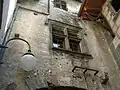 The distinctive stone-cross windows in the town
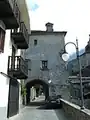 A tower house crosses a road
References
- ↑ "Superficie di Comuni Province e Regioni italiane al 9 ottobre 2011" (in Italian). ISTAT.
- 1 2 3 "Resident population". ISTAT.
- ↑ Unité des communes valdôtaines du Mont-Rose - Official webpage.
- ↑ "Valle d'Aosta" (in Italian). Retrieved 31 July 2023.
- ↑ "Popolazione residente dei comuni. Censimenti dal 1861 al 1991" [Resident population of the municipalities. Censuses from 1861 to 1991] (PDF) (in Italian). ISTAT. Archived from the original (PDF) on 2025-11-12.
- ↑ "Resident population - Time series". ISTAT.
- ↑ "Resident population by sex, municipality and citizenship". ISTAT.
External links
 Media related to Bard at Wikimedia Commons
- (in Italian and French) Bard official website
- Bard page Archived 2013-04-11 at the Wayback Machine on "The most beautiful villages in Italy" website
