Ball-pen probe
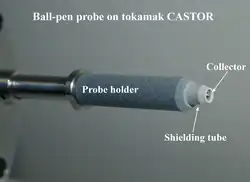
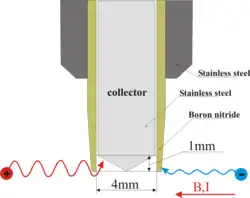
A ball-pen probe[1] is a modified Langmuir probe used to measure the plasma potential[2] in magnetized plasmas. The ball-pen probe balances the electron and ion saturation currents, so that its floating potential is equal to the plasma potential. Because electrons have a much smaller gyroradius than ions, a moving ceramic shield can be used to screen off an adjustable part of the electron current from the probe collector.
Ball-pen probes are used in plasma physics, notably in tokamaks such as CASTOR, [1][2] ASDEX Upgrade,[3][4][5][6] COMPASS,[5][6][7] ISTTOK,[6][8] MAST,[9] TJ-K,[10] RFX,[11] H-1 Heliac,[12][13] IR-T1,[14][15] GOLEM[16] and stellarator Wendelstein 7-X[17] as well as low temperature devices as DC cylindrical magnetron in Prague[10][18] and linear magnetized plasma devices in Nancy[19] and Ljubljana.[10][20]
Principle
If a Langmuir probe (electrode) is inserted into a plasma, its potential is not equal to the plasma potential because a Debye sheath forms, but instead to a floating potential . The difference with the plasma potential is given by the electron temperature :


where the coefficient is given by the ratio of the electron and ion saturation current density ( and ) and collecting areas for electrons and ions ( and ):


The ball-pen probe modifies the collecting areas for electrons and ions in such a way that the ratio is equal to one. Consequently, and the floating potential of the ball-pen probe becomes equal to the plasma potential regardless of the electron temperature:


Design and calibration

A ball-pen probe consists of a conically shaped collector (non-magnetic stainless steel, tungsten, copper, molybdenum), which is shielded by an insulating tube (boron nitride, Alumina). The collector is fully shielded and the whole probe head is placed perpendicular to magnetic field lines.
When the collector slides within the shield, the ratio varies, and can be set to 1. The adequate retraction length strongly depends on the magnetic field's value. The collector retraction should be roughly below the ion's Larmor radius. Calibrating the proper position of the collector can be done in two different ways:
- The ball-pen probe collector is biased by a low-frequency voltage that provides the I-V characteristics and obtain the saturation current of electrons and ions. The collector is then retracted until the I-V characteristics becomes symmetric. In this case, the ratio is close to unity, though not exactly.[1][4][21] If the probe is retracted deeper, the I-V characteristics remain symmetric.
- The ball-pen probe collector potential is left floating, and the collector is retracted until its potential saturates. The resulting potential is above the Langmuir probe potential.
Electron temperature measurements
Using two measurements of the plasma potential with probes whose coefficient differ, it is possible to retrieve the electron temperature passively (without any input voltage or current). Using a Langmuir probe (with a non-negligible) and a ball-point probe (whose associated is close to zero) the electron temperature is given by:

where is measured by the ball-pen probe, by the standard Langmuir probe, and is given by the Langmuir probe geometry, plasma gas composition, the magnetic field, and other minor factors (secondary electron emission, sheath expansion, etc.). It can be calculated theoretically, its value being about 3 for a non-magnetized hydrogen plasma.[22][23]
In practice, the ratio for the ball-pen probe is not exactly equal to one,[4] so that the coefficient must be corrected by an empirical value for :
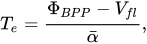
where

Ion temperature measurements
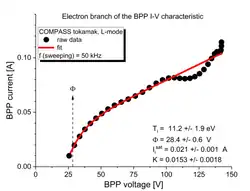
The ion temperature is an important quantity in fusion plasmas; however, it is only rarely measured using electrical probes. The ball-pen probe can be used to determine this quantity by fitting its current–voltage characteristics. The method [24] is relatively simple, but requires a source of sweeping voltage. The ion temperature is obtained from the exponential part of the electron branch () of the current–voltage characteristic, as described below:


where denotes the ion saturation current (), and the coefficient represents a generally observed linear increase with electron current ( for fully saturated case), combined with an exponential dependence describing the ion current, which is governed by the ion temperature .


The main advantages of this method include:
- Robust and local measurements, making it suitable for both small and large fusion devices (COMPASS[24][25], Wendelstein 7-X[17])
- A relatively high level of the effective probe signal (), which enables the use of a fast voltage sweeping regime and allows high temporal resolution (on the order of ).

References
- 1 2 3 Adámek, J.; J. Stöckel; M. Hron; J. Ryszawy; M. Tichý; R. Schrittwieser; C. Ionită; P. Balan; E. Martines; G. Van Oost (2004). "A novel approach to direct measurement of the plasma potential". Czechoslovak Journal of Physics. 54 (3): 95–99. Bibcode:2004CzJPS..54C..95A. doi:10.1007/BF03166386. ISSN 1572-9486. S2CID 54869196.
- 1 2 Adámek, J.; J. Stöckel; I. Ďuran; M. Hron; R. Pánek; M. Tichý; R. Schrittwieser; C. Ionit; P. Balan; E. Martines; G. Oost (2005). "Comparative measurements of the plasma potential with the ball-pen and emissive probes on the CASTOR tokamak". Czechoslovak Journal of Physics. 55 (3): 235–242. Bibcode:2005CzJPh..55..235A. doi:10.1007/s10582-005-0036-8. ISSN 0011-4626. S2CID 54002051.
- ↑ Adamek, J.; V. Rohde; H.W. Müller; A. Herrmann; C. Ionita; R. Schrittwieser; F. Mehlmann; J. Stöckel; J. Horacek; J. Brotankova (2009). "Direct measurements of the plasma potential in ELMy H-mode plasma with ball-pen probes on ASDEX Upgrade tokamak". Journal of Nuclear Materials. 390–391: 1114–1117. Bibcode:2009JNuM..390.1114A. doi:10.1016/j.jnucmat.2009.01.286. hdl:11858/00-001M-0000-0026-F6E0-E.
- 1 2 3 Adamek, J.; J. Horacek; H.W. Müller; V. Rohde; C. Ionita; R. Schrittwieser; F. Mehlmann; B. Kurzan; J. Stöckel; R. Dejarnac; V. Weinzettl; J. Seidl; M. Peterka (2010). "Ball-Pen Probe Measurements in L-Mode and H-Mode on ASDEX Upgrade". Contributions to Plasma Physics. 50 (9): 854–859. Bibcode:2010CoPP...50..854A. doi:10.1002/ctpp.201010145. S2CID 122712744.
- 1 2 Adamek, J.; J. Horacek; J. Seidl; H.W. Müller; R. Schrittwieser; F. Mehlmann; P. Vondracek; S. Ptak (2014). "Direct Plasma Potential Measurements by Ball-Pen Probe and Self-Emitting Langmuir Probe on COMPASS and ASDEX Upgrade". Contributions to Plasma Physics. 54 (4): 279–284. Bibcode:2014CoPP...54..279A. doi:10.1002/ctpp.201410072. S2CID 117937384.
- 1 2 3 Adamek, J.; H.W. Müller; C. Silva; R. Schrittwieser; C. Ionita; F. Mehlmann; S. Costea; J. Horacek; B. Kurzan; P. Bilkova; P. Böhm; M. Aftanas; P. Vondracek; J. Stöckel; R. Panek; H. Fernandes; H. Figueiredo (2016). "Profile measurements of the electron temperature on the ASDEX Upgrade, COMPASS, and ISTTOK tokamak using Thomson scattering, triple, and ball-pen probes". Review of Scientific Instruments. 87 (4): 043510. Bibcode:2016RScI...87d3510A. doi:10.1063/1.4945797. PMID 27131677.
- ↑ Adamek, J.; J. Seidl; J. Horacek; M. Komm; T. Eich; R. Panek; J. Cavalier; A. Devitre; M. Peterka; P. Vondracek; J. Stöckel; D. Sestak; O. Grover; P. Bilkova; P. Böhm; J. Varju; A. Havranek; V. Weinzettl; J. Lovell; M. Dimitrova; K. Mitosinkova; R. Dejarnac; M. Hron (2017). "Electron temperature and heat load measurements in the COMPASS divertor using the new system of probes". Nuclear Fusion. 57 (11): 116017. Bibcode:2017NucFu..57k6017A. doi:10.1088/1741-4326/aa7e09. hdl:11858/00-001M-0000-002D-BA59-3. S2CID 125143428.
- ↑ Silva, C.; J. Adamek; H. Fernandes; H. Figueiredo (2015). "Comparison of fluctuations properties measured by Langmuir and ball-pen probes in the ISTTOK boundary plasma". Plasma Physics and Controlled Fusion. 57 (2) 025003. Bibcode:2015PPCF...57b5003S. CiteSeerX 10.1.1.691.3443. doi:10.1088/0741-3335/57/2/025003. S2CID 59151012.
{{cite journal}}: Cite uses deprecated parameter|citeseerx=(help) - ↑ Walkden, N R; J. Adamek; S. Allan; B. D. Dudson; S. Elmore; G. Fishpool; J. Harrison; A. Kirk; M. Komm (2015). "Profile measurements in the plasma edge of MAST using a ball pen probe". Review of Scientific Instruments. 86 (2): 023510. arXiv:1411.7298. Bibcode:2015RScI...86b3510W. doi:10.1063/1.4908572. PMID 25725845. S2CID 21518172.
- 1 2 3 Adamek, Jiri; Matej Peterka; Tomaz Gyergyek; Pavel Kudrna; Mirko Ramisch; Ulrich Stroth; Jordan Cavalier; Milan Tichy (2013). "Application of the ball-pen probe in two low-temperature magnetised plasma devices and in torsatron TJ-K". Contributions to Plasma Physics. 53 (1): 39–44. Bibcode:2013CoPP...53...39A. doi:10.1002/ctpp.201310007. S2CID 120969312.
- ↑ "Welcome to Consorzio RFX site". Archived from the original on 2009-09-01. Retrieved 2020-06-26.
- ↑ Michael, C.A.; F. Zhao; B. Blackwell; M. F. J. Vos; J. Brotankova; S. R. Haskey; B. Seiwald; J. Howard (2017). "Influence of magnetic configuration on edge turbulence and transport in the H-1 Heliac" (PDF). Plasma Physics and Controlled Fusion. 59 (2) 024001. Bibcode:2017PPCF...59b4001M. doi:10.1088/1361-6587/59/2/024001. hdl:1885/112461. S2CID 73588015.
- ↑ Hole, M.J.; B.D. Blackwell; G. Bowden; M. Cole; A. Koenies; C.A. Michael; F. Zhao; S.R. Haskey (2017). "Global Alfven eigenmodes in the H-1 heliac". Plasma Physics and Controlled Fusion. 59 (12): 125007. arXiv:1704.02089. Bibcode:2017PPCF...59l5007H. doi:10.1088/1361-6587/aa8bdf. S2CID 119096017.
- ↑ Ghoranneviss, M.; S. Meshkani (2016). "Techniques for improving plasma confinement in IR-T1 Tokamak". International Journal of Hydrogen Energy. 41 (29): 12555–12562. Bibcode:2016IJHE...4112555G. doi:10.1016/j.ijhydene.2016.03.075.
- ↑ Lafouti, M.; M. Mahjour (2026). "Experimental Study of Blob Dynamics and Turbulence Spreading in the Sol of IR-T1 Tokamak by Mix-probe". Instrum Exp Tech. 69: 66–72. doi:10.1134/S002044122670003X.
- ↑ J. Cerovsky, M. Farnik, M. Sos, J. Svoboda, O. Ficker, M. Hetflejs, P. Svihra, M. Shkut, O. Grover, J. Veverka, V. Svoboda, J. Stockel, J. Adamek, M. Dimitrova, "Tokamak GOLEM for fusion education", 44th EPS Conference on Plasma Physic, 26–30 June 2017, Belfast, Northern Ireland (UK), P1.107,
- 1 2 Cipciar, D.; J. Adamek; C. Killer; D. Matthew; V. Winters; V. Perseo; O. Grulke; J. Hua; A. Knipes (2025). "Study of ion-to-electron temperature ratio at the edge of Wendelstein 7-X using a fast swept ball-pen probe". Plasma Phys. Control. Fusion. 67: 115029. doi:10.1088/1361-6587/ae1b6b.
- ↑ Zanaska, Michal; J. Adamek; M. Peterka; P. Kudrna; M. Tichy (2015). "Comparative measurements of plasma potential with ball-pen and Langmuir probe in low-temperature magnetized plasma". Physics of Plasmas. 22 (3): 033516. Bibcode:2015PhPl...22c3516Z. doi:10.1063/1.4916572.
- ↑ Bousselin, G.; J. Cavalier; J. F. Pautex; S. Heuraux; N. Lemoine; G. Bonhomme (2013). "Design and validation of the ball-pen probe for measurements in a low-temperature magnetized plasma". Review of Scientific Instruments. 84 (1): 013505–013505–8. Bibcode:2013RScI...84a3505B. doi:10.1063/1.4775491. ISSN 0034-6748. PMID 23387648.
- ↑ Kovacic, Jernej; Salamon, Lino; Ikovic, Gabrijela; Gyergyek, Tomaz; Fonda, Boris (2016). "Ball-Pen Probe Diagnostics of a Weakly Magnetized Discharge Plasma Column". Proceedings of 1st EPS conference on Plasma Diagnostics — PoS(ECPD2015). p. 052. doi:10.22323/1.240.0052.
- ↑ Silva, C.; J. Adamek; H. Fernandes; H. Figueiredo (2014). "Comparison of fluctuations properties measured by Langmuir and ball-pen probes in the ISTTOK boundary plasma". Plasma Physics and Controlled Fusion. 57 (2) 025003. Bibcode:2015PPCF...57b5003S. CiteSeerX 10.1.1.691.3443. doi:10.1088/0741-3335/57/2/025003. S2CID 59151012.
{{cite journal}}: Cite uses deprecated parameter|citeseerx=(help) - ↑ Stangeby P.C.: The Plasma Boundary of Magnetic Fusion Devices, Institute of Physics Publishing. Bristol and Philadelphia (2000).
- ↑ Hutchinson I.H.: Principles of Plasma Diagnostics, Cambridge University Press (1992).
- 1 2 Adamek, J.; D. Cipciar; A. Devitre; J. Horacek; J. Cavalier; M. Komm; J. Krbec; M. Tichy; D. Trunec; P. Böhm; R. Panek (2021). "Ion temperature measurements in the tokamak scrape-off layer with high temporal resolution". Nuclear Fusion. 61: 036023. doi:10.1088/1741-4326/abd41d.
- ↑ Cipciar, D.; J. Adamek; J. Horacek; J. Cavalier; M. Hron (2022). "Statistical properties of ion and electron temperature fluctuations in the edge of the COMPASS tokamak". Plasma Phys. Control. Fusion. 64: 055021. doi:10.1088/1361-6587/ac5a0b.
External links
- PhD thesis, Jiri Adamek (Czech and English language)
- Overview: Advances in Plasma Diagnostics: 20 Years of the Ball-Pen Probe in Fusion and Non-Fusion Research.
- Electrical Probe Measurements on the COMPASS Tokamak
- Scanning ion sensitive probe for plasma profile measurements in the boundary of the Alcator C-Mod tokamak
- Development of Probes for Assessment of Ion Heat Transport and Sheath Heat Flux in the Boundary of the Alcator C-Mod Tokamak
- Video: Temporal evolution of Type-I ELM in the divertor region on the COMPASS tokamak.
- The new divertor Ball-pen and Langmuir probes on the COMPASS tokamak.
- Ball-pen and Langmuir probe on GOLEM tokamak