Ramayanam (1997 film)
| Ramayanam | |
|---|---|
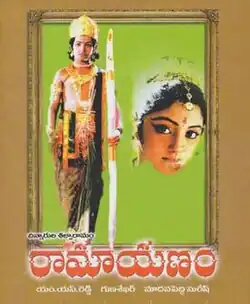 Poster | |
| Directed by | Gunasekhar |
| Based on | |
| Produced by | M. S. Reddy |
| Dialogue by | M. V. S. Haranatha Rao |
| Starring | N. T. Rama Rao Jr. Smitha Madha Swathi Kodali |
| Cinematography | Sekhar V. Joseph |
| Edited by | B. B. Reddy |
| Music by | Songs: Madhavapeddi Suresh Score: L. Vaidyanathan |
Production company | |
Release date |
|
Running time | 144 minutes |
| Country | India |
| Language | Telugu |
Ramayanam, also known as Bala Ramayanam (transl. Child Ramayanam), is a 1997 Indian Telugu-language mythological film directed by Gunasekhar and produced by M. S. Reddy. Based on the Hindu epic Ramayana, the film features overs 3000 child actors. It stars N. T. Rama Rao Jr. as Lord Rama Smitha Madhav as Sita Swathi Kodali as Ravanasura, won the Nandi Award for Best Child Actor.
The film is released on 11 April 1997. It received the National Film Award for Best Children's Film and two Nandi Awards.[2]
Plot
In the kingdom of Ayodhya, King Dasharatha rules justly but grieves over his childlessness. On the advice of Sage Vasishta, he performs the Putrakameshti Yagna and is blessed with four sons: Rama, Lakshmana, Bharata, and Shatrughna. As the princes grow, Rama and Lakshmana are summoned by Sage Vishwamitra to protect his sacred rituals from disruptive demons. Rama successfully slays the demoness Tataka and her son Subahu, securing the peace of the sages. Impressed by Rama’s virtue, Vishwamitra takes the young princes to the kingdom of Mithila, where King Janaka is hosting a swayamvaram for his daughter, Sita. To win her hand, suitors must string the legendary, heavy bow of Lord Shiva. While all others fail, Rama effortlessly lifts and breaks the divine bow, marrying Sita. His brothers are subsequently wedded to Sita's sister and cousins.
Years later, an aging Dasharatha decides to crown Rama as his successor. However, Queen Kaikeyi, manipulated by her scheming maid Manthara, invokes two promises Dasharatha had made to her long ago. She demands that her son Bharata be crowned king and that Rama be exiled to the forest for fourteen years. Committed to preserving his father's honor, Rama willingly accepts the exile. Sita and Lakshmana refuse to leave his side and accompany him into the wilderness. Heartbroken by the separation, Dasharatha passes away. When Bharata returns to Ayodhya, he rejects his mother’s actions, refuses to take the throne, and goes to the forest to plead with Rama to return. Rama declines to break his vow, prompting Bharata to return to Ayodhya with Rama’s sandals, which he places on the throne, ruling merely as his brother's regent.
In the forest, the trio establishes a peaceful life at Panchavati. Their tranquility is shattered when the demoness Surpanakha tries to entice Rama and attacks Sita, prompting Lakshmana to sever her nose and ears. Seeking vengeance, Surpanakha appeals to her brother, Ravana, the formidable ten-headed demon king of Lanka. Captivated by Surpanakha's description of Sita's beauty, Ravana hatches a plan. He tasks the demon Maricha to disguise himself as a magical golden deer. Sita, enchanted by the deer, begs Rama to capture it. When Rama goes after the deer, Maricha mimics Rama's voice in a cry for help, prompting a worried Sita to send Lakshmana after him. Seizing the opportunity, Ravana arrives disguised as an ascetic, abducts Sita, and flies her away to Lanka.
On their search for Sita, Rama and Lakshmana meet the monkey warrior Hanuman and form an alliance with the exiled Vanara king, Sugriva. Rama kills Sugriva’s tyrannical brother, Vali, restoring Sugriva to his throne. In return, Sugriva dispatches his Vanara army to locate Sita. Hanuman successfully crosses the ocean to Lanka, finds a captive Sita in the Ashoka Vatika, and gives her Rama's ring as a token of hope. Before leaving, Hanuman destroys Ravana's orchards and sets fire to Lanka as a warning.
With Hanuman's intelligence, the Vanara army constructs a floating stone bridge, the Rama Setu, across the ocean. Rama and his army invade Lanka, leading to a massive war. One by one, Ravana's formidable commanders, including his giant brother Kumbhakarna and his warrior son Indrajit, are slain by Rama and Lakshmana. Finally, Rama confronts Ravana in a fierce duel and kills him, liberating Sita. To prove her purity to the world, Sita voluntarily undergoes an Agni Pariksha (trial by fire), emerging unscathed. The victorious group returns to a celebrating Ayodhya, where Rama is formally crowned king, ushering in a golden era of peace and justice.
Cast
- N. T. Rama Rao Jr. as Rama
- Smitha Madhav as Sita
- Narayanam Nikhil as Lakshmana
- Swathi Kodali as Ravana
- Arun Gangadhar as Anjaneya
- Aanand Vardhan as Valmiki and Bala Anjaneya
- Aditya Varma as Dasharatha
- Chiranjeevi as Bharata
- Manisha Chudamani as Kausalya
- Vasundhara as Kaikeyi
- Suma as Sumitra
- Svetha Rao as Urmila
- Sunaina as Shabari
- Sudha Gummadi as Sudha
Production
The film's cast features over 3000 child actors.[2]
Soundtrack
The music was composed by Madhavapeddi Suresh.
Songs:
- "Adi Subhodaya Vela" - S. P. Balasubrahmanyam
- "Virisi Viriyani Malliyalara" - K. S. Chithra
- "Sitaramula Kalyanam " - S. Janaki, Vani Jayaram
- "Ramayya Rajavutadanta" - Vani Jayaram, S.P. Sailaja
- "Purajanula Sambaramu" - S. P. Balasubrahmanyam
- "Entha Manchivadivayya" -Vani Jayaram
- "Andabayani Jantaga" - K. J. Yesudas, K. S. Chithra
- "Budi Budi Adigulu"
- "Adigadigo Modalayindi" - S. P. Balasubrahmanyam
Poems:
- "Aa Surya Bhagavanudu" - B. Sai Karthikeya
- "Hari Hari Entha Maata"
- "Vande Sri Raghuvamsa"
- "Gaduvu Lopala"
- "Aagumaagumu Talli"
- "Nanu Talliga "
- "Dharma Samsthapanarthammu"
- "Poulastya Brahmaga" - B. Sai Karthikeya
- "Vinumo Raghava"
- "Ramayanammu" - Mangalampalli Balamuralikrishna
Slokas:
- "Jata Kataha Sambhrama" (from Shiva Tandava Stotram)
- "Kausalya Supraja Rama" (from Suprabhatam/Valmiki Ramayana) - Mangalampalli Balamuralikrishna
- "Sri Anjaneyam" (from Anjaneya Dandakam)
Critical response
Upon release, the film received positive reviews from critics.[3] A critic from Andhra Today wrote that "The novelty of this movie is that all the characters in the movie are played by children. Director Gunasekhar, with just two movies to his credit, has vindicated the confidence reposed in him by the producer by this spectacular theatrical. He must have needed all his skills to create the visual extravaganza, that the picture is made to be, with a story that has been told by many, many a time. He deserves kudos for his competent handling of the long story into a three-hour movie".[4]
Awards
The film received National Film Award for Best Children's Film in 1997 for "presenting the classical Indian epic in an entertaining narrative style with child actors playing all legendary characters with ease and nerve." Director Gunasekhar and producer M. S. Reddy were presented the award.[5]
- Best Children's Film - Gold - M. S. Reddy
- Best Child Actress - Jr NTR, Swathi.
References
- ↑ "Ramayanam". The Times of India. Retrieved 12 April 2022.
- 1 2 "Veteran Telugu film producer MS Reddy dies". Hindustan Times. Archived from the original on 13 December 2011. Retrieved 4 March 2015.
- ↑ "Treated like cattle!" (PDF) (in Telugu). Archived from the original (PDF) on 13 September 2016.
- ↑ "Reviews". Archived from the original on 13 February 1998.
- ↑ "45th National Film Festival 1998" (PDF). p. 20. Archived from the original (PDF) on 28 September 2011. Retrieved 30 July 2011.
- ↑ "నంది అవార్డు విజేతల పరంపర (1964–2008)" [A series of Nandi Award Winners (1964–2008)] (PDF). Information & Public Relations of Andhra Pradesh. Retrieved 21 August 2020.(in Telugu)
External links
- 1997 films
- 1997 Telugu-language films
- Films based on the Ramayana
- Hanuman in popular culture
- Hindu mythological films
- Films directed by Gunasekhar
- Indian children's films
- Best Children's Film National Film Award winners
- Films scored by Madhavapeddi Suresh
- 1990s Telugu-language film stubs
- Children's film stubs
- Hindu film stubs