Baiano people
Povo Baiano | |
|---|---|
 | |
| Total population | |
| c. 8-10 million (2022) | |
| Regions with significant populations | |
| Brazil | |
| Languages | |
| Portuguese, Baiano dialect | |
| Religion | |
| Predominantly Roman Catholic, minority Protestant and Afro-Brazilian religions | |
| Related ethnic groups | |
| Portuguese, Yorubas, Igbo, Kongo, Sertanejos, Tupinambás, Akans |
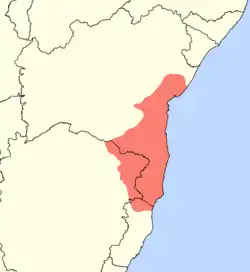
The Baianos (Natively: [bɐjˈɐ̃nu(s)]) are a Brazilian ethnocultural group distributed across the coastal regions of Bahia, the northeast of Minas Gerais and the north of Espiríto Santo.[1][2][3][4][5] They originated from the late 16th to early 17th century from the adaptation of Portuguese immigrants to the tropical climate of Brazil and heavy cultural influence from Africans that were brought to the region as slaves during the transatlantic slave trade.[6] Their population is estimated to be roughly 8 to 10 million people.[7]
Culture

The Baiano people have one of the most easily identifiable cultures among the Brazilians, with a higher degree of influence from cultures of modern-day Nigeria and West Africa in general.[1] Traditional Baiano clothing for women include voluminous white dresses, white headwear made of the same fabric as the dresses and the use of many necklaces, rings, bracelets and earrings.[8]
Baiano cuisine is based on beans, rice, fish, shrimps and other seafood. Dishes from the coast of Bahia are spicier and more seasoned than those of the rest of the country, a culinary tradition inherited from the cuisine of the Yoruba people in Nigeria.[9][10] Traditional Baiano dishes include acarajé, abará, bobó de camarão, moqueca baiana, caruru, xinxim, vatapá, cocada, beiju and doce de banana.[11]
The majority of Baianos are Roman Catholic, numbering at around 50 to 55%, followed by Protestants at 25 to 30%, irreligious people at 15 to 20% and followers of afro-Brazilian religions at 1 to 2%.[12] Despite the low numbers, the traditions and practices of afro-Brazilian religions such as candomblé and umbanda have influenced Baiano culture to an incredible degree, mainly through syncretism with Catholicism.[13][14][15]

Genetics
According to the 2022 census the coastal area of Bahia is the region of Brazil with the highest concentration of self-identified black people, with the overall Baiano population being around 25 to 35% black, 50 to 60% pardo, and 10 to 15% white.[12][16]
Genetically, Baianos have the highest proportion of Subsaharan African ancestry among all the Brazilian ethnocultural groups. A 2019 systematic scoping reveal of 51 genetic studies put the autosomal ancestries of Baianos from Salvador as being 52% European, 40% African and 7% Amerindian; samples from Ilhéus, further south in the state of Bahia, put their ancestry at 61% European, 31% African and 7% Amerindian; and the ancestry of Jequié at 44% European, 42% African and 11% Amerindian.[17]
Notable baianos
- Caetano Veloso - musician
- Carlinhos Brown - singer
- Irmã Dulce - Catholic saint
- Gilberto Gil - singer
- Vampeta - footballer
- Gal Costa - singer
- Raul Seixas - singer
- Jorge Amado - writer
- Ruy Barbosa - politician
- Lázaro Ramos - actor
- Dante - footballer
- Maria Quitéria - lieutenant
- Magno Malta - politician
- Daniela Mercury - singer
- Leo Santana - singer
- Bebeto - footballer
References
- 1 2 CR, Armando (2024-08-14). Os baianos (in Brazilian Portuguese). Salvador, BA: P55 Edição. ISBN 978-65-88597-55-2.
- ↑ Risério, Antonio; Falcón, Gustavo (2020). Bahia de todos os cantos: uma introdução à cultura baiana. Lauro de Freitas, Brazil: Solisluna Editora. ISBN 978-65-86539-03-5.
- ↑ Bezerra, Laura (2022-03-02). "Coletivos populares no Recôncavo da Bahia: cultura, memória e resistência". PragMATIZES - Revista Latino-Americana de Estudos em Cultura. 12 (22): 29–49. doi:10.22409/pragmatizes.v12i22.50792. ISSN 2237-1508.
- ↑ "Manifestações culturais no Recôncavo da Baía de Todos os Santos from Baía de todos os santos: aspectos humanos on JSTOR". Scielo. doi:10.7476/9788523211622.20.
- ↑ Santana, Isamar Neiva de (2018-07-19). "VOCABULÁRIO DIALETAL BAIANO V.1 - V.2". UFBA (in Brazilian Portuguese).
- ↑ Nunes, Antonietta d’Aguiar (2015-08-21). Conhecendo a história da Bahia da pré-história a 1815 (in Brazilian Portuguese). Quarteto Editora. ISBN 978-85-8005-056-1.
- ↑ "Mapas | Panorama do Censo Demográfico 2022". Mapas | Panorama do Censo Demográfico 2022. Retrieved 2026-06-19.
- ↑ Moda e história: as indumentárias das mulheres de fé (in Brazilian Portuguese). Editora Senac São Paulo. 2021-11-19. ISBN 978-85-396-0889-8.
- ↑ "Comida da Bahia, comida quente - Portal Senac". www.ba.senac.br. Retrieved 2026-06-20.
- ↑ Sul, Equipe Zona (2025-11-18). "Sabores da Bahia: temperos e receitas de uma culinária recheada de cultura". Gastronomia Carioca (in Brazilian Portuguese). Retrieved 2026-06-20.
- ↑ São, inglês-São Paulo : Editora Senac (2024-01-31). A culinária baiana no restaurante do Senac Pelourinho (in Brazilian Portuguese). São Paulo, SP: Editora Senac São Paulo. ISBN 978-85-396-5056-9.
- 1 2 "Mapas | Panorama do Censo Demográfico 2022". Mapas | Panorama do Censo Demográfico 2022. Retrieved 2026-06-20.
- ↑ iBahia (2021-01-14). "Entenda o sincretismo religioso entre Senhor do Bonfim e Oxalá". iBahia (in Brazilian Portuguese). Retrieved 2026-06-20.
- ↑ Flaksman, Clara (2017-12-01). "Enredo de santo e sincretismos no candomblé de Salvador, Bahia". Revista de Antropologia da UFSCar (in Portuguese). 9 (2): 153–169. doi:10.52426/rau.v9i2.208. ISSN 2175-4705.
- ↑ Moura, Mariana Mendes de. "A UMBANDA EM SALVADOR: MEMÓRIAS E CONSIDERAÇÕES" (PDF). Ebecult.
- ↑ "Censo 2022: Bahia segue como estado com maior proporção de pessoas pretas no Brasil, aponta IBGE". G1 (in Brazilian Portuguese). 2023-12-22. Retrieved 2026-06-20.
- ↑ Souza, Aracele Maria de; Resende, Sarah Stela; Sousa, Taís Nóbrega de; Brito, Cristiana Ferreira Alves de (2019). "A systematic scoping review of the genetic ancestry of the Brazilian population". Genetics and Molecular Biology. 42 (3): 495–508. doi:10.1590/1678-4685-GMB-2018-0076. ISSN 1415-4757. PMC 6905439. PMID 31188926.