Baden-Württemberg–Bavaria rivalry
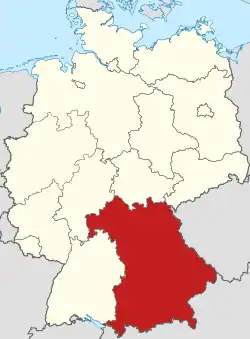

The rivalry between the German federal states of Bavaria and Baden-Württemberg,[1][2][3][4] the nation's second- and third-most populous states behind North Rhine-Westphalia, respectively, is a rhetorical rivalry especially regarding their economies and cultures.
Bavaria is typically considered to be a very proud state, known for its "Mia-san-mia" (Bavarian for Wir sind wir; English: We are [who] we [are]) motto, which would represent their confident mentality and attitude,[5] while Baden-Württemberg is usually portrayed as a rather modest state.[4] Politically, both states have long been center-right CDU/CSU strongholds, though in Baden-Württemberg, the Greens have significantly gained ground since the 2010s. While Baden-Württemberg is seen as the cradle of German liberalism, Bavaria is rather traditional and conservative.[6][7]
Culture
Overall, Bavaria is more culturally popular and influential than Baden-Württemberg. Its culture has become synonymous with Germany in the eyes of many people around the world,[2] and Bavarian traditions and festivals, such as the Oktoberfest,[4] are celebrated worldwide. A popular festival of Baden-Württemberg, although not nearly as popular and famous as the Oktoberfest, is the Cannstatter Volksfest, the second-largest Volksfest after the Oktoberfest.[8]
Bavaria is popular for its football club FC Bayern München, whereas Baden-Württemberg is known for the VfB Stuttgart. Both states are famous motorsport sites, with Bavaria being famous for the Norisring and Baden-Württemberg for its Hockenheimring.
Bavaria is famous for its beer gardens and Bavarian cuisine, which includes traditional food such as schnitzel, sausages, and pretzels. In Baden-Württemberg, the Swabian cuisine is widespread, which is known for dishes such as maultaschen, schupfnudeln and spätzle. Baden-Württemberg is also known for its wine regions, such as Württemberg and Baden.
The state capital cities of Munich and Stuttgart are also their most populous cities and are both vibrant cities in Germany, with each having a significant amount of city culture. Munich has a thriving theater and opera scene, and is home to numerous art galleries and museums, such as the Pinakothek der Moderne and the Deutsches Museum, the world's largest museum of science and technology.[9] Stuttgart is also home to several cultural institutions, such as the Staatsgalerie Stuttgart, the Stuttgart Ballet, and the Landesmuseum Württemberg.
Economy
Once a relatively poor region based primarily on agriculture, Southern Germany became the country's foremost economic powerhouse and most prosperous area following the Wirtschaftswunder.[10]
According to a study from the German Economic Institute, Bavaria has the strongest economy of any German state, closely followed by Baden-Württemberg.[11] After North Rhine-Westphalia, by far the most populous state of Germany, Bavaria and Baden-Württemberg have the second and third highest gross regional product (GRP) and the second and third highest number of billionaires,[12] respectively.
Bavaria is home to a number of major global companies, including Siemens, Adidas, and Allianz. The state has Germany's lowest unemployment rate,[13] third-highest exports,[14] third-highest imports (2022),[15] second-highest total research and development expenditure,[16] and third-largest GDP per capita.[17]
Baden-Württemberg is also home to many large and famous companies, such as Bosch, Schwarz Gruppe and SAP. The state has the second-lowest unemployment rate,[13] highest exports[14] and second-highest imports (2022),[15] highest absolute and relative research and development expenditure,[16] as well as the fourth-largest GDP per capita[17] of any German state. In addition, with an industrial revenue of 309 billion euros and 32.5% of its GRP coming from the industrial sector (both figures as of 2013),[18] Baden-Württemberg is the most industrialized German state both in absolute and relative terms, with the highest industrial output.[18][19]
Baden-Württemberg has 277 world market-leading companies compared to Bavaria's 211,[2] as well as 14,813 patent registrations versus Bavaria's 12,969,[2] making it the German state with the most patents pending per capita (2020).[20] It also has the second-highest absolute and highest relative number of companies considered "hidden champions".[21] Therefore, Baden-Württemberg is considered the most innovative state of Germany, followed by Bavaria.[22] A 2023 study by the German Economic Institute based on various metrics such as company establishments, R&D spending and patent applications found Baden-Württemberg to be the third-most innovative region in the world, behind California and Massachusetts, with Bavaria ranking seventh worldwide and second in Germany.[23][24]
Both Bavaria and Baden-Württemberg have a highly developed automotive industry, with Bavaria housing the headquarters of BMW and Audi, and Baden-Württemberg having Mercedes-Benz and Porsche. However, Baden-Württemberg has a larger automotive industry; despite having a lower population, Baden-Württemberg has more workers employed in the automotive industry (240,000 vs 180,000)[2] and more businesses operating in this industry (285 vs 240).[25] In addition, Stuttgart, Baden-Württemberg's capital and most populous city, is often called Germany's "Autohauptstadt" ("car capital city").[26][27][28] It is also home to famous automobile museums like the Mercedes-Benz Museum and Porsche Museum, as well as numerous auto-enthusiast magazines.
Both Munich and Stuttgart are leading fintech centres in Germany.[29] Bavaria and Baden-Württemberg are also leading regions in the arms and aerospace industries.[30] Furthermore, the two states are the most popular tourist destinations in Germany, with Bavaria ranking first and Baden-Württemberg second by the total number of overnight stays of visitors.[31]
See also
References
- ↑ Hägler, Max; Wittl, Wolfgang (14 June 2019). "Zwei Rivalen auf denselben Gleisen". Süddeutsche.de (in German). Retrieved 2023-03-16.
- 1 2 3 4 5 Zeitung, Süddeutsche (3 May 2011). "Der Süden im Clinch - wer gewinnt?". Süddeutsche.de (in German). Retrieved 2023-03-16.
- ↑ deutschlandfunkkultur.de (19 December 2006). "Rivalität auf der Südschiene". Deutschlandfunk Kultur (in German). Retrieved 2023-03-16.
- 1 2 3 Wörner, Achim. "Bayern oder Baden-Württemberg: Wer ist die Nummer eins im Süden?". stuttgarter-nachrichten.de (in German). Retrieved 2023-03-16.
- ↑ "Mia san Mia: What does Bayern Munich's club motto mean?". bundesliga.com - the official Bundesliga website. Retrieved 2023-03-16.
- ↑ Schuler, Katharina. "Erfolg, keine Macht". www.zeit.de. Retrieved 2023-03-16.
- ↑ Bennhold, Katrin (2018-06-30). "Bavaria: Affluent, Picturesque — and Angry". The New York Times. ISSN 0362-4331. Retrieved 2026-07-18.
- ↑ "10 Dinge über Stuttgart, die kaum jemand weiß". www.bw24.de (in German). 2023-08-13. Retrieved 2023-08-13.
- ↑ Richards, Tim (2015-11-27). "Munich's Deutsches Museum: The world's largest museum of science and technology". The Sydney Morning Herald. Retrieved 2026-06-25.
- ↑ Kollewe, Julia (2012-09-17). "How Germany's south became the backbone of a vibrant economy". The Guardian. ISSN 0261-3077. Retrieved 2026-08-01.
- ↑ "Wirtschaft im Ranking: Bayern behauptet, Sachsen drängt". FAZ.NET (in German). ISSN 0174-4909. Retrieved 2023-03-28.
- ↑ "Hamburg und Co: So viele Milliardäre in Ihrem Bundesland". www.manager-magazin.de (in German). 2015-07-07. Retrieved 2023-04-03.
- 1 2 "Arbeitslosenquote in Deutschland nach Bundesländern 2021". Statista (in German). Retrieved 2021-01-01.
- 1 2 "Exportquote in Deutschland nach Bundesländern". www.statistik-bw.de. Retrieved 2021-01-01.
- 1 2 "Wert der Importe nach Deutschland nach Bundesländern 2020". Statista (in German). Retrieved 2021-04-25.
- 1 2 "Forschungs- und Entwicklungsausgaben in Deutschland nach Bundesländern". www.statistik-bw.de. Retrieved 2021-01-01.
- 1 2 "Bruttoinlandsprodukt je Einwohner nach Bundesländern 2021". Statista (in German). Retrieved 2023-03-16.
- 1 2 "Gemeinsam in die Zukunft – Industrieland Baden-Württemberg!" (PDF). 2013.
Baden-Württemberg ist das stärkste Industrieland in Deutschland. Mit einem Umsatz von 309 Milliarden Euro und einem Wertschöpfungsanteil der Industrie von 32,5 % liegt Baden-Württemberg absolut und relativ vor allen anderen Bundesländern.
- ↑ Hochrebe, Stephan (2024-03-12). "Industriestandort Deutschland". aktiv (in German). Retrieved 2026-06-26.
Die Bundesländer mit den bei Weitem meisten Industriebetrieben und -umsätzen sind Nordrhein-Westfalen, Baden-Württemberg und Bayern. Das Bundesland mit den meisten Industrieunternehmen ist NRW (fast 5.000 Betriebe); in Baden-Württemberg mit seinen vergleichsweise vielen Großbetrieben erwirtschaftet die Industrie allerdings die höchsten Umsätze – nämlich insgesamt 370 Milliarden Euro (2021).
- ↑ "Patentanmeldungen je 100.000 Einwohner in Deutschland nach Bundesländern 2020". Statista (in German). Retrieved 2021-01-01.
- ↑ "Hidden Champions: Die Starken aus der zweiten Reihe". iwd (in German). Retrieved 2021-04-02.
- ↑ Einwiller, Ruth (2012). "Innovationsindex 2012: Baden-Württemberg im europäischen Vergleich" (PDF). Statistisches Monatsheft Baden-Württemberg 12/2012 (in German).
- ↑ "Studie sieht Baden-Württemberg auf Augenhöhe mit Kalifornien". ntv.de (in German). 2023-09-14. Retrieved 2026-06-25.
- ↑ "Fast so innovativ wie Kalifornien: Baden-Württemberg weltweilt auf Platz 3" (in German). Frankfurter Allgemeine Zeitung. 2023-09-14. Retrieved 2026-06-25.
- ↑ Schäfer, Kristina Antonia (11 February 2020). "Blick hinter die Zahlen #5: Wo in Deutschland die meisten Jobs an der Autobranche hängen". www.wiwo.de (in German). Retrieved 2023-03-28.
- ↑ Friedmann, Jan; Gorris, Lothar (2017-08-11). "Stuttgart: Eine Autostadt auf der Suche nach einer neuen mobilen Zukunft - DER SPIEGEL". Der Spiegel (in German). ISSN 2195-1349. Archived from the original on 17 April 2022. Retrieved 2022-04-17.
- ↑ Fischer, Konrad (31 May 2017). "Feinstaub und Fahrverbote: In Stuttgart stirbt der Diesel". www.wiwo.de (in German). Archived from the original on 11 April 2021. Retrieved 2022-04-17.
- ↑ Hägler, Max (15 June 2017). "Vorarbeit aus Stuttgart". Süddeutsche.de (in German). Archived from the original on 17 April 2022. Retrieved 2022-04-17.
- ↑ "Berlin und Stuttgart preschen bei Fintech-Ranking nach vorne". finanzbusiness.de (in German). 2022-09-23. Retrieved 2026-03-13.
- ↑ Munk, Stephanie (2026-05-12). "Özdemir mit Kampfansage an Söder: Neue Regierung in Baden-Württemberg will an Bayern vorbeiziehen". www.merkur.de (in German). Retrieved 2026-06-26.
- ↑ "Urlaubs-Ranking: In welchen Bundesländern der Tourismus boomt". Der Spiegel (in German). 2011-01-17. ISSN 2195-1349. Retrieved 2026-06-28.