Backcountry huts in Tararua Forest Park
Huts in Tararua Forest Park includes all official backcountry huts and bivouac shelters located within Tararua Forest Park, in the lower North Island of New Zealand. Covering roughly 1,150 km2 (440 sq mi) across the Wellington Region, Kāpiti Coast District, and Wairarapa, the Tararua Forest Park is the largest conservation area in the lower North Island. Established in 1954 as New Zealand's first official Forest Park,[1][2] the park features rugged mountain ranges, deep river valleys, steep ridgelines, and dense native bush, providing a popular destination for trampers, hunters, and outdoor enthusiasts.
History
Tramping clubs in the Wellington region, including the Tararua Tramping Club, the Welington Tramping and Mountaineering Club and the Hutt Valley Tramping Club had a key role in originally establishing the network of huts.[3] Field Hut, constructed in 1924 by the Tararua Tramping Club, is the oldest surviving recreational hut in the Tararuas and is recognised for its heritage value.[4][5]
The park now contains over 50 official huts and bivouac shelters (bivvies), forming one of the most extensive backcountry hut networks in New Zealand. These shelters vary greatly in size and facilities, ranging from small two-bunk bivvies tucked into remote alpine valleys to large serviced lodges with 28 bunks designed for high-use tracks. Huts are categorised by the Department of Conservation (DOC) as 'Serviced Huts', 'Standard Huts', or 'Basic Huts/Bivvies'.[6]
These huts have been integral to the growth of organised outdoor recreation in the early 20th century and continue to serve as key sites for both recreation and cultural heritage. The huts in Tararua Forest Park are integral components of New Zealand’s tramping infrastructure, forming a well-documented network that supports both recreational and cultural activities.[7] They are maintained by the Department of Conservation and volunteer tramping clubs, demonstrating a long-standing public–private partnership in conservation management.[8] Notability is conferred through their historical significance, reflecting early 20th-century tramping club activity, forest management, and hunting practices, as well as their continuing role in New Zealand’s outdoor recreation culture.
Usage
According to DOC visitor research, Tararua Forest Park attracts approximately 152,000 visitors annually, with around 130,000 originating from the Wellington region. The majority of these visitors tramp or camp around the park.[9] DOC manages over 30 huts and bivvies in the park, supporting a range of tramping experiences from day trips to multi-day crossings such as the Holdsworth-Jumbo,[10] and the Southern Crossing.[11] Routine maintenance of huts and community engagement are supported by volunteer tramping clubs, who organize working bees and foster stewardship of the huts.[12]
Huts and bivvies
| Hut name | Hut category | Main access point | Notes | Reference |
|---|---|---|---|---|
| Holdsworth Lodge | Serviced Hut (28 bunks) | Holdsworth road end | Popular starting point for many different tramps. | [13] |
| Powell Hut | Serviced Hut (32 bunks) | Holdsworth road end | Offers panoramic views of the Tararua Range. | [14] |
| Jumbo Hut | Serviced Hut (20 bunks) | Holdsworth road end | Spacious hut with scenic surroundings. | [15] |
| Atiwhakatu Hut | Standard Hut (26 bunks) | Holdsworth road end | Near the Atiwhakatu Stream, suitable for families. | [16] |
| Totara Flats Hut | Serviced Hut (28 bunks) | Waiohine Gorge | Large hut on grassy flats beside the Waiohine River. | [17][18] |
| Mid Waiohine Hut | Standard Hut (6 bunks) | Waiohine Gorge | Located near the Waiohine River swingbridge | [19] |
| Neill Forks Hut | Standard Hut (6 bunks) | Waiohine Gorge | Located beside Hector River. | [20] |
| Dorset Ridge Hut | Standard Hut (6 bunks) | Waiohine Gorge | Remote, High-level hut with views over Waiohine Valley. | [21] |
| Carkeek Hut | Standard Hut (6 bunks) | Waiohine Gorge | Remote hut named after early settler William Carkeek. | [22] |
| Cone Hut | Standard Hut (5 bunks) | Waiohine Gorge | Historic slab hut, second-oldest in Tararuas. | [23][24] |
| Winchcombe Bivvy | Basic Bivvy (2 bunks) | Waiohine Gorge | 2-bunk bivvy built 2021; maintained by volunteers. | [25] |
| Parawai Lodge | Standard Hut (18 bunks) | Ōtaki Forks | Situated in a clearing at Ōtaki Forks, Popular with families. | [26] |
| Field Hut | Standard Hut (20 bunks) | Ōtaki Forks | Oldest purpose-built tramping hut in New Zealand (built 1924). | [27] |
| Kime Hut | Standard Hut (20 bunks) | Ōtaki Forks | Alpine hut at 1400 m, often used on Southern Crossing. | [28][29] |
| Waitewaewae Hut | Standard Hut (16 bunks) | Ōtaki Forks | Known as YTYY, sits by Ōtaki River; popular overnighter. | [30] |
| Penn Creek Hut | Standard Hut (6 bunks) | Ōtaki Forks | Popular with hunters, beside Penn Creek, less visited due to steep access. | [31] |
| Anderson Memorial Hut | Standard Hut (6 bunks) | Ōtaki Forks | On slopes of Mt Crawford, popular Main Range stop. | [32] |
| Aokaparangi Hut | Basic Hut (2 bunks) | Ōtaki Forks | Small hut on Main Range circuit, seldom visited. | [33] |
| Waiotauru Hut | Basic Hut (4 bunks) | Ōtaki Forks | Beside Waiotauru River, with good swimming holes nearby. | [34] |
| Waiopehu Hut | Standard Hut (18 bunks) | Poads Road | Above bushline; offers expansive views across Horowhenua | [35] |
| Te Matawai Hut | Standard Hut (18 bunks) | Poads Road | Below bushline; common stop before heading to Main Range | [36] |
| South Ohau Hut | Standard Hut (10 bunks) | Poads Road | On a terrace just above the Ohau River | [37] |
| North Ohau Hut | Basic Hut (4 bunks) | Poads Road | Beside the Ohau River; requires good navigation, no formed tracks | [38] |
| Dracophyllum Hut | Basic Hut (2 bunks) | Poads Road | Located below Dracophyllum Knob; part of the Main Range hut network | [39] |
| Roaring Stag Lodge | Standard Hut (12 bunks) | Putara Road | Beside the Ruamāhanga River; popular family tramp | [40][41] |
| Herepai Hut | Standard Hut (10 bunks) | Putara Road | Good overnighter above bushline near Herepai Peak | [42] |
| Cattle Ridge Hut | Standard Hut (5 bunks) | Putara Road | Small hut above bushline with views to Eketāhuna | [43] |
| Dundas Hut | Standard Hut (6 bunks) | Putara Road | Near Dundas Peak; sometimes used by hunters | [44] |
| Arete Hut | Basic Hut (2 bunks) | Mangahao Valley | Situated near Arete Peak; offers panoramic views; part of the Main Range hut network | [45][41] |
| Mangahao Flats Hut | Standard Hut (16 bunks) | Mangahao Valley | Sits beside the Mangahao River | [46] |
| Burn Hut | Basic Hut (6 bunks) | Mangahao Valley | Sits above the bushline offering expansive views | [47] |
| North Mangahao Bivvy | Basic Bivvy (2 bunks) | Mangahao Valley | Remote 2-bunk bivvy; no marked track, strong navigation skills required | [48] |
| Mitre Flats Hut | Standard Hut (14 bunks) | Waingawa Road | Base for those summiting Mitre | [49] |
| Cow Creek Hut | Standard Hut (6 bunks) | Waingawa Road | Sits beside the Cow Creek - Waingawa Forks | [50] |
| Tarn Ridge Hut | Standard Hut (16 bunks) | Waingawa Road | In storm-damaged condition as at 2025 | [51][52] |
| Mid King Bivvy | Basic Bivvy (2 bunks) | Waingawa Road | Remote 2-bunk bivvy; no formed track(s) | [53] |
| McGregor Bivvy | Basic Bivvy (2 bunks) | Waingawa Road | Very remote 2-bunk bivvy; no formed access track | [54][52] |
| Renata Hut | Basic Hut (6 bunks) | Akatarawa Saddle | Historic hut, suitable for older children | [55] |
| Elder Hut | Standard Hut (4 bunks) | Akatarawa Saddle | Sub-alpine hut with views over the Waiotauru Valley | [56] |
| Kapakapanui Hut | Standard Hut (6 bunks) | Ngatiawa Road | Popular route, offers views across Waikanae | [57] |
| Blue Range Hut | Standard Hut (4 bunks) | Kiriwhakapapa Road | Small 4-bunk hut, short climb from Kiriwhakapapa | [58] |
| Sayer Hut | Standard Hut (6 bunks) | Mangatarere Valley Road | Historic 6-bunk hut, multiple river crossings to access | [59] |
| Alpha Hut | Standard Hut (20 bunks) | Kaitoke or Waiohine Gorge | Popular hut on Southern Crossing Route | [60] |
| Tutuwai Hut | Standard Hut (20 bunks) | Kaitoke or Waiohine Gorge | Sits near the Tauwharenīkau River; popular overnighter for older children. | [61] |
| Arete Forks Hut | Standard Hut (6 bunks) | Kiriwhakapapa or Waingawa Road | Popular with hunters, not often visited | [62] |
| Nichols Hut | Standard Hut (6 bunks) | Ōtaki Forks or Poads Road | Sits below Mt Crawford in the sub-alpine zone; commonly used on Main Range tramps | [63] |
| Maungahuka Hut | Standard Hut (10 bunks) | Ōtaki Forks or Waiohine Gorge | High altitude hut situated beside a large alpine alpine tarn with expansive views | [64][65] |
Gallery
 Totara Flats Hut
 Maungahuka Hut at sunrise
 The view from Jumbo Hut
 Neill Forks Hut
 Kime Hut in summer
 Tutuwai Hut, in summer
 Downstairs interior of historic Field Hut built 1924
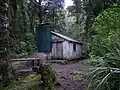 Historic Cone Hut, built 1946
References
- ↑ "Tararua Forest Park". Department of Conservation. Retrieved 5 October 2025.
- ↑ Barnett, Shaun (2012). Shelter from the Storm: the story of New Zealand's backcountry huts. Craig Potton Publishing. ISBN 978-1877517709.
- ↑ Barnett & Brown 1999, p. 11.
- ↑ "Field Hut". Department of Conservation. Retrieved 5 October 2025.
- ↑ "Field Hut". Heritage New Zealand. Retrieved 5 October 2025.
- ↑ Barnett, Brown & Spearpoint 2016, p. 17.
- ↑ "Tararua Forest Park huts". Department of Conservation. Retrieved 5 October 2025.
- ↑ "Hut makeover at Parawai Lodge". Department of Conservation. 29 April 2018. Retrieved 5 October 2025.
- ↑ "Visitor Insights Report 2021/22" (PDF). Department of Conservation. Retrieved 5 October 2025.
- ↑ Barnett 2006, pp. 140–141.
- ↑ Barnett 2006, pp. 136–138.
- ↑ "Tararua Tramping Club Annual Report". Tararua Tramping Club. Retrieved 5 October 2025.
- ↑ "Holdsworth Lodge". Department of Conservation. Retrieved 17 September 2025.
- ↑ "Powell Hut". Department of Conservation. Retrieved 17 September 2025.
- ↑ "Jumbo Hut". Department of Conservation. Retrieved 17 September 2025.
- ↑ "Atiwhakatu Hut". Department of Conservation. Retrieved 17 September 2025.
- ↑ "Totara Flats Hut". Department of Conservation. Retrieved 17 September 2025.
- ↑ Barnett, Brown & Spearpoint 2016, pp. 74–75.
- ↑ "Mid Waiohine Hut". Department of Conservation. Retrieved 17 September 2025.
- ↑ "Neill Forks Hut". Department of Conservation. Retrieved 30 September 2025.
- ↑ "Dorset Ridge Hut". Department of Conservation. Retrieved 17 September 2025.
- ↑ "Carkeek Hut". Department of Conservation. Retrieved 17 September 2025.
- ↑ "Cone Hut". Department of Conservation. Retrieved 17 September 2025.
- ↑ Barnett, Brown & Spearpoint 2016, pp. 70–71.
- ↑ "Winchcombe Biv". Department of Conservation. Retrieved 17 September 2025.
- ↑ "Parawai Lodge". Department of Conservation. Retrieved 6 October 2025.
- ↑ "Field Hut". Department of Conservation. Retrieved 17 September 2025.
- ↑ "Kime Hut". Department of Conservation. Retrieved 17 September 2025.
- ↑ Barnett, Brown & Spearpoint 2016, p. 76.
- ↑ "Waitewaewae Hut". Department of Conservation. Retrieved 17 September 2025.
- ↑ "Penn Creek Hut". Department of Conservation. Retrieved 17 September 2025.
- ↑ "Anderson Memorial Hut". Department of Conservation. Retrieved 17 September 2025.
- ↑ "Aokaparangi Hut". Department of Conservation. Retrieved 17 September 2025.
- ↑ "Waiotauru Hut". Department of Conservation. Retrieved 17 September 2025.
- ↑ "Waiopehu Hut". Department of Conservation. Retrieved 4 October 2025.
- ↑ "Te Matawai Hut". Department of Conservation. Retrieved 4 October 2025.
- ↑ "South Ohau Hut". Department of Conservation. Retrieved 4 October 2025.
- ↑ "North Ohau Hut". Department of Conservation. Retrieved 4 October 2025.
- ↑ "Dracophyllum Hut". Department of Conservation. Retrieved 4 October 2025.
- ↑ "Roaring Stag Lodge". Department of Conservation. Retrieved 4 October 2025.
- 1 2 Barnett, Brown & Spearpoint 2016, p. 73.
- ↑ "Herepai Hut". Department of Conservation. Retrieved 4 October 2025.
- ↑ "Cattle Ridge Hut". Department of Conservation. Retrieved 4 October 2025.
- ↑ "Dundas Hut". Department of Conservation. Retrieved 4 October 2025.
- ↑ "Arete Hut". Department of Conservation. Retrieved 4 October 2025.
- ↑ "Mangahao Flats Hut". Department of Conservation. Retrieved 4 October 2025.
- ↑ "Burn Hut". Department of Conservation. Retrieved 4 October 2025.
- ↑ "North Mangahao Bivvy". Department of Conservation. Retrieved 4 October 2025.
- ↑ "Mitre Flats Hut". Department of Conservation. Retrieved 4 October 2025.
- ↑ "Cow Creek Hut". Department of Conservation. Retrieved 17 September 2025.
- ↑ "Tarn Ridge Hut". Department of Conservation. Retrieved 23 October 2025.
- 1 2 Barnett, Brown & Spearpoint 2016, p. 69.
- ↑ "Mid King Bivvy". Department of Conservation. Retrieved 4 October 2025.
- ↑ "McGregor Bivvy". Department of Conservation. Retrieved 4 October 2025.
- ↑ "Renata Hut". Department of Conservation. Retrieved 4 October 2025.
- ↑ "Elder Hut". Department of Conservation. Retrieved 4 October 2025.
- ↑ "Kapakapanui Hut". Department of Conservation. Retrieved 17 September 2025.
- ↑ "Blue Range Hut". Department of Conservation. Retrieved 4 October 2025.
- ↑ "Sayer Hut". Department of Conservation. Retrieved 5 October 2025.
- ↑ "Alpha Hut". Department of Conservation. Retrieved 4 October 2025.
- ↑ "Tutuwai Hut". Department of Conservation. Retrieved 17 September 2025.
- ↑ "Arete Forks Hut". Department of Conservation. Retrieved 17 September 2025.
- ↑ "Nichols Hut". Department of Conservation. Retrieved 4 October 2025.
- ↑ "Maungahuka Hut". Department of Conservation. Retrieved 17 September 2025.
- ↑ Barnett, Brown & Spearpoint 2016, p. 72.
Works cited
- Barnett, S.; Brown, R.; Spearpoint, G. (2016). A Bunk for the Night: A guide to New Zealand's best backcountry huts (first ed.). Nelson: Potton & Burton. ISBN 978-0-947503-06-2. Wikidata Q113390328.
- Barnett, S. (2006). Tramping in New Zealand: A Guide to 40 of New Zealand's Best Tracks (1st ed.). Nelson: Potton & Burton. ISBN 978-1-877333-51-4. Wikidata Q113389263.
- Barnett, S.; Brown, R. (1999). Classic Tramping in New Zealand. Nelson: Potton & Burton. ISBN 978-0-908802-51-7. OCLC 48607243. Wikidata Q136442564.