B. Shyam Sunder
B. Shyam Sunder | |
|---|---|
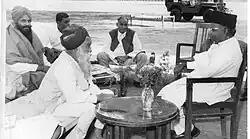 B. Shyam Sunder (right) with Tara Singh (left) | |
| Born | 21 December 1908 |
| Died | 19 May 1975 (aged 66) Hyderabad |
Resting place | Hyderabad |
| Education | B.A. LL.B (Osmania University) |
| Occupation | Lawyer |
| Movement | Eradication of Untouchability, |
| Parent(s) | B. Manicham (father) Sudha Bai (mother) |
| Awards | Khusro-e-Deccan |
B. Shyam Sunder (21 December 1908 – 19 May 1975) was a political thinker, jurist, prolific writer, parliamentarian and a revolutionary leader.[1]
Early life and education
Sunder was born into a Mala family in Aurangabad Cantonment, Aurangabad district, Maharashtra, then part of the princely state of Hyderabad. He completed his schooling in Aurangabad. He visited the Ajanta Caves and later moved with his family to Hyderabad, where he enrolled at Osmania University. He studied political science and economics and later obtained a law degree. Sunder spoke Urdu, English, and Marathi. He served as a member of the Senate and Syndicate of Osmania University. He entered politics through the student wing of the Depressed Classes Association, serving as its general secretary before becoming its president in 1947.[2]
In 1937, Sunder established the Dalit–Muslim unity movement at Parbhani, then in Aurangabad district. He advocated cooperation between Dalit and Muslim communities.[3] He later served as a legislator representing Andhra Pradesh and Mysore State.
In 1956, Sunder established the All India Federal Association of Minorities in Hyderabad. In 1968, he organised a movement for Bahujans in Lucknow district, Uttar Pradesh, and adopted the slogan "India is ours" in connection with the movement. He later established the Bhim Sena, a voluntary organisation, in Gulbarga, Karnataka. The organisation subsequently expanded to other parts of India. V. T. Rajshekar, editor of Dalit Voice, described Sunder as the "Father of Dalit movements in India".[4][5]
Political career
Sunder practised law for a brief period before joining the Swadeshi movement, which was associated with the leadership of Sarojini Naidu. He later served as its general secretary in Andhra Pradesh. He was elected president of the Literary Society of Hyderabad and became a member of the Exhibition Society of Hyderabad. He was elected unopposed from the graduates' constituency to the Hyderabad Legislative Assembly and later served as its deputy speaker.[6]
Sunder was a member of the Nizam of Hyderabad's delegation to the United Nations. P. R. Venkataswamy, author of Our Struggle for Emancipation, described Sunder's involvement in the Depressed Classes movement as significant and recorded that he was referred to as Qaid-e-Pusthakhome, translated as "Leader of the Depressed Classes". The Nizam of Hyderabad awarded Sunder the Khusro-e-Deccan. V. T. Rajshekar, editor of Dalit Voice, wrote about Sunder and the Bhim Sena.[7]
Dalit-Muslim unity movement
Change! Change swiftly; if you do not change now you will never change!
— Shyam Sunder, All India Depressed Classes Association Conference, 30 May 1941
He was associated with the Dalit–Muslim Unity Movement. At one of its conferences, a resolution was adopted calling for opposition to untouchability and the caste system. He delivered a 64-page presidential address, Khutbe-e-Sadarat, which discussed the caste system and cooperation between Dalit and Muslim communities. He was described by some sources as a pro-Muslim leader.[8][9]
Address to the UN Security Council
Sunder was a member of the Nizam of Hyderabad's delegation to the United Nations Security Council. He was described as one of the first leaders from post-independence India to address the UN Security Council. As a representative of the Depressed Classes, he spoke about the social conditions and discrimination faced by these communities in India. He compared the situation of the Depressed Classes with racial segregation in the United States.[2]
Following Operation Polo and the accession of the princely state of Hyderabad to India, Sunder ended his European tour and returned to India. He was placed under house arrest at his sister's residence in Pune and was later released. He subsequently resumed his political activities and contested the first Indian general election from the Chanchalguda constituency in Hyderabad, but was unsuccessful. He was later elected to the Mysore Legislative Assembly from the Bhalki constituency in Bidar district.
In 1962, Sunder contested an assembly seat from the Aland constituency in Kalaburagi district and a Lok Sabha seat from Bidar district, but was unsuccessful in both elections.[2] Following the death of Ram Manohar Lohia, he became president of the Praja Socialist Party.
Minorities movement
On 13 October 1956, Sunder founded the All India Federal Association of Minorities in Hyderabad. He also authored the pamphlet Federation is a Must for Indian Minorities, in which he advocated constitutional safeguards for minorities, the preservation of cultural rights, and electoral reforms. In a 1969 publication, he advocated greater minority representation in legislatures, protection of minority rights and culture, and the reorganisation of states.[10][11]
Bhim Sena
Sunder founded the Bhim Sena in Gulbarga district, Karnataka, on 29 April 1968, the 77th anniversary of the birth of Dr. B. R. Ambedkar. The organisation was named after Ambedkar.[12] It was described as a self-defence movement based on non-violence and opposition to caste-based violence against Dalits.[13] One source estimated its membership at approximately 200,000 Dalits.[14] The movement has been described as a challenge to the Hindu caste system and as a caste-based rather than class-based movement.[15] Sunder advocated separate political and educational institutions for Dalits and proposed the establishment of a separate state, which he called Dalitastan.
Publications
Mool Bharathis
- They Burn: the 16,00,00,000 untouchables of India
- The four immediate needs of twelve crores suppresses human beings in India : resolutions passed unanimously
- Veda Mecum for Mool Bharatis
- Bhim Sena kya Chahati hai (Urdu)
- Problems of Scheduled Caste
- Harijans and General Elections
- Neo-Buddhist Claims as Scheduled Caste
- The Plight of Scheduled Caste in India Petition to Lok Sabha
- National Integration and Problems of Indian Minorities
- Danger Ahead for Minorities let us Unite and Face them
- Federation is a Must for Indian Minorities
- Problems of Indian Minorities
On Bahujans
- Presidential Address Uttar Pradesh Minorities and Backward Classes Convention (English, Urdu and Hindi)
- Khutebe-e-Sadarat, Parbhani Presidential Address in (Urdu)
- Deeksha (Hindi, Urdu and English)
- Bhoodevataon ka Manifesto (Hindi, Kannada and Urdu)
- Educational conference at Hyderabad (Urdu)
- Zionist Plot to Dominate the World
- Today's Muslims are Tomorrows Harijans
- Interview to Meherab Urdu Digest
On Hinduism
- Bhudevataon ka Manifesto (Hindi and Kannada)
- UDHR Must be Honored in India
- The Menace of the Dragon
References
- ↑ "A nation builder's pride of place". The Hindu. 14 April 2015. ISSN 0971-751X. Retrieved 23 July 2026.
- 1 2 3 Kshirsagar, R.K (1994). Dalit Movement in India and its leaders, 1857-1956. New Delhi: MD Publication. pp. 335–336. ISBN 978-81-85880-43-3.
- ↑ Kshirsagar, R. K. Dalit Movement in India and Its Leaders, 1857–1956. p. 210.
- ↑ Council on Religion and International Affairs, Donald Dugene Smith, p.56.
- ↑ Mohan, Brij (1972). India's Social problems:analysing basic issues. New Delhi: India International Publication. p. 28.
- ↑ "Welcome to www.sikhvicharmanch.com". www.sikhvicharmanch.com. Retrieved 23 July 2026.
- ↑ Shetty, Rajsheker VT (1978). Dalit Movement in Karnataka. Bangalore: Christian Literature Society. p. 15.
- ↑ Omvdt, Gail (1994). Dalit and Democratic Revolutions. New Delhi: Sage Publication. p. 296. ISBN 978-0-8039-9139-2.
- ↑ Gran, Peter (1996). Beyond Eurocentrism: a new view of modern world history. New York: Syracuse University Press. p. 379. ISBN 978-0-8156-2692-3.
- ↑ Sunder, Shyam B. India Quarterly. Indian Council of World Affairs. 20: 196.
{{cite journal}}: CS1 maint: untitled periodical (link) - ↑ National Integration and Problems of Minorities, The Monthly Symposium, 1969, p. 27, Bharat Prakashan Ltd., New Delhi.
- ↑ Jogdand, Prahlad Gangaram (1991). Dalit movement in Maharashtra. New Delhi: Kanak Publications. p. – 184.
- ↑ Virdi, Santokh Lal (2001). Casteism: The Eighth Worst Wonder. Punjab: Dalit Sahit Academy Punjab. p. 104.
- ↑ Veena Poonacha, Divya Pandey (1999). Responses to Domestic Violence in the States of Karnataka & Gujarat. Bombay: Research Centre for Women's studies, SNDT Women's University. p. – 354.
- ↑ Alice Jacob; Usha Loghani (1984). Violation of journalistic ethics and public taste. Bombay: N.M. Tripathi. p. 138. #4822233.
- Dalit activists
- 1908 births
- 1975 deaths
- People from Aurangabad district, Maharashtra
- Praja Socialist Party politicians
- People from Marathwada
- Activists from Maharashtra
- Dalit leaders
- Indian Dalit politicians
- Dalit writers
- Indian social reformers
- Indian political writers
- Indian lawyers
- Indian revolutionaries
- Indian independence activists
- Osmania University alumni
- Indian Buddhists
- 20th-century Indian Buddhists
- Politicians from Maharashtra