Atskuri (Akhaltsikhe Municipality)
Atskuri
აწყური | |
|---|---|
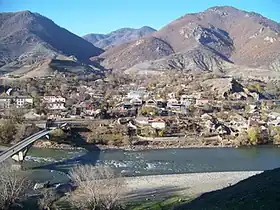 Village view of Atskuri | |
  Atskuri Location within Georgia | |
| Coordinates: 41°43′45″N 43°09′34″E / 41.72917°N 43.15944°E | |
| Country |  Georgia |
| Mkhare | Samtskhe–Javakheti |
| Municipality | Akhaltsikhe Municipality |
| Population (2014)[1] | |
• Total | 1,539 |
| Time zone | UTC+4 (Georgian Time) |
Atskuri (Georgian: აწყური) is a village in Akhaltsikhe Municipality, Samtskhe–Javakheti region, Georgia. It is the center of a local community that also includes the villages of Tiseli and Tkemlana.
The village is located on the banks of the Mtkvari River, near the confluence with the Abanoskhevi River, at an elevation of 900 metres above sea level and approximately 22 km from Akhaltsikhe. The local economy is based on animal husbandry and fruit growing. The village has a public school, culture house, library, and pharmacy. In the Middle Ages, Atskuri was a town.
Demographics
According to the 2014 census, Atskuri had a population of 1,539.
| Census year | Population | Men | Women |
|---|---|---|---|
| 2002 | 1,984 | 945 | 1,039 |
| 2014[1] | 1,539 | 760 | 779 |
Etymology
The name Atskuri is derived from the Georgian root *tsq* (water), found in words such as *tsqali* (water) and *tsqaro* (spring). The toponym is generally interpreted as meaning “a watery place” or “place of water”.[2]
History
Atskuri is one of the oldest settlements in Georgia. Its earlier name was Sosangeti, and it is also mentioned in historical sources as Atskveri. It is first recorded in the 11th century. According to Georgian chronicles, a church was built here during the campaign of Byzantine Emperor Heraclius in the 7th century.
In the early feudal period, Atskuri was an important political center of Samtskhe and the seat of the Samdzivari noble family. It remained significant during the existence of the Samtskhe–Atabegate. Several Georgian scribes and clerics worked in Atskuri, including Giorgi Matsqvereli (9th–10th century), Gabriel Kotai (11th century), Ioakime Matsqvereli (16th century), and Ieremia Matsqvereli (16th century).
In the second half of the 16th century, Atskuri was occupied by the Ottoman Empire.
In the 18th century, it was a small town with customs posts. Following the Treaty of Adrianople (1829), it was transferred to the Russian Empire and incorporated into the Akhaltsikhe district.
During the 19th century, the population changed significantly due to migration. Armenian settlers arrived in 1830, while many local Georgian Muslims and Jewish residents later emigrated.
Diocese
Atskuri was an important episcopal center. The Atskuri Diocese is one of the oldest in Georgia. Its bishop was known as the Matsqvereli. The earliest known bishop was Ioseb (6th century). The last known bishop was Gedeon.
According to “The Life of Gregory of Khandzta”, the diocese already existed in the 8th–9th centuries. Ephrem the Great Matskvereli (855–895), a disciple of Gregory of Khandzta, is considered one of its most notable bishops.
Landmarks
The village preserves the Virgin Mary domed church, with construction phases dating to the 10th–11th and 13th–14th centuries. The renovation of its ruins began in 2015.[3] The structure was once one of the largest churches in Georgia. The area also includes Atskuri Fortress and Slesa Fortress, and there are several small chapels within the village territory.
Gallery
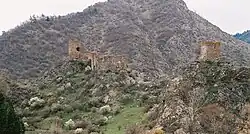 Slesa Fortress
 Atskuri Fortress (north-east view)
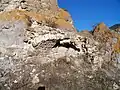 Church ruins inside the fortress walls
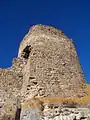 One of the fortress towers
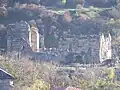 Church of the Virgin Mary of Atskuri
 19th-century photograph by Vladimir Barkanov
 View from Atskuri Fortress
Literature
Georgian Soviet Encyclopedia, Vol. 2, Tbilisi, 1977, p. 77.
External links
- Information about Slesa Fortress Archived 2015-06-19 at the Wayback Machine
- Vakhtang Beridze – Architectural Monuments of Samtskhe Archived 2016-08-02 at the Wayback Machine
References
- 1 2 "Population Census 2014". www.geostat.ge. National Statistics Office of Georgia. November 2014. Retrieved 28 June 2021.
- ↑ Merab Beridze, “On the etymology of several Georgian anthroponyms and toponyms”, Ivane Javakhishvili Tbilisi State University journal Spekali.
- ↑ "Restoration works in Atskuri church ruins". sknews.ge. Retrieved 2026-05-28.