Aristillus (crater)
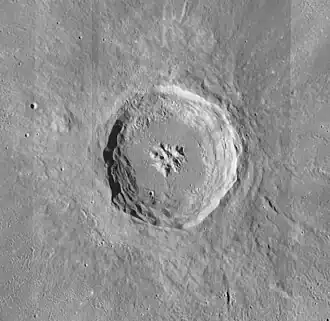 LRO mosaic | |
| Coordinates | 33°54′N 1°12′E / 33.9°N 1.2°E |
|---|---|
| Diameter | 54.37 km (33.78 mi)[1] |
| Depth | 3.30 km (2.05 mi)[2] |
| Colongitude | 359° at sunrise |
| Formation | Copernican[3] ? |
| Eponym | Aristyllus |

NASA photo.

Aristillus is a prominent lunar impact crater that lies in the eastern Mare Imbrium. T. W. Webb described it as "a very magnificent crater" and "the ring stands up nobly from the plain, and is flanked on all sides ... by radiating banks".[4] Patrick Moore noted that the "interior details show optical variations over a lunation." Directly to the south is the smaller crater Autolycus, while to the southwest is the large Archimedes.[5] To the northeast are the craters Theaetetus and Cassini.[6]: 55
This crater was named after the Greek astronomer Aristyllus (fl. c. 280 B.C.). Its designation was formally adopted by the International Astronomical Union in 1935.[1] The name was introduced into lunar nomenclature by Italian astronomer Giovanni Ricciolli in 1651.[7]
Description
The Apollo 15 landing site is located around 250 km (160 mi) to the south of Aristillus.[8] Ejecta samples collected from that site suggest a tentative age of 1.3 Gyr for this crater.[9][10] Measurements with the Gamma-Ray Spectrometer on the Lunar Prospector spacecraft indicate an anomalously high abundance of thorium nearby.[11]
The rim of Aristillus has a wide, irregular outer rampart of ejecta that is relatively easy to discern against the smooth surface of the surrounding mare. The crater impact created a ray system that extends for a distance of over 600 kilometers. These intersect with the less pronounced rays from Autolycus.[12][13] Due to its rays, Aristillus is mapped as part of the Copernican System,[3] although it may be older.[9] The rim is generally circular in form, but possesses a slight hexagonal shape.
The inner walls of the rim have a terraced surface, and descend to a relatively rough interior that has not been flooded with lava.[6]: 55 In the middle of the crater is a set of three clustered peaks,[5] which rise to a height of about 0.9 km. American planetary scientist C. A. Wood observed that the "peaks look like they stick nearly straight up in a tight circle, with one fallen slab across the middle."[14] The spectra of the central peak fits an olivine-bearing gabbroic norite mineralogy, which originated from a depth of 5.5 to 8.4 km.[15]
In the northern outer ramparts of Aristillus is a ghost crater remnant. This is the protruding rim of an old crater that has been almost completely submerged by the lava flows of the surrounding Mare Imbrium. The southern end of the rim has been covered by the ejecta from Aristillus. Along the eastern inner wall and rim is an unusual narrow ribbon of dark material.[6]: 55
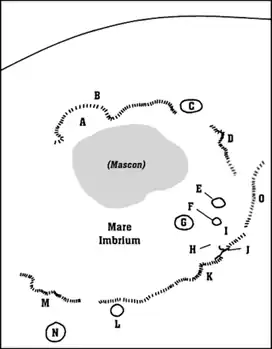
In 1914, American astronomer W. H. Pickering observed what he called "canals" within the crater under certain lighting conditions. These cross the northwest rim.[16][17][18]
In culture
English progressive rock band Camel named the first song on their album Moonmadness after the crater. Science fiction author Travis J I Corcoran set much of his first novel, The Powers of the Earth, on and under Aristillus.
Satellite craters
By convention these features are identified on lunar maps by placing the letter on the side of the crater midpoint that is closest to Aristillus.[19]
| Aristillus[6]: 292 | Latitude | Longitude | Diameter |
|---|---|---|---|
| A | 33.6° N | 4.5° E | 5 km |
| B | 34.8° N | 1.9° W | 8 km |
References
- 1 2 "Aristillus". Gazetteer of Planetary Nomenclature. USGS Astrogeology Research Program.
- ↑ Pike, R. J. (September 1976). "Crater Dimensions from Apollo Data and Supplemental Sources". The Moon. 15 (3–4): 463–477. Bibcode:1976Moon...15..463P. doi:10.1007/BF00562253.
- 1 2 Wilhelms, Don E.; McCauley, John F.; Trask, Newell J. (1987). The geologic history of the Moon. USGS Professional Paper 1348. Washington: U.S. Government Printing Office. doi:10.3133/pp1348. Plate 11: Copernican System.
- ↑ Webb, Rev. T. W. (1962). Celestial Objects for Common Telescopes (6th revised ed.). Dover. pp. 114–115, 154–159. Reprint: ISBN 978-0-486-20917-3
- 1 2 Moore, Patrick (2001). On the Moon. Sterling Publishing Co. ISBN 978-0-304-35469-6.
- 1 2 3 4 Bussey, B.; Spudis, P. (2004). The Clementine Atlas of the Moon. New York: Cambridge University Press. ISBN 978-0-521-81528-4.
- ↑ Whitaker, Ewen A. (1999). Mapping and Naming the Moon. Cambridge University Press. pp. 60, 210. ISBN 978-0-521-62248-6.
- ↑ Le Mouélic, Stéphane; et al. (February 1999). "A new data reduction approach for the Clementine NIR data set: Application to Aristillus, Aristarchus and Kepler". Journal of Geophysical Research. 104 (E2): 3833–3844. Bibcode:1999JGR...104.3833L. doi:10.1029/1998JE900035.
- 1 2 Grier, Jennifer A.; et al. (December 2001). "Optical maturity of ejecta from large rayed lunar craters". Journal of Geophysical Research. 106 (E12): 32847–32862. Bibcode:2001JGR...10632847G. doi:10.1029/1999JE001160.
- ↑ Hiesinger, Harald; et al. (April 2016). How old is Autolycus crater?. EGU General Assembly 2016, held 17-22 April, 2016 in Vienna Austria. id. EPSC2016-9655. Bibcode:2016EGUGA..18.9655H.
- ↑ Lawrence, D. J.; et al. (2000). "Thorium abundances on the lunar surface". Journal of Geophysical Research. 105 (E8): 20307–20332. Bibcode:2000JGR...10520307L. doi:10.1029/1999JE001177.
- ↑ Anunziato, Alberto (July 2022). "Wonders of the Full Moon: Northern Bright Ray Craters" (PDF). The Lunar Observer. Association of Lunar & Planetary Observers, Lunar section: 50–52. Retrieved 2026-05-21.
- ↑ Grego, Peter (2005). The Moon and How to Observe It. Astronomers' Observing Guides Series. London: Springer-Verlag. p. 140. ISBN 1-85233-748-6.
- ↑ Wood, Chuck (November 7, 2007). "Lunar Stonehenge". Lunar Photo of the Day. Retrieved 2026-05-21.
- ↑ Cahill, J. T. S.; et al. (September 2009). "Compositional variations of the lunar crust: Results from radiative transfer modeling of central peak spectra". Journal of Geophysical Research. 114 (E9) E09001. Bibcode:2009JGRE..114.9001C. doi:10.1029/2008JE003282.
- ↑ Pickering, William H. (November 1914). "The Double Canal of the Lunar Crater Aristillus". Popular Astronomy. 22: 570–578. Bibcode:1914PA.....22..570P.
- ↑ Christie, W. H. M. (April 1921). "Moon, Changes in the lunar craters Aristillus and Eratosthenes observed at the Harvard College Observatory, Mandeville, Jamaica". Monthly Notices of the Royal Astronomical Society. 81: 451. Bibcode:1921MNRAS..81..451C. doi:10.1093/mnras/81.6.451.
- ↑ Maggini, Mentore (March 1922). "The Lunar Crater Aristillus, with Plate XV". Popular Astronomy. 30: 140. Bibcode:1922PA.....30..140M.
- ↑ Grego, P. (2015). "Satellite Crater". In Hargitai, H.; Kereszturi, Á. (eds.). Encyclopedia of Planetary Landforms. New York, NY: Springer. doi:10.1007/978-1-4614-3134-3_328.
Sources
- Price, Fred W. (1988). The Moon Observer's Handbook. Cambridge University Press. ISBN 978-0-521-33500-3.
- Rükl, Antonín (1990). Atlas of the Moon. Kalmbach Books. ISBN 978-0-913135-17-4.
- Wlasuk, Peter T. (2000). Observing the Moon. Springer. ISBN 978-1-85233-193-1.
External links
 Media related to Aristillus (crater) at Wikimedia Commons
- Wood, Chuck (April 25, 2005). "A Ribbon of Darkness". Lunar Photo of the Day. Retrieved 2026-05-21.
| Physical properties |  | |
|---|---|---|
| Orbit | ||
| Surface and features | ||
| Science | ||
| Exploration | ||
| Time-telling and navigation | ||
| Phases and names | ||
| Daily phenomena | ||
| Related |
| |
