Archytas (crater)
 Lunar Orbiter 4 image | |
| Coordinates | 58°42′N 5°00′E / 58.7°N 5.0°E |
|---|---|
| Diameter | 31.95 km (19.85 mi)[1] |
| Depth | 2.4 km |
| Colongitude | 355° at sunrise |
| Formation | Eratosthenian[2] |
| Eponym | Archytas |
Archytas is a lunar impact crater that protrudes into the northern edge of Mare Frigoris. To the northwest is the comparably sized crater Timaeus, and the smaller Protagoras lies in the opposite direction to the southeast.[3] Further to the southwest, beyond the opposite edge of the mare, is the dark-floored crater Plato.
On the lunar geologic timescale, Archytas dates to the Eratosthenian age.[2] The rim of Archytas is sharp-edged and shows little appearance of erosion due to subsequent impacts. The outer wall is nearly circular, with a slight outward bulge in the southeast. The interior is rough, with a ring of material deposited at the base of the inner wall. Just to the east of the crater midpoint is a pair of central peaks.[4]: 12
The surface surrounding the crater is relatively smooth to the south due to the lava flows that formed the mare. The surface is more rugged to the north and northeast. The satellite crater Archytas B, located to the northwest of Archytas, forms a lava-flooded bay along the edge of the Mare Frigoris.
This crater is named after the Greek mathematician Archytas (435/410–360/350 BC). This designation was formally adopted by the International Astronomical Union in 1935.[1]
Satellite craters
By convention these features are identified on lunar maps by placing the letter on the side of the crater midpoint that is closest to Archytas.[5]
| Archytas[4]: 292 | Latitude | Longitude | Diameter |
|---|---|---|---|
| B | 61.3° N | 3.2° E | 36 km |
| D | 63.5° N | 11.8° E | 43 km |
| G | 55.6° N | 0.5° E | 7 km |
| K | 62.6° N | 7.7° E | 15 km |
| L | 56.2° N | 0.9° E | 5 km |
| U | 62.8° N | 9.2° E | 8 km |
| W | 61.2° N | 5.2° E | 6 km |
Archytas G is a concentric crater, located on top of a large lunar dome in Mare Frigoris.[6]
Gallery
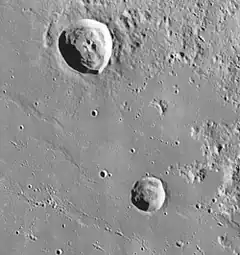 Archytas (upper left) and Protagoras (lower right). LRO image.
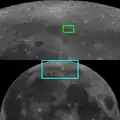 Location of Archytas
References
- 1 2 "Archytas". Gazetteer of Planetary Nomenclature. USGS Astrogeology Research Program.
- 1 2 Wilhelms, Don E.; McCauley, John F.; Trask, Newell J. (1987). The geologic history of the Moon. USGS Professional Paper 1348. Washington: U.S. Government Printing Office. doi:10.3133/pp1348. Table 12.2.
- ↑ Moore, Patrick (2001). On the Moon. Sterling Publishing Co. p. 171. ISBN 978-0-304-35469-6.
- 1 2 Bussey, B.; Spudis, P. (2004). The Clementine Atlas of the Moon. New York: Cambridge University Press. p. 292. ISBN 978-0-521-81528-4.
- ↑ Grego, P. (2015). "Satellite Crater". In Hargitai, H.; Kereszturi, Á. (eds.). Encyclopedia of Planetary Landforms. New York, NY: Springer. doi:10.1007/978-1-4614-3134-3_328.
- ↑ Wöhler, C.; Lena, R. (March 2009). The Lunar Concentric Crater Archytas G Associated with an Intrusive Dome. 40th Lunar and Planetary Science Conference, (Lunar and Planetary Science XL), held March 23-27, 2009 in The Woodlands, Texas, id.1091. Bibcode:2009LPI....40.1091W.
Sources
- Price, Fred W. (1988). The Moon Observer's Handbook. Cambridge University Press. ISBN 978-0-521-33500-3.
- Rükl, Antonín (1990). Atlas of the Moon. Kalmbach Books. ISBN 978-0-913135-17-4.
- Wlasuk, Peter T. (2000). Observing the Moon. Springer. ISBN 978-1-85233-193-1.
External links
 Media related to Archytas (crater) at Wikimedia Commons
| Physical properties |  | |
|---|---|---|
| Orbit | ||
| Surface and features | ||
| Science | ||
| Exploration | ||
| Time-telling and navigation | ||
| Phases and names | ||
| Daily phenomena | ||
| Related |
| |
