Architecture of Neukölln
Architecture of Neukölln encompasses more than six centuries of urban development in the Neukölln locality of Berlin, Germany. The area contains architectural landmarks ranging from the late medieval Bethlehem Church and the surviving buildings of the former Bohemian village of Rixdorf to the dense Gründerzeit apartment blocks that characterize much of inner Berlin, early 20th-century civic architecture, modernist housing estates, and contemporary redevelopment projects.
The locality is particularly associated with the work of municipal architect Reinhold Kiehl, whose public buildings and urban planning helped shape Rixdorf during its rapid expansion around the turn of the 20th century. Neukölln also contains notable examples of Expressionist architecture, Art Deco, postmodern architecture, industrial architecture, and large-scale social housing, reflecting successive phases of Berlin's growth, reconstruction after the Second World War, and ongoing urban renewal.
Gründerzeit
 Richardplatz 20, Rixdorf
 Jonasstraße 1, Körnerpark
 Bürknerstraße 22–23, Reuterkiez
 Emser Straße 102, Körnerpark
 Fuldastraße 45–46, Flughafenkiez
 Herrnhuter Weg 17, Rixdorf
 Isarstraße 3, Flughafenkiez
 Turmblock, Sonnenallee 125–33, Rixdorf
 Idealpassage, Fuldastraße 55–56, Flughafenkiez
 Schillerpromenade
As a general makeup, like most of Berlin's inner-city quarters, many parts of Neukölln belong to the Wilhelmine Ring with its historicist Gründerzeit residential houses, which are most prominent in the older neighborhoods of Reuterkiez, Flughafenstraße, Rixdorf, Körnerpark and Schillerpromenade. Part of the homogenous nature of Berlin's so-called Altbauten (old structures) stems from the city's regulations regarding a uniform eaves height. Furthermore, Berlin's classically trained architects had never strayed far from the dimensional design of the adjacent buildings, especially the height of their floors. These measures all contribute to the harmonious nature of Berlin's old residential blocks from the Gründerzeit era.
Alt-Rixdorf
 Blacksmith's shop, Richardplatz
 Blacksmith's shop, Richardplatz
 Villa Rixdorf, Richardplatz
 Backyard, Richardplatz 17
 Backyard, Richardplatz 3
 Bethlehem Church
 Bohemian duplex house, Richardstraße 36–37
 Bohemian house, Richardstraße 80
 Reformed Bethlehem parish, Richardstraße 97
 Belfry, Reformed Bethlehem Church
 Comenius Garden
 Hussite school building, Kirchgasse 5
 Bohemain house, Kirchgasse 6
 Cemetery Böhmischer Gottesacker
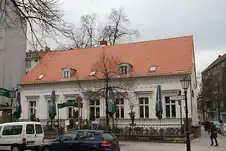
The oldest areas of Neukölln are to be found in the historical center of Rixdorf around Richardplatz and along both Richardstraße and Kirchgasse. Among them are the 15th century Bethlehem Church, partially reconstructed after a fire, the historical blacksmith's shop, Berlin's oldest forge still in operation, a few old eclecticist residential houses like the Villa Rixdorf, the Bohemian cemetery Böhmischer Gottesacker, and two original estates (Richardstraße 36–37), which represent the Moravian colony's traditional style of duplex houses and have retained backyard structures from as far back as the year 1670, even before the first settlers arrived. Other Bohemian remnants can also be found, like traditional backyards, stables, old narrow streets, the former Hussite school on Kirchgasse, the oldest school building of Neukölln and now a museum, and the Reformed Bohemian parish house with its separated wooden belfry on Richardstraße.
Modern architecture
 Bürknerstraße 12–14, Reuterkiez
 Oderstraße 45, Schillerkiez
 Estrel Tower, 176 m
 Die Ringe, Rollberg
 Weiße Siedlung
 High-Deck-Siedlung
 Apostolic Nunciature, Hasenheide
 School entrance wing, Drorystraße, Rixdorf
 Estrel Berlin, Rixdorf
On the other end of the spectrum are the early modernist estates like the projects by Bruno Taut, among them the 1910 estate on Bürknerstraße 12–14, the 1927 Ossastraße settlement, both in the Reuterkiez, and the 1927 buildings on Oderstraße (Schillerkiez). Later modernist developments originated from the public housing projects of the 1960s to '80s like Weiße Siedlung, High-Deck-Siedlung and most of Rollberg. While the Weiße Siedlung was still built using the high-rise concept of urbanity through concentration, the High-Deck-Siedlung as well as the Rollberg redevelopment, with its meandering estates in the east and Die Ringe (The Rings) in the west, used a more open and locally interconnected approach instead, especially the High-Deck-Siedlung with its eponymous pedestrian skyways. Due to the quarter's older compact urban characteristics, 21st century postmodernist stand-alone buildings or estates are more scarce in Neukölln than in other quarters of Berlin. Examples are the perimeter block estate at Böhmische Straße 38 in Rixdorf, the Apostolic Nunciature near Südstern, or the primary school in Rixdorf's Drorystraße. One of the most prominent redevelopment undertakings in the whole of Berlin, comparable to the 1990s construction on Potsdamer Platz, is happening in the Neukölln Docklands, an industrial neighborhood along the Neukölln Ship Canal north and south of the Sonnenbrücke at the outskirts of Rixdorf, which will include the Estrel Tower, Berlin's tallest skyscraper and Germany's tallest hotel at 176 m (577 ft), providing an upgrade to the nearby Estrel, Germany's largest hotel, and its convention center.
Reinhold Kiehl
 Rathaus Neukölln (City Hall), Rixdorf
 Stadtbad Neukölln (public bath house), Rixdorf
 Stadtbad Neukölln (public bath house), Rixdorf
 Orangerie, Körnerpark
 Pump room kiosk, Richardplatz, Rixdorf
 Sonnenallee station, Rixdorf
 Chapel, Alter Friedhof St. Jacobi
 Dammwegsiedlung
The most popular architectural locations, however, originated from Rixdorf's boomtown phase, which spanned the mid-19th to early 20th century.[note 1] Aside from the ubiquitous Gründerzeit apartment blocks, many important stand-alone buildings and representative locations were constructed in this era, in which Reinhold Kiehl played a central role, both as an architect and as director of Rixdorf's Hochbauamt (office of public works service) in charge of urban planning and development. Together with development official Hermann Weigand, architect Heinrich Best and design director John Martens, Rixdorf's building authority received a stellar reputation across the German Empire, which attracted young architects like Ludwig Mies van der Rohe, Bruno and Max Taut, Franz Hoffmann and others, who all earned their stripes in Rixdorf before becoming renowned independent architects. After Kiehl stepped down in 1912, most of his remaining projects were finished by his colleague Heinrich Best or under Neukölln's new building official Friedrich Zollinger (1912–18).
Kiehl's two most important projects, both of them in Rixdorf, are the 1905 Rathaus Neukölln (city hall) on Karl-Marx-Straße, inspired by the German Renaissance and expanded in the 1950s, and the 1912 neoclassicist Stadtbad Neukölln (public city bath) on Ganghoferstraße, with a green neoclassical atrium and interior stylistic callbacks to the thermae and temples of Roman and Greek antiquity. Among his lesser known, but nonetheless important works, are the Baroque orangerie in the Körnerpark, the central pump room kiosk on Richardplatz,[note 2] and the 1911 entrance building at the Sonnenallee S-Bahn station. Kiehl is buried on the cemetery Alter Friedhof St. Jacobi, whose chapel (near Hermannplatz) he had designed in the style of ancient Roman temples. After his death in 1913, more of his original plans were implemented, for example the modern-day Carl Legien School on Leinestraße (Schillerkiez), which was originally constructed in 1924 as a building academy (Baugewerbeschule Neukölln), and the proto-modernist settlement in the south-eastern outskirts of Rixdorf, the Dammwegsiedlung, which was finished in 1922 south of modern-day Weiße Siedlung.
Other representative buildings
 Alte Post (old post office), Rixdorf
 Kindle Ballrooms, Flughafenkiez
 Amtsgericht Neukölln (municipal court), Rixdorf
 Neue Welt, Hasenheide, Schillerkiez
 Neuer Rollkrug, Flughafenkiez
 Hermannplatz U-Bahn station (U7)
Many other architects have added to Neukölln's important historical building structure. Examples are the 1905 imperial Alte Post (Old Post Office) on Karl-Marx-Straße, primarily styled after Renaissance buildings, the 1893 Kindl Ballrooms on Hermannstraße, and the 1899–1901 Renaissance revivalist Amtsgericht Neukölln, the borough's municipal court and former prison on Karl-Marx-Straße, which replaced the original 1879 Amtsgericht. The beer hall Neue Welt (New World) on the street Hasenheide close to Hermannplatz, originally founded in 1865 as a beer garden, was constructed in 1902, and is today a concert venue called Huxleys Neue Welt (see above). Directly on Hermannplatz is the 1907 Neuer Rollkrug, an old office building which was built at the location of the demolished Rollkrug, Rixdorf's most famous historical tavern. Next to it is the plaza's U-Bahn station, of which the lower U7 platform is especially noteworthy due to its spacious Art Deco design and direct access to the Karstadt department store. Both were constructed together in 1923, and the subway station's main hall opened in 1926.
Commercial and industrial buildings
 Passage, Rixdorf
 Banking house, Alfred-Scholz-Platz, Rixdorf
 Reichsbank building, Ganghoferstraße, Rixdorf
 Eisenwerk Franz Weeren, Körnerpark
 Industrial villa, Eisenwerk Franz Weeren, Körnerpark
 Hermannshof, Hermannstraße, Schillerkiez
 Niemann factory, Sonnenallee, Rixdorf
 Transformer station, Richardstraße, Rixdorf
 Neukölln water tower, Rollberg
 Geyer film factory, Reuterkiez
 Sudhaus, Kindl brewery, Rollberg
 Bergschloss-Brauerei, Schillerkiez
 Institute for Disinfection, Rixdorf
 Jacobs factory, High-Deck-Siedlung
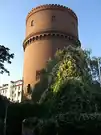
Neukölln's central industrial and commercial areas evolved in the same boomtown period. Important buildings from Rixdorf are Reinhold Kiehl's 1909 arcade building (Passage) between Richardstraße and Karl-Marx-Straße, which now houses a cinema and Neukölln's opera (see above), the 1912 banking house at the Alfred-Scholz-Platz, and the former Reichsbank branch office on Ganghoferstraße, built between 1912 and 1914. Industrial buildings of note are the 1887 Franz Weeren Eisenwerk (ironworks) with industrial villa on Glasower Straße (Körnerpark), the 1904 Hermannshof on Hermannstraße (Schillerkiez), the 1916 Niemann factory on Sonnenallee, the 1928 Umspannwerk (transformer station) on Richardstraße, the heating power plant on Weigandufer with many of the old factory buildings still intact, the Neukölln Water Tower in the Rollberg neighborhood, the 1914 Geyer film factory on Harzer Straße, and the 1926 expressionist Gothic revivalist Sudhaus der Berliner Kindl-Brauerei, an old brewery and today a center for arts and culture, including a museum of modern art (see above). Another notable brewery is the Bergschloss-Brauerei near Hermannplatz, which has been housing cultural centers for many years. In Rixdorf's periphery south of Neukölln's industrial railroad around Mittelbuschweg, some old factories and workshops have survived, for example a former liquor factory, or the 1914 former Institute for Disinfection, another building supervised by Reinhold Kiehl. After World War II, many newer factories and industrial plants were built further south, for example the Jacobs factory at the Britz Canal south of the High-Deck-Siedlung, and many of them are already under industrial monument preservation as well.
Gallery
 Hermannplatz, Donaukiez
 County Court
 County Court and City Hall
 Public bath house
 Buddy Bear Rixi at City Hall
 Volkspark Hasenheide in winter, 2013
 Hall of Honor, Lilienthalstraße cemetery, Hasenheide
Notes
- ↑ For a list of Neukölln's old and newer cultural monuments, see also Liste der Kulturdenkmale in Berlin-Neukölln; for the current official list, see "Denkmalliste" with download, Landesdenkmalamt Berlin, Berlin 2023.
- ↑ The kiosk was originally called the Pilz ("mushroom") by Rixdorf's citizens, because it was painted in red and white like an Amanita muscaria.