Apollonius (crater)
 Apollo 15 image | |
| Coordinates | 4°31′N 61°58′E / 4.51°N 61.96°E |
|---|---|
| Diameter | 50.66 km (31.48 mi)[1] |
| Depth | 2.75[2] km |
| Colongitude | 299° at sunrise |
| Eponym | Apollonius of Perga |
Apollonius is a lunar impact crater located near the eastern limb of the Moon. It lies in the region of uplands to the west of Mare Undarum and northeast of the Sinus Successus on the Mare Fecunditatis. It is southwest of the crater Firmicus, and north of Condon.[3][4]
The outer rim of Apollonius is somewhat worn and is overlain by a pair of small craters (including Apollonius E) across the western wall. The nearly flat interior floor has a low albedo and has been covered by lava. It lacks a central peak or notable small craters across the bottom.[5]: 62
This crater was named after Greek mathematician Apollonius of Perga (c. 262–190 B.C.). It was formerly adopted by the International Astronomical Union in 1935.[1] The name was introduced into lunar nomenclature by Johann Madler during the 19th century.[6]
Satellite craters
By convention these features are identified on lunar maps by placing the letter on the side of the crater midpoint that is closest to Apollonius.[7]
| Apollonius[5]: 292 | Latitude | Longitude | Diameter |
|---|---|---|---|
| A | 4.8° N | 56.8° E | 24 km |
| B | 5.7° N | 57.6° E | 32 km |
| E | 4.4° N | 61.9° E | 16 km |
| F | 5.6° N | 60.0° E | 16 km |
| H | 3.4° N | 59.6° E | 20 km |
| J | 4.6° N | 57.5° E | 12 km |
| L | 6.5° N | 54.6° E | 9 km |
| M | 4.8° N | 61.9° E | 10 km |
| N | 4.8° N | 64.1° E | 9 km |
| S | 1.1° N | 62.6° E | 15 km |
| U | 4.9° N | 59.9° E | 7 km |
| V | 4.4° N | 58.2° E | 16 km |
| X | 7.0° N | 58.1° E | 31 km |
| Y | 4.9° N | 62.6° E | 10 km |
The following craters have been renamed by the IAU.[8]
- Apollonius C — See Ameghino (crater).
- Apollonius D — See Cartan (crater).
- Apollonius G — See Townley (crater).
- Apollonius K — See Abbot (crater).
- Apollonius P — See Daly (lunar crater).
- Apollonius T — See Bombelli (crater).
- Apollonius W — See Petit (crater).
Apollonius N is a concentric (double-walled) crater.[9] The landing site of Luna 20 was just to the west of what is now called Ameghino (crater).[10]
Gallery
 Location of Apollonius on the near side of the Moon
 Oblique view from Apollo 10
 Oblique view from Apollo 17
 Apollonius N is a concentric crater
 Oblique view of Apollonius N from Apollo 17
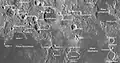 Apollonius and surroundings
References
- 1 2 "Apollonius". Gazetteer of Planetary Nomenclature. USGS Astrogeology Research Program.
- ↑ Pike, R. J. (September 1976). "Crater Dimensions from Apollo Data and Supplemental Sources". The Moon. 15 (3–4): 463–477. Bibcode:1976Moon...15..463P. doi:10.1007/BF00562253.
- ↑ Moore, Patrick (2001). On the Moon. Sterling Publishing Co. p. 166. ISBN 978-0-304-35469-6.
- ↑ "LTO-62C1 Firmicus". Lunar Topographic Orthophotomap (LTO) Series. Lunar and Planetary Institute. Retrieved 2026-05-17.
- 1 2 Bussey, B.; Spudis, P. (2004). The Clementine Atlas of the Moon. New York: Cambridge University Press. ISBN 978-0-521-81528-4.
- ↑ Whitaker, Ewen A. (1999). Mapping and Naming the Moon. Cambridge University Press. pp. 120, 219. ISBN 978-0-521-62248-6.
- ↑ Grego, P. (2015). "Satellite Crater". In Hargitai, H.; Kereszturi, Á. (eds.). Encyclopedia of Planetary Landforms. New York, NY: Springer. doi:10.1007/978-1-4614-3134-3_328.
- ↑ Moore, Patrick; Rees, Robin (2014). Patrick Moore's Data Book of Astronomy (2 ed.). Cambridge University Press. pp. 50–79. ISBN 978-1-139-49522-6.
- ↑ Dembowski, William M. (October 2006). "Enigmatic lunar craters". Journal of the Association of Lunar & Planetary Observers, The Strolling Astronomer (ISSN 0039-2502). 48 (4): 27–31. Bibcode:2006JALPO..48d..27D.
- ↑ Wilshire, H. G.; et al. (1974). "Lunar highlands vulcanism – implications from Luna 20 and Apollo 16". Journal of Research of the U.S. Geological Survey. 2 (1). U.S. Geological Survey: 2.
Sources
- Price, Fred W. (1988). The Moon Observer's Handbook. Cambridge University Press. ISBN 978-0-521-33500-3.
- Rükl, Antonín (1990). Atlas of the Moon. Kalmbach Books. ISBN 978-0-913135-17-4.
- Wlasuk, Peter T. (2000). Observing the Moon. Springer. ISBN 978-1-85233-193-1.
External links

| Physical properties |  | |
|---|---|---|
| Orbit | ||
| Surface and features | ||
| Science | ||
| Exploration | ||
| Time-telling and navigation | ||
| Phases and names | ||
| Daily phenomena | ||
| Related |
| |
