Anthrone
 | |
 | |
| Names | |
|---|---|
| Preferred IUPAC name
Anthracen-9(10H)-one | |
Other names
| |
| Identifiers | |
3D model (JSmol) |
|
| ChEBI | |
| ChEMBL | |
| ChemSpider | |
| ECHA InfoCard | 100.001.813 |
PubChem CID |
|
| UNII | |
CompTox Dashboard (EPA) |
|
| |
| |
| Properties | |
| C14H10O | |
| Molar mass | 194.233 g·mol−1 |
| Appearance | White to light yellow needles |
| Melting point | 155 to 158 °C (311 to 316 °F; 428 to 431 K) |
| Insoluble | |
Except where otherwise noted, data are given for materials in their standard state (at 25 °C [77 °F], 100 kPa).
Infobox references | |


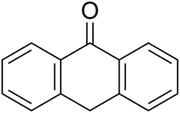
Anthrone is a tricyclic aromatic ketone. It is used for a common cellulose assay and in the colorimetric determination of carbohydrates.[1]
Derivatives of anthrone are used in pharmacy as laxative. They stimulate the motion of the colon and reduce water reabsorption. Some anthrone derivatives can be extracted from a variety of plants, including Rhamnus frangula, Aloe ferox, Rheum officinale, and Cassia senna.[2] Glycosides of anthrone are also found in high amounts in rhubarb leaves, and alongside concentrated amounts of oxalic acid are the reason for the leaves being inedible.
Synthesis and reactions
Anthrone can be prepared from anthraquinone by reduction with tin or copper.[3]
An alternative synthesis involves cyclization of o-benzylbenzoic acid induced with hydrogen fluoride.[4]

Anthrone condenses with glyoxal to give, following dehydrogenation, acedianthrone, a useful octacyclic pigment.[5]

Anthrone is the more stable tautomer relative to the anthrol as has been established also by X-ray crystallography.[6] The tautomeric equilibrium is estimated at 100 in aqueous solution. For the two other isomeric anthrols, the tautomeric equilibrium is reversed: they are phenolic.[7]
Anthrone undergoes nitration using conventional conditions for aromatic nitration, implying that it is the hydroxy tautomer that is the reactant.[8]
Applications
This is a list of some of the applications of anthrone: XE-991,[9] DMP 543,[10] maprotiline,[11] 1-(9-Anthryloxy)-2-aminoethane (c.f. flunamine). In Lednicer's textbook it was said that melitracen was made from anthrone.[12] However, since the time of publication it has now been discovered that there are other avenues to making the 10,10-dimethylanthrone [5447-86-9] precursor compound.
The Beckmann rearrangement or Schmidt reaction of anthrone would give 6-morphanthridinone [1211-06-9].[13] The relevance of this to drug chemistry is that it finds involvement in the synthesis of perlapine, epinastine, mianserin, prazepine & pitrazepin, for example.
References
- ↑ Trevelyan, W. E.; Forrest, RS; Harrison, JS (1952). "Determination of Yeast Carbohydrates with the Anthrone Reagent". Nature. 170 (4328): 626–627. Bibcode:1952Natur.170..626T. doi:10.1038/170626a0. PMID 13002392. S2CID 4184596.
- ↑ Niaz, Kamal; Khan, Fazlullah (2020-01-01), "Chapter 3 - Analysis of polyphenolics", in Sanches Silva, Ana; Nabavi, Seyed Fazel; Saeedi, Mina; Nabavi, Seyed Mohammad (eds.), Recent Advances in Natural Products Analysis, Elsevier, pp. 39–197, doi:10.1016/b978-0-12-816455-6.00003-2, ISBN 978-0-12-816455-6, retrieved 2024-06-01
- ↑ Macleod, L. C.; Allen, C. F. H. (1934). "Benzanthrone". Organic Syntheses. 14: 4. doi:10.15227/orgsyn.014.0004.
- ↑ Fieser, Louis F.; Hershberg, E. B. (May 1939). "Inter- and Intramolecular Acylations with Hydrogen Fluoride". Journal of the American Chemical Society. 61 (5): 1272–1281. Bibcode:1939JAChS..61.1272F. doi:10.1021/ja01874a079.
- ↑ Bien, H.-S.; Stawitz, J.; Wunderlich, K. (2005). "Anthraquinone Dyes and Intermediates". Ullmann's Encyclopedia of Industrial Chemistry. Weinheim: Wiley-VCH. doi:10.1002/14356007.a02_355. ISBN 978-3-527-30673-2.
- ↑ Lian, Jian-Jou; Lin, Chung-Chang; Chang, Hsu-Kai; Chen, Po-Chiang; Liu, Rai-Shung (2006). "Thermal and Metal-Catalyzed Cyclization of 1-Substituted 3,5-Dien-1-ynes via a [1,7]-Hydrogen Shift: Development of a Tandem Aldol Condensation−Dehydration and Aromatization Catalysis between 3-En-1-yn-5-al Units and Cyclic Ketones". Journal of the American Chemical Society. 128 (30): 9661–9667. Bibcode:2006JAChS.128.9661L. doi:10.1021/ja061203b. PMID 16866518.
- ↑ Ośmiałowski, Borys; Raczyńska, Ewa D.; Krygowski, Tadeusz M. (2006). "Tautomeric Equilibria and Pi Electron Delocalization for Some Monohydroxyarenes Quantum Chemical Studies". The Journal of Organic Chemistry. 71 (10): 3727–3736. doi:10.1021/jo052615q. PMID 16674042.
- ↑ Kurt H. Meyer (1928). "Nitroanthrone". Organic Syntheses. 8: 78. doi:10.15227/orgsyn.008.0078.
- ↑ Wilkerson, W., Earl, R., Calabrese, J., Drammond, S., Teleha, C., Voss, M., Zaczek, R. (January 1996). "Acetylcholine release enhancers related to linopirdine: A structure—activity relationship study. II". European Journal of Medicinal Chemistry. 31 (4): 319–330. doi:10.1016/0223-5234(96)80369-2.
- ↑ Earl, R. A., Zaczek, R., Teleha, C. A., Fisher, B. N., Maciag, C. M., Marynowski, M. E., Logue, A. R., Tam, S. W., Tinker, W. J., Huang, S.-M., Chorvat, R. J. (1 November 1998). "2-Fluoro-4-pyridinylmethyl Analogues of Linopirdine as Orally Active Acetylcholine Release-Enhancing Agents with Good Efficacy and Duration of Action". Journal of Medicinal Chemistry. 41 (23): 4615–4622. doi:10.1021/jm9803424.
- ↑ Wilhelm, M., Schmidt, P. (January 1969). "Synthese und Eigenschaften von 1‐Aminoalkyl‐dibenzo[ b , e ]bicyclo[2.2.2]octadienen". Helvetica Chimica Acta. 52 (6): 1385–1395. doi:10.1002/hlca.19690520602.
- ↑ Lednicer, D. (13 October 2008). Strategies for Organic Drug Synthesis and Design (1st ed.). Wiley. doi:10.1002/9780470399613. ISBN 9780470190395.
- ↑ Weinreb, S. M., Schaumann, E., eds. (2004). Category 2, Hetarenes and Related Ring Systems: Six-Membered Hetarenes with Two Unlike or More than Two Heteroatoms and Fully Unsaturated Larger-Ring Heterocycles. Georg Thieme Verlag. doi:10.1055/b-003-121805. ISBN 9783131186713.