Annihilator table
| f(x) | A(D) |
|---|
 |  |
 |  |
 |  |
 |  |
 |  |
 |  |
 |  |
 |  |
Where  is in the natural numbers, and
 are in the real numbers.
If  consists of the sum of the expressions given in the table, the annihilator is the product of the corresponding annihilators.
Example
Given  ,
 .
The simplest annihilator of
 is
 . The zeros of
 are
 , so the solution basis of
 is

Setting  we find

giving the system


which has solutions
 ,

giving the solution set
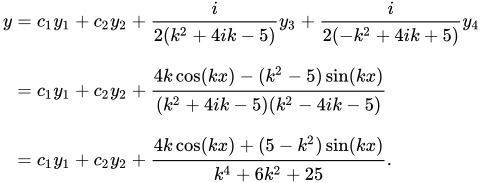
This solution can be broken down into the homogeneous and nonhomogeneous parts. In particular,  is a particular integral for the nonhomogeneous differential equation, and
 is a complementary solution to the corresponding homogeneous equation. The values of
 and
 are determined usually through a set of initial conditions. Since this is a second-order equation, two such conditions are necessary to determine these values.
The fundamental solutions  and
 can be further rewritten using Euler's formula:


Then  , and a suitable reassignment of the constants gives a simpler and more understandable form of the complementary solution,
 .


