Temple of the True Inner Light
 | |
| Formation | 1980[1][2] |
|---|---|
| Founders | Alan Birnbaum (born 1946 or 1947 (age 78–79))[1][3] |
| Type | Psychedelic church[1][2][4] |
| Location(s) |
|
| Members | Unknown (but five in 1989)[1][6] |
Publication | Testimony to the Psychedelic (1981);[1][7][8][4][9] Temple Literature (2010s)[10][11] |
| Website | psychede.tripod.com (alt) youtube |
Formerly called | The Church of the Psychedelic Eucharist (1975);[1][12] The Native American Church of New York (1976–1979)[1][13][4] |
The Temple of the True Inner Light (TTIL), formerly briefly and misleadingly known as the Native American Church of New York (NACNY), is a small psychedelic church or cult that was founded in 1980 and operated for decades, most notably on the Lower East Side of Manhattan in New York City, New York.[1][7][2][14][4] It employed the psychedelic drug dipropyltryptamine (DPT; "The Light") as its eucharist and believed DPT and other psychedelics to be God in physical form.[7][15][1][16][17][14] While not actually Native American, an earlier and much larger incarnation of the church called the Native American Church of New York operated between 1976 and 1979 and focused primarily on use of peyote.[1][13][18]
Beliefs and practices
The Temple of the True Inner Light followed a kind of psychedelic-based eclectic revisionist Christian religion.[2][1][16][7][19][17][9] It appears to have mainly been based in Christianity, but incorporated elements and avatars from multiple world religions.[7][1][19][20][21][9] The church believed that DPT and other psychedelics are the physical form of God, calling them the literal "Flesh of God", and professed that all religions actually have their basis in the psychedelic experience.[1][22][23][24][25][21] They likewise believed in a literal sense that God, consciousness, and psychedelics are one and the same.[14][1][19][9] The temple's slogan was "The Psychedelic is the Creator".[26][21][23] They primarily employed dipropyltryptamine (DPT; "The Light") as their sacrament, but also used and/or advocated other psychedelics including peyote, LSD, dimethyltryptamine (DMT), diethyltryptamine (DET), and psilocybin, as well as cannabis.[1][27][7][17][4][9] DPT is capable of producing short yet strong psychedelic experiences analogously to DMT.[15][28][29] The church has been described as genuine and sincere in their beliefs.[15][19][18][30][4]
The temple is said to have been fixated on their founder and leader Alan Birnbaum, who they describe as the "Firstborn of the Psychedelic" and claim has been reborn throughout history as religious figures such as Moses, Zoraster, and Jesus.[21][1] According to multiple sources, they believed Birnbaum to be Christ or a prophet and members to be reincarnations of Christ's disciples.[1][19][8][21][24] The church is also said to have believed that those who rejected their teachings were sinners and were condemned to hell.[1][14][8] They have been referred to by many sources as a "cult", albeit with some dissent.[1][19][4][16][21][31]
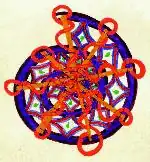
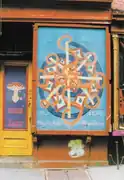
The church operated out of a small storefront in the East Village on the Lower East Side of Manhattan and offered free communion services with smoked DPT to the public following an initial interview session.[7][14][19][8][2][4][26][32] It required that visitors stay for the duration of their psychedelic experience, about 1 to 2 hours, whilst listening to audiotapes that consisted of biblical recitations on a background of meditative music.[7][14][19][8][2][4][26][32] According to the temple, the "Psychedelic", who they view as God, instructed them to offer communion with DPT to the public.[1][17] The group published a long booklet called Testimony to the Psychedelic (1981) and handed out the booklet and flyers in New York City to advertise their church and spread their word.[1][7][8][4][26][21][9] The booklet contains multiple detailed works of psychedelic art created by church members.[1][4][9]
Other principles of the Temple of the True Inner Light included adherence to vegetarian and nutritious diets, opposition to the use of other drugs including alcohol, opioids, and cocaine, and promotion of non-violence and honesty.[1][8][24][9] In addition to their church services, they have also run a non-profit organization called Temple Charities sponsoring detox programs and building affordable housing for low-income and homeless people.[1][22][33][34][35]
History
The Temple of the True Inner Light was founded in the East Village of Manhattan in New York City by Alan Birnbaum in 1980.[1][2] Many other psychedelic churches and storefront temples preceded the church on the Lower East Side of Manhattan starting in the mid-1960s with the availability of street LSD.[36] This neighborhood is described as having once been a small "psychedelicist city-state" and has been likened as the Haight-Ashbury district of the East Coast.[37][38][36] Though the temple was founded in 1980, earlier versions of the group also started by Birnbaum existed under other names beginning in the early 1970s, including the Church of the Psychedelic Eucharist (1975)[1][12] and the Native American Church of New York (NACNY) (1976–1979).[1][4][18][13][39] Birnbaum appears to have been a Yippie[1] and the temple has been described as being "kind of like very radical hippies".[16]
Despite the earlier name of the Native American Church of New York, the church was not actually Native American, was not affiliated with the Native American Church (NAC), and had few or no Native American members.[1][4][13][40] The Native American Church of New York sued for the right to use peyote and other psychedelics for religious purposes in Native American Church of New York v. United States in 1979, but largely lost the case.[1][13][40][41][18][42] An appeal led to the ruling being affirmed in 1980.[1][41][43] The church was raided and Birnbaum arrested for having 20,000 peyote buttons in 1979, with a possible sentence for Birnbaum of 15 years to life in prison, but the case appears to have never gone to court.[1][4][18] The Native American Church of New York claimed to have roughly 1,000 members in 1979.[1][42] Birnbaum wrote to the Drug Enforcement Administration (DEA) inquiring about the legality of several designer psychedelics such as dipropyltryptamine (DPT) in 1980.[1][18][44] News about DPT's use in psychedelic-assisted therapy had begun to appear in the late 1970s.[44][45][46] Birnbaum was informed by the DEA that DPT was currently legal.[1][18][44] As a result, the church renamed itself to the Temple of the True Inner Light and began using DPT in 1980.[1] DPT has never been made an explicitly controlled substance in the United States, but it could be considered illegal under the Federal Analogue Act (1986).[17][47][48][2][26]
Journalist and actor Max Cantor came upon the Temple of the True Inner Light and was writing a story on them in the years before he died in 1991.[26][49] Daniel Rakowitz, a local eccentric with schizophrenia and later murderer dubbed the "Butcher of Tompkins Square Park", is known to have briefly visited the temple in the late 1980s.[1][6][26][50][51] The members of the church were disturbed by Rakowitz, who proclaimed himself to be the Antichrist and carried around a copy of Adolf Hitler's Mein Kampf and a live rooster, but nonetheless tried to counsel and help him.[6] Cantor incidentally encountered Rakowitz and interviewed him for his story about the temple in June 1989.[26] Rakowitz told Cantor that he had smoked DPT at the church three times.[26] At some point, Rakowitz also attempted to form his own sect or cult around cannabis called the Church of 966.[1][52][53][54][55] In August 1989, Rakowitz murdered his girlfriend, made her into a soup, and fed the soup to homeless people in Tompkins Square Park.[52][26][54][56][50] The park was only about 0.2 miles (0.3 km) or a 4-minute walk from the temple.[26][57] Rakowitz's case and trial were highly publicized, with him eventually being found not guilty by reason of insanity in 1991 and being indefinitely committed to a psychiatric institution.[1][50][56] Although Rakowitz smoked DPT at the temple prior to his crimes,[26] he also had a long history of psychosis since childhood and heavily used cannabis and drugs in general.[6][58]
The Temple of the True Inner Light operated for decades but was largely defunct by 2018, though it is said to still exist as of 2023.[1][4][59][60][31] It has been described as having been the most publicly visible psychedelic church in North America for many years.[1] The church was apparently able to operate without legal problems or prosecution due to factors like their nature as a religious group, DPT being an obscure legal hallucinogen, and New York City being preoccupied with more dangerous drugs and organizations.[1][61][30] Authorities such as the DEA were well-aware of the group, but opted not to interfere with their operations.[15][17][62][18] The temple's membership over time is unknown, though it is thought to have never gained many members[1] and had only five young male and female full members in 1989.[6] Its beliefs and practices are said to have repelled many potential or would-be members.[1] One of the church's members defected and there has been a long-running online feud between the church and that member since 1999.[1][14][4] The Temple of the True Inner Light's storefront eventually closed, with the location being a high-end boutique since 2001, and the church relocated from Manhattan to private dwellings, for instance in New Jersey.[1][5][63][64] It continued to operate publicly until at least the early 1990s.[1][19][17][14][26][6][65] Their website existed by 1996[66] and remained online until early 2026 when their hosting provider shut down.[1][67][68]
Peter Gorman, the editor-in-chief of High Times magazine, visited the church and smoked DPT there, publishing his experience at the temple in High Times in early 1990.[1][69][19] The psychedelic chemist Alexander Shulgin once corresponded with the Temple of the True Inner Light and wrote briefly yet kindly about them in his 1997 book TiHKAL (Tryptamines I Have Known and Loved).[15][70] One of the experience reports for DPT in TiHKAL describes experiencing "The Light" and appears to be from the temple.[15] The church has been covered in modern times by Mike Marinacci in his 2023 book Psychedelic Cults and Outlaw Churches[16][1] and by others such as Hamilton Morris.[4][31][59][71][2][16] Morris, the creator of the television show Hamilton's Pharmacopeia, spent much of 2018 researching and spending time with the group and has a long-running project on them that has yet to be published.[59][71][72][4] The temple was referenced in a satirical segment by The Late Show With Stephen Colbert in 2022.[73][74][75]
Gallery


See also
References
- 1 2 3 4 5 6 7 8 9 10 11 12 13 14 15 16 17 18 19 20 21 22 23 24 25 26 27 28 29 30 31 32 33 34 35 36 37 38 39 40 41 42 43 44 45 46 47 48 49 50 51 Marinacci, Mike (4 July 2023). "Temple of the True Inner Light: A DPT Eucharist on the Lower East Side". Psychedelic Cults and Outlaw Churches: LSD, Cannabis, and Spiritual Sacraments in Underground America. Simon and Schuster. pp. 219–231. ISBN 9781644117088.
- 1 2 3 4 5 6 7 8 9 Elcock, Chris (15 May 2023). "The Sixties Happened in the Seventies". Psychedelic New York: A History of LSD in the City. McGill-Queen's University Press. pp. 180–197. doi:10.2307/jj.3816088.12. ISBN 978-0-2280-1803-2.
[...] In 1980, Alan Birnbaum founded the Temple of the True Inner Light and took participants through psychedelic sessions. This occurred after Birnbaum had a revelatory experience with DET, which convinced him that "the psychedelic is a pure light being and primeval ... also being God the Creator." Subsequently, he guided sessions using DPT (N,N-Dipropyltryptamine) in the temple's Lower East Side storefront. Its catechism was a kind of Christian revisionism that held DPT "as an actual manifestation or physical form of God." By 1987, however, DPT had been outlawed.68
- ↑ "Two Are Arrested Here at Park 'Freepot' Party". The New York Times. 3 September 1974.
Those arrested were Alan Birnbaum, 27 years old, of 437 East Ninth Street, and Lawrence Berg, 31, address unknown. They were "observed handing out cigarettes from a bag," the police said.
- 1 2 3 4 5 6 7 8 9 10 11 12 13 14 15 16 17 18 19 20 Morris, Hamilton (31 May 2019). "Finding Hide-and-Seek". The Museum of Modern Art. Supplemental Video
- 1 2 Clinton Kaley (5 October 2020). "Dipropyltriptamine and The Temple of True Inner Light". Psychedelicast (Podcast). No. 29. Mary (interviewee), The Temple of the True Inner Light (interviewee). Retrieved 13 August 2026.
In this episode we are offering a fascinating chat with a wonderful lady named Mary, a spokesperson from the New Jersey based church: The Temple of True Inner Light. The church claims a lesser-known psychedelic molecule, Dipropyltriptamine, as their holy sacrament. They also hold some interesting beliefs concerning the nature of God and the psychedelic experience; namely that psychedelic molecules are the physical form of God.
- 1 2 3 4 5 6 Cantor, Max (18 September 2020) [10 October 1989]. "The Untold Story of the Tompkins Square Murder". The Village Voice. Retrieved 14 August 2026.
While interviewing Rakowitz, Taibbi questioned him about the Temple of the True Inner Light, a storefront on East Ninth Street that houses five young men and women who worship psychedelics. [...] "I believe we were the only people that briefly — and I'm talking about real brief — got Dan [Rakowitz] in touch with his conscience," says temple member Mary, a woman with spectacular red hair. [...] The temple members were so spooked by Rakowitz, they actually took him outside to search him for weapons — the first such incident in over five years. [...]
- 1 2 3 4 5 6 7 8 9 Lyttle, Thomas (1988). "Drug Based Religions and Contemporary Drug Taking". Journal of Drug Issues. 18 (2): 271–284. doi:10.1177/002204268801800212. ISSN 0022-0426. Retrieved 21 June 2026.
[...] a branch of the New York City charter of the Native American Church (circa 1967) is the offshoot Temple of the True Inner Light, which was founded in 1980 by Alan Birnbaum. [...] Birnbaum states, "DET (Di-Ethyl Tryptamine) is the first psychedelic which convinced me that the psychedelic is a pure light being and primeval...also being God the Creator. [...] The Temple uses DPT (Di-Propyl Tryptamine) as its sacrament. [...] From such sources comes the Temple's basic catechism and ethical stance which is available in printed form as The Testimony to the Psychedelic (Temple of the True Inner Light, 1981), and in experiential form as the DPT sacrament. [...] The Temples basic catechism and ethical/moral posture is firmly rooted in an eclectic drug-based Christian revisionism, [...]
- 1 2 3 4 5 6 7 Stuart, R. (2002). "Entheogenic Sects and Psychedelic Religions" (PDF). MAPS Bulletin. 12 (1): 17–24.
Temple Of The True Inner Light. [...] This Manhattan group asserts that anybody who is not a member of their church is doomed to be endlessly reincarnated in horrific hell realms. The members believe that their leader Alan Birnbaum is Jesus, and that they are the reincarnation of His disciples. [...] The public is invited to the Temple to participate in guided communion with DPT. [...] The communicant must listen to a tape recording of excerpts from religious texts with a background soundtrack of sentimental music. [...] They published The Testimony to the Psychedelic (1981, now out-of-print).
- 1 2 3 4 5 6 7 8 9 Temple of the True Inner Light (8 December 1981), Testimony To The Psychedelic (The Newest Testament To The Light), New York City, New York: Temple of the True Inner Light,
The psychedelic: LSD, Marijuana, DMT, Peyote, Psilocybin, DPT is the true Host, [...] if they eat it with respect due to the True Creator, [...] then, it will guide them and teach them and show the way, Its sacred path [...] The Temple of the True Inner Light is an organization of worshipers of the true Creator: the Psychedelic. It is located at 335 East 9th Street, New York, New York, 10003, telephone: 212-777-8009. We are involved in fighting for the right to worship God in the courts and are having regular communions with non-controlled Psychedelics such as Dipropyl Tryptamine. [...] December 8, 1981
- ↑ Temple of the True Inner Light, [Temple Literature], ~2017, Temple of the True Inner Light, archived from the original on 27 August 2026, retrieved 11 October 2017
- ↑ Temple of the True Inner Light, [Temple Literature], ~2011, Temple of the True Inner Light, archived from the original on 27 August 2026, retrieved 17 July 2011,
The following is our Temple literature. [...]
- 1 2 Gram, Billy (1975). "The Psychedelic Church". The Yipster Times. 3 (3): 14–14.
The [Church of the Psychedelic Eucharist] is present residing in small, [...] apartment on the lower east side of Manhattan where a co-founder and president of the Church, Alan Birnbaum, [...] The Church of the Psychedelic Eucharist, 437 East 9th Street, New York, N.Y. 10009
- 1 2 3 4 5 Lekhtman, Alexander (7 September 2017). "Does the First Amendment Protect Spiritual Cannabis Use? A D.C. Activist Plans to Argue For It". Psymposia.
[...] This question came up in Native American Church of New York v. U.S. (1979). Here, a church in New York sued for their right to use psychedelics in a religious context. The Church, founded by Alan Birnbaum, was not affiliated with the Native American Church and few of its members were of Native American descent. However, they believed that all psychedelics—including peyote, cannabis, LSD, and more—were deities and wanted to use them freely in their practice. The court concluded the law cannot restrict the peyote exemption to one particular church or group, and that any organization who used peyote sincerely in a religious context would be protected. However, the court would not let Birnbaum claim the exemption to use and distribute other psychedelics in his church besides peyote. [...]
- 1 2 3 4 5 6 7 8 Kaplan, Eric (October 1987). "Still hippies, after all these years". Spy Magazine (October 1987): 61–61. Archived from the original on 24 April 2018.
God's Not Dead. [...] A prophet [...] stands and speaks in a doorway of the storefront Temple of the True Inner Light on East 9th Street. [...] The first tenet of temple theology is the equation God = consciousness = the psychedelics. [...] Temple members mean each of those equal signs quite earnestly and absolutely literally. The actual chemical structure and physical existence of DPT, they maintain, is God. [...] Communion is open to the public, and, considering the certainty of a life in hell without it, we are advised to attend. [...] There was a temple member who left once whom they call Judas. [...]
- 1 2 3 4 5 6 Shulgin, Alexander; Shulgin, Ann (September 1997). TiHKAL: The Continuation. Berkeley, California: Transform Press. ISBN 0-9630096-9-9. OCLC 38503252. https://www.erowid.org/library/books_online/tihkal/tihkal09.shtml "#9. DPT [...] QUALITATIVE COMMENTS: [...] (with 250 mg, orally) "I was seeing the Light real strongly. [...] There is a rather remarkable religious group known as the Temple of the True Inner Light, in New York City, which has embraced as its Eucharist DPT which they refer to as a powerful Angel of the Host. Their communion is confirmed by either the smoking or the drinking of the sacrament, and they have been totally unbothered by any agency of the Federal Government, as far as I know. [...] I wish the True Inner Light congregation Godspeed, if you will excuse the expression. My impressions of them from our correspondence have left me totally convinced of their integrity and dedication. [...]"
- 1 2 3 4 5 6 Macaya, Cristina (25 April 2024). "Religious Groups Fighting to Legalize Psychedelics". Uptown Radio.
[Macaya:] [...] The [Temple of the True Inner Light], which also refers to itself as a church, practices a revisionist Christianity and uses psychedelics such as DMT, cannabis and mushrooms as a sacrament. [...] the Temple of the True Inner Light is sometimes referred to as a "cult." Mike Marinacci is the author of "Psychedelic Cults and Outlaw Churches." He wrote a chapter on the Temple of the True Inner Light in his book. [Marinacci:] They're kind of like very radical hippies. [Macaya:] But Marinacci says, the Temple isn't a cult and it's one of a growing number of nontraditional religious groups built around the use of psychedelics.
- 1 2 3 4 5 6 7 "Report: Church lures converts with 'designer drug'". UPI. 2 July 1988. Retrieved 21 June 2026.
- 1 2 3 4 5 6 7 8 Stafford, Peter (18 February 2013) [1992]. Psychedelics Encyclopedia (3 ed.). Ronin Publishing. pp. 120–, 316, 322. ISBN 978-1-57951-169-2. Archived from the original on 30 September 2015. Retrieved 13 August 2026.
[...] Judge Milton Pollack ruled that the [Native American Church of New York] was not bona fide because it was selling peyote. On the other hand, he declared that Birnbaum [...] was bona fide because he sincerely believed that "peyote was God." [...] Birnbaum showed [New York state police] receipts of purchase for the 20,000 peyote buttons on the premises. [...] Birnbaum is now facing a sentence of fifteen years to life. [...] Alan Birnbaum, from the Native American Church of New York, wrote to the DEA about the legal status of several DMT-like compounds. [...] Alan Birnbaum writes in regard to DPT, "some people have reported to be immediately immersed in the light on the first toke." [...] the most intense part of a DPT experience is over in about twenty minutes. [...]
- 1 2 3 4 5 6 7 8 9 10 Gorman, Peter (January 1990). "Divine Smoke and God's Flesh: Psychedelics and Religion". High Times. No. 173. pp. 41–44, 75.
- ↑ Rose, Mike (July 1997). "Psychedelic Eden". Spirit Magazine. No. 6.
[Michael Hoana:] [...] this religion, the true religion, is not something that started in the '60s. If you look at the scriptures, the Bible, there are certain things like oil and unctions, that teach people, that teach directly. [...] And to actually say that this is food from heaven, they can only be talking about a psychedelic".
Cited by Pauli (1997) and by Saunders, Saunders, & Pauli (2000). - 1 2 3 4 5 6 7 Hayes, C. (2000). Tripping: An Anthology of True-Life Psychedelic Adventures. Compass. Penguin Publishing Group. p. 272. ISBN 978-1-101-15719-0. Retrieved 27 August 2026.
I even visited a psychedelic church. It was a grungy storefront on 13th Street with an impressive mandala painted on the boarded-up windows, above the slogan The Psychedelic is the Creator. I found it through a flyer handed out at a pro-pot rally. They offered free initiation with their "sacrament," DPT, a short-acting, smokable tryptamine. I was indoctrinated by a classic scraggly hippie type. We had a lengthy discussion, from which I got the idea that the group was a cult that fixated on a mysterious leader said to be the "firstborn of the Psychedelic" and reborn throughout history as Moses, Zoroaster, Jesus, etc. [...]
- 1 2 Tuidara, Felix (22 February 2018). "El DPT: Un Sacramento Moderno" [DPT: A Modern Sacrament]. Cáñamo (in Spanish). Retrieved 21 August 2026.
- 1 2 Devine, Colin A. (2015). "A Critique of the Secular Exceptions Approach to Religious Exemptions" (PDF). UCLA Law Review. 62: 1348. Archived from the original on 1 October 2025.
The Temple of the True Inner Light believes that psychedelics—DPT, psilocybin mushrooms, LSD, peyote, DMT—are the Flesh of God and that ingesting them leads to spiritual awakening. [...] The Psychedelic Is the Creator, TEMPLE TRUE INNER LIGHT, [psychede.tripod.com/psychede.html] (last visited Apr. 6, 2015).
- 1 2 3 Pokorný, Lukáš (8 December 2015). "Nová psychedelická náboženství" [New psychedelic religions]. Legalizace: Magazín, který vám rozšíří zorničky (in Czech). Retrieved 28 August 2026.
- ↑ Power, Mike (14 October 2014). Drugs Unlimited: The Web Revolution That's Changing How the World Gets High. Macmillan. p. 81. ISBN 978-1-4668-5774-2. Retrieved 28 August 2026.
Some drugs and the groups using them were truly bizarre: [...] another powerful tryptamine, DPT, was believed by members of The Temple of the True Inner Light, an esoteric religious movement in Manhattan, to be the literal flesh of God.
- 1 2 3 4 5 6 7 8 9 10 11 12 13 Aronowitz, Al (1 June 2002). "The Strange Case of Max Cantor: Monika's Ghost". The Blacklisted Journalist. Retrieved 13 August 2026.
[Max] discovered a place on East Ninth Street that called itself the Temple of the True Inner Light, a temple whose members worshipped drugs, which they referred to collectively as "the Psychedelic." [...] It said they give away free communion to the public with a non-controlled psychedelic. [...] So I decided I'm gonna write an article about these guys. [...] And one of the people I met there was Daniel Rakowitz [...] I asked him, 'You ever been over to that temple? You ever smoke that shit?'" [...] "'Yo, yeah, man, three times!' I said, 'Can I interview you?' He said, 'Yeah, sure!' [...] his interview that I got with him was so outlandish, describing [...] the experiences he had at the Psychedelic Temple. [...]
- ↑ Jim DeKorne (26 July 2011) [1994]. Psychedelic Shamanism, Updated Edition: The Cultivation, Preparation, and Shamanic Use of Psychotropic Plants (Updated ed.). North Atlantic Books. p. 81. ISBN 978-1-58394-290-1.
- ↑ Pinchbeck, Daniel (2003). "[Chapter 36:] Not For Human Consumption". Breaking Open the Head: A Psychedelic Journey into the Heart of Contemporary Shamanism. Crown. pp. 260–272. ISBN 0767907434. Archived from the original on 24 September 2016.
[...] the most astonishing aspect of [DMT and DPT] is that, despite their similarity, they reveal completely different worlds. [...] In Shulgin's book and on the Internet I found accounts of DPT trips. Some described the effects as terrifying: "The whole universe falls apart, all colors in electrik air whirlpool into a mandala, eaten up for-ever. That's it, the world's over." Others felt, after smoking the drug, they entered, for the first time, the "clear light" of God. [...] Shulgin also mentioned a church in New York, Temple of the True Inner Light, which uses DPT as its sacrament. [...]
- ↑ Toad (1999). "DPT Primer". The Entheogen Review. 8 (1): 4–6. ISSN 1066-1913.
[While it is true that DPT has never been terribly common on the underground market, it has been used as a sacrament by the Temple of the True Inner Light in New York City for nearly 20 years. — DAVID]
- 1 2 Tramacchi, Desmond Thomas (1 January 2006). Vapours and Visions: Religious Dimensions of DMT Use (PhD thesis). The University of Queensland. p. 88. doi:10.14264/158343. Retrieved 14 August 2026.
DPT is one of the rare instances of a totally synthetic substance that is employed as an entheogenic sacrament by a Christian Church that is evidently sincere in its doctrinal belief that their "Eucharist" DPT is "a powerful Angel of the Host", with communion confirmed by either smoking or drinking the material. This fascinating Church, known as the 'Temple of the True Inner Light' has thus far observed its religious practices unhindered by the United States Federal Government (Shulgin & Shulgin, 1997:430). [...]
- 1 2 3 D. H. Ticklish (Hamilton Morris) (2 February 2008). ""A Giant Chinese Finger Trap Made Of Rainbows…" – Part 1". VICE. Retrieved 17 August 2026.
There is a cult/church on the Lower East Side of New York called the Temple of the True Inner Light that has been taking this drug as the Eucharist for the last 30 years. Apparently it's tough to join because they already have enough people willing to participate in Holy Communions where they smoke Christ's psychedelic flesh out of a communal pipe instead of eating a flavorless wafer. [...]
- 1 2 Jarnow, Jesse (29 March 2016). Heads: A Biography of Psychedelic America. Grand Central Publishing. pp. 134–134, 155–155. ISBN 978-0-306-82256-8. Retrieved 14 August 2026.
[In the East Village], [...] the Native American Church has a house where the peyote arrives fresh from Texas [...] One night, Bilrock shares some with [...] the young artist Jean-Michel Basquiat. [...] On New York's Lower East Side, one can visit the Temple of the True Inner Light, established in 1980 as an offshoot of the peyote-eating Native American Church. Visitors are (after an interview session) welcome to use the temple hookah to smoke the free DPT, dipropyltyptamine, so long as they stay for the entirety of their multihour trip to listen to some of the temple's tapes [...]
- ↑ "Temple Charities Inc. New York, NY". bizprofile.com. 27 September 2025. Retrieved 27 August 2026.
Temple Charities Inc. Active Updated 9/27/2025 [...] Temple Charities Inc., a Not-For-Profit Corporation, is a business entity located in New York, NY. Officially filed on August 2, 1994, this corporation is recognized under the document number 1841105. Governed by the New York Department of State, the corporation maintains an active filing status. The mailing address of the corporation is located at 127 1st Avenue, Box 3, New York, NY, 10003, [...]
- ↑ "Temple Charities Incorporated in New York, New York". Nonprofit Locator. Retrieved 27 August 2026.
Temple Charities Incorporated in New York, NY [...] 207 East 5th Street Apartment 1c, New York, NY 10003 [...] Temple Charities Incorporated is a tax exempt organization located in New York, New York. [...] EIN: 13-3920554 [...] Subsection and Classification Codes: Code 03-1: Charitable Organization - 501(c)(3) [...] Activity Codes: Code 380: Low-income housing, Code 573: Rehabilitating alcoholics, drug abusers, compulsive gamblers, etc., [...]
- ↑ "Temple Charities". Temple Charities. Archived from the original on 10 August 1997.
Temple Charities is a non-profit charitable organization incorporated with the New York State Department of State. We are involved in building housing for low-income and street people, and in helping people to detox from alcohol, opiates, and cocaine using medical-nutritional methods. Anyone who would like to contribute can send a tax deductable contribution to: Temple Charities, 127 1st Avenue, Box 3, New York, New York, 10003; Phone: (212) 473-9271; To contact us send email to: haoma@dorsai.org [...] Description of detox methods: alcohol, opiates, cocaine, cigarettes [...]
- 1 2 Greer, J. C. (24 October 2022). "Psychedelic Church Movement" (PDF). In Asprem, E. (ed.). Dictionary of Contemporary Esotericism. Leiden: Brill. Retrieved 25 August 2026.
Due to its proximity to Millbrook, the earliest psychedelicist enclave on the East Coast developed on the Lower East Side of Manhattan, in New York City. Storefront temples seemed to open on a nightly basis in this hip neighborhood after the first wave of black-market LSD hit the streets in 1964. [...] An army of street-level LSD evangelists stationed themselves on the front lines of the psychedelicist movement, both in the East Village and beyond. [...] psychedelicist city-state that emerged in the East Village.
- ↑ Crowd DNA NYC (25 September 2019). "The Neighborhoods Project: Lower East Side". Crowd DNA. Retrieved 27 August 2026.
Over the years [Tompkins Square Park] has housed protesters, gangs and addicts. In the 60s, it was the East Coast's Haight-Ashbury, home to artists, hippies, musicians, and political activists. [...]
- ↑ Nanos, Janelle (28 October 2009). "The Veselka Cookbook". Travel. Retrieved 27 August 2026.
When I first came [to the East Village] it was the Haight-Ashbury of the East Coast. Hippie artisans were selling leather goods and pottery — one guy made chess sets. It was a fun, nice place to be in the '60s. That changed in the '70s when the neighborhood was very drug-infested and dangerous. [...] Many young people were addicted to heroin and ended up dying. [...]
- ↑ Vozar, Annie (9 May 2019). "Checkpoint Consciousness: Exploring Legal Limitations and Inconsistencies in the Religious Use of Entheogenic Drugs". Northeastern University Law Review. Retrieved 27 August 2026.
Seven years later, a New York district court extended the exemption's reach. In Native American Church of New York v. United States, the Native American Church of New York ("NACNY") petitioned the Drug Enforcement Agency ("DEA") for the right to use peyote in religious ceremonies under the peyote exemption.42 Contrary to its name, most members of the NACNY were non-Native.43 [...]
- 1 2 Fisher, Louis (2003). Congressional Protection of Religious Liberty. Nova Publishers. p. 56. ISBN 9781590336694.
In 1979, a federal district court in New York read the peyote exception differently. In addition to the [Native America Church (NAC)], it ruled that the exception covered the Native American Church of New York, which was not affiliated with the NAC, and only a few of its roughly one thousand members were Indians. Also, the Native American Church of New York expresses a belief that all psychedelic drugs, including LSD and marijuana, are deities.34 The district court concluded that the exemption for peyote is available to any bona fide religious organization that uses peyote for sacramental purposes and regards peyote as a deity.35
- 1 2 Dawson, Alexander S. (31 December 2019). The Peyote Effect: From the Inquisition to the War on Drugs. University of California Press. p. 202. doi:10.1515/9780520960909. ISBN 978-0-520-96090-9. Retrieved 29 June 2026.
A 1979 court ruling in New York affirmed that if he could establish that his church had a bona fide belief in peyote as a god, Alan Birnbaum's Native American Church of New York qualified for an exemption under the law (the case had begun with an exemption granted by the state of New York but later denied by the DEA), Native American Church of New York v. US, 468 F. Supp. 1247, 1251 (1979). It was affirmed in 1980.
- 1 2 Native American Church of New York v. United States, 468 F. Supp. 1247 (S.D.N.Y. 17 April 1979) ("Native American Church of New York, Alan Birnbaum, Minister and Custodian, Plaintiffs, v. United States of America, Griffin Bell, Attorney General, Defendants. [...] United States District Court, S. D. New York. [...] the motion of the plaintiffs will be denied and the motion of the defendants will be granted in part and denied in part. [...] In 1976, Alan Birnbaum founded the Native American Church of New York and is now its minister and custodian. It is not affiliated with the Native American Church described above, and only a few of its roughly one thousand members are American Indians. The Native American Church of New York allegedly believes that all psychedelic drugs, including peyote, are deities. [...]").
- ↑ Native American Church of New York v. United States, 633 F.2d 205 (2d Cir. 2 June 1980).
- 1 2 3 Stock, Stuart H. (October 1986). "Synthetic Drugs: A History of Ups and Downs, Part Two". PharmChem Newsletter. 15 (5). PharmChem Research Foundation. Retrieved 28 August 2026.
In the late '70s, however, news about DPT's use in psychotherapy began to appear. In 1980, Alan Birnbaum of the Native American Church wrote to the DEA about the legality of several DMT-related compounds and was told these drugs were perfectly legal for use. And, according to the Arizona-based Do It Now Foundation, the short-acting tryptamines were rarely seen on the street until the early 1980s when DEA lab seizures recorded an increase of 200 times in DMT manufacture. [...]
- ↑ Garcia-Romeu A, Kersgaard B, Addy PH (August 2016). "Clinical applications of hallucinogens: A review". Experimental and Clinical Psychopharmacology. 24 (4): 229–268. doi:10.1037/pha0000084. PMC 5001686. PMID 27454674.
[...] research with dipropyltryptamine (DPT), a closely related synthetic analog of DMT, revealed some promise as an adjunct to psychotherapy both with alcoholics (Grof et al., 1973; Rhead et al., 1977; Soskin et al., 1973), and those with anxiety associated with a terminal cancer diagnosis (Richards et al., 1977; 1980; Richards, 1978).
- ↑ Marion Goldin, Dan Rather, William Richards, Kenneth Pugh, others (1976). LSD (Television production). 60 Minutes. United States: CBS. Archived from the original on 1 March 2021.
- ↑ Varley TF, Havert D, Fosque L, Alipour A, Weerawongphrom N, Naganobori H, O'Shea L, Pope M, Beggs J (2024). "The serotonergic psychedelic N,N-dipropyltryptamine alters information-processing dynamics in in vitro cortical neural circuits". Netw Neurosci. 8 (4): 1421–1438. doi:10.1162/netn_a_00408. PMC 11674936. PMID 39735490.
[...] [DPT] was never criminalized in the United States and it remains unscheduled at the Federal level. Despite its legality, DPT remains much less well-known among the general public than its more famous siblings such as psilocybin, DMT, mescaline, and LSD. A notable exception to this is its use by a religious organization based in New York City, The Temple of the True Inner Light, which uses DPT as a religious sacrament of the Temple of the True Inner Light (n.d.).
- ↑ Orange Book: List of Controlled Substances and Regulated Chemicals (January 2026) (PDF), United States: U.S. Department of Justice: Drug Enforcement Administration (DEA): Diversion Control Division, January 2026
- ↑ Ferguson, Sarah (1 February 1992). "The Strange, Sad Death of Max Cantor". Esquire. Retrieved 16 August 2026.
THE FIRST time I saw Max Cantor was in the summer of 1989. He was wandering around Tompkins Square Park on Manhattan's Lower East Side with a microcassette recorder, trying to interview the local squatters, punks, and anarchists about where to buy the best pot, and was there really a church in the East Village that worships psychedelic drugs? (Of course. Next question.) [...]
- 1 2 3 Lee, Tien-Shun (22 June 2004). "Butcher of Tompkins Sq seeks legal release". amNewYork. Retrieved 14 August 2026.
- ↑ Kobek, Jarett (15 August 2017). "August 1989: Daniel Rakowitz". The Future Won't Be Long. Penguin. pp. 153–159. ISBN 978-0-7352-2249-6. Retrieved 14 August 2026.
The storefront at 335 East 9th Street housed the Temple of the True Inner Light. Anyone could attend Sunday service and be given a free dose of DPT, or dipropyltryptamine, a legal hallucinogenic. The sole requirement for receiving this head-chugging charity was that its recipient must consent to suffer a lecture about the true nature of Christ, some silly nonsense about God's incarnation within lysergic acid. There is a story that Rakowitz visited the temple. [...]
- 1 2 McKinley, James C. (20 September 1989), Accused Slayer of Girlfriend Began a Religion, Police Say, ISSN 0362-4331, retrieved 14 August 2026
- ↑ Newsday (18 February 1992). "Man held in cult slaying of ballerina Flesh was fed to homeless, N.Y. police say". Baltimore Sun. Retrieved 14 August 2026.
- 1 2 "Satanic cult may have had hand in ballerina's death, police say". Tampa Bay Times. 19 February 1992. Retrieved 14 August 2026.
- ↑ Moynihan, Colin (15 June 2004), Hearing Revisits East Village Killing and Dismemberment, ISSN 0362-4331, retrieved 14 August 2026
- 1 2 "Easton Man Held in Killing Victim was Stabbed, Dismembered". The Morning Call. 18 February 1992. Retrieved 14 August 2026.
- ↑ "335 E 9th St, New York, NY 10003 to Tompkins Square Park - Google Maps" (Map). Google Maps. Retrieved 14 August 2026.
- ↑ "INSANE KILLER SEZ HE'S NOW OK". New York Daily News. 19 October 1995. Retrieved 14 August 2026.
- 1 2 3 Hamilton Morris (13 October 2023). "POD 89: September Patreon Q&A". The Hamilton Morris Podcast. Patreon. Event occurs at 30:11–33:23, 45:40–50:20.
The Temple of the True Inner Light is a New York City-based religion that worships the psychedelic tryptamine DPT as their sacrament. They have existed in some form since the 1970s and in a extremely reduced capacity exist to this day. And it's been brought up a few times that I was working on a big project about the Temple of the True Inner Light. I actually spent the majority of the year 2018 intensively involved in researching them. [...] I navigated [these difficulties] in part by not publishing the article. [...] I will publish something one day. I do have the article basically written. I just need to navigate some of these remaining issues.
- ↑ Mangini, Maria Victoria (2000). "Yes, Mom Took Acid:" The Sociohistorical Influence of Prior Psychedelic Drug Use in Adults (PhD thesis). University of California, San Francisco.
In New York, the Temple of the True Inner Light, which also traces its origins to the [Native American Church (NAC)], has used di-propyl tryptamine (DPT) as its sacrament for the last 20 years. DPT is closely related to psilocybin but is not a controlled substance. Temple followers regard DPT as itself divine, as distinct from being simply a way to access the realm of the divine. DPT ingestion, according to the Temple, allows direct communication with spirits. Services, which are conducted in the Temple for individuals or small groups, consist of smoking DPT while listening to taped Bible readings (Lyttle, 1988).
- ↑ Langlitz, Nicolas (2013). Neuropsychedelia: The Revival of Hallucinogen Research Since the Decade of the Brain. University of California Press. pp. 269–269. ISBN 978-0-520-27481-5. Retrieved 14 August 2026.
3. Smaller religious associations using psychedelic drugs (for example, the Temple of the True Inner Light or the Peyote Way Church of God) have managed to subsist without legal sanction or prosecution since the 1970s, even though they never received permission. I thank Hamilton Morris for this piece of information.
- ↑ Chapman, Kate (1997). "1997 Botanical Preservation Corps Seminar on Ethnobotany and Chemistry of Psychoactive Plants" (PDF). MAPS Bulletin. 7 (2): 13–17.
[...] Another reason [Shulgin] suggested why [dipropyltryptamine (DPT)] may still exist without [legal] scrutiny is that it is used by a church based in New York, the Church of the True Inner Light, and the DEA might not wish to publicly acknowledge the religious use of a psychedelic.
- ↑ EV Grieve (9 March 2016). "Half the size but still Fabulous at Fanny's". EV Grieve: News About the East Village of NYC. Retrieved 14 August 2026.
As we noted a few weeks ago, Fabulous Fanny's had to give up part of its storefront at 335 E. Ninth St. between First Avenue and Second Avenue. [...] Jared Kushner purchased 329-335 E. Ninth Street and 325 E. 10th St. in April 2013 for $28.75 million. [...] That unique offering has contributed to Fabulous Fanny's success, 15 years after it moved to the East Village from the Chelsea Flea Market and Chelsea Antique Center.
- ↑ "335 E 9th St, New York (Fabulous Fanny's) in Google Street Review" (Map). Google Maps. Retrieved 14 August 2026.
- 1 2 "[Mike Marinacci on Instagram]". Instagram. 8 November 2023. Retrieved 14 August 2026.
Flyer from the Temple of the True Inner Light. Based in a storefront in Manhattan's Lower East Side, the Temple believed that entheogenic substances were "The Creator," and dispensed the legal tryptamine DPT to visitors to their church in the late Eighties and early Nineties. The Temple has since gone underground, but still exists. #entheogens #psychedelic"
- ↑ Waltz, Mitzi; Schultz, Steve (1996). Internet International Directory 1997. Lycos Press. p. 192. ISBN 978-1-56276-416-6. Archived from the original on 21 October 2009. Retrieved 28 August 2026.
Temple of the True Inner Light: This is the Internet home of this religious group, which worships psychedelics as the flesh of God. You'll find here all the usual religious-style dogma (with an inner light twist)—fliers, writings, and scriptures abound. Type: WWW. Address: [phantom.mindvox.com/~psychede]. Region: World.
- ↑ Temple of the True Inner Light. "Temple of the True Inner Light". tripod.com. Archived from the original on 26 March 2026. Retrieved 14 August 2026.
The Temple of the True Inner Light is an organization that believes that Psychedelics, (DPT, Marijuana, LSD, Peyote, Psilocybin, DMT, etc.), are the true Flesh of God. This is our Temple Flier. This is a collection of religious writings and scriptures We also have a non-profit charitable organization involved in building housing for low-income and street people, and in helping people to detox from alcohol, opiates, and cocaine. [...] Our email address is Somae7@yahoo.com. [...]
- ↑ Lee, Gene (14 April 2026). "Lycos to Shutter Angelfire and Tripod, Concluding Three Decades of 'Under Construction' Web Hosting". Triopolitan.com. Retrieved 21 August 2026.
Lycos, the enduring web portal and early internet pioneer, has announced the impending termination of its legacy web hosting services, Angelfire and Tripod. According to a notification on the Lycos Portal (yes, it still exists.), all associated websites will be closing in 30 days.
- ↑ Saunders, Nicholas; Saunders, Anja; Pauli, Michelle (2000). "A Different Kind of Church". In Search of the Ultimate High: Spiritual Experiences Through Psychoactives. London: Rider. pp. 48–87. ISBN 9780712670876. Archived from the original on 4 May 2023.
The [Temple of the True Inner Light] uses dipropyltyramine (DPT) as its sacrament and Temple followers regard it as the actual manifestation of God, rather than a means to access God. DPT is a short-acting tryptamine, inducing psychedelic experiences which last for about three and half hours and often end abruptly. [...] Sections of the Old and New Testament are re-examined and found to contain many references to psychedelics. A Temple member, Michael Hoana, says [...]
- ↑ Temple of the True Inner Light (reuploaded by SleepyE) (24 December 2025). "The Temple Of The True Inner Light [TiHKAL Copy]". YouTube. Retrieved 28 August 2026.
[Temple of the True Inner Light:] So... this is our copy of TiHKAL. Sasha was our friend. "To Mary Eve and the others at the TTIL, Temple of the True Inner Light. We always remain interested in your world. - Sasha and Ann. Lafayette 11/1/97". So... I don't know if you know, but uh, Alexander Shulgin was known as Sasha by his friends.
- 1 2 Hamilton Morris (30 September 2022). "POD 59: Tripping On Peyote With Jean-Michel Basquiat". The Hamilton Morris Podcast. Patreon. Event occurs at 1:02–1:42, 3:11–3:47, 19:51–21:24, 22:17–22:37, 40:01–40:48, 41:53–42:26, 49:10–50:47.
[...] arguably since 2006, I've been actively researching the Temple of the True Inner Light. And, I got to a point in 2018, where, I not only felt as if I had collected every piece of information that could possibly be collected, I was having some difficult with some members of the church, which is, its own story. [...] story of this graffiti writer BIL-ROCK getting peyote buttons from the [Native American Church of New York] [...] He got this peyote [...] took it with [Jean-Michel] Basquiat [...] I've been working on this big project about them, kind of an oral history trying to collect every little piece of information I can find. [...]
- ↑ Duncan Trussell (12 February 2021). "Hamilton Morris". Duncan Trussell Family Hour (Podcast). No. 422. Hamilton Morris (guest). Event occurs at 1:22:14–1:29:57. Retrieved 14 August 2026.
[Morris:] I got very close to a psychedelic cult for a while [...] I was writing a story about [...] it went sour with them. [...] maybe I'll write something about them at some point for an article in Harper's. This was like one of the things that was contributing to my depression in 2018. [...] I was not—although I did actually try to join this cult as a freshman in college—uh, I was never a member of this cult. I was involved with them via a strange series of connections and was ultimately trying to write a story about them [...]
- ↑ "CBS's "The Late Show" spoofs SCOTUS ruling". Sports Business Journal. 30 June 2022. Retrieved 28 August 2026.
CBS's "The Late Show" weighed in on the SCOTUS ruling in favor of former high school football coach Joseph Kennedy's right to pray on the field after games. The opening segment featured a dubbed-over version of a pregame speech [...] with the coach telling players he was a "member of the Temple of the True Inner Light." [...]
- ↑ Bailey, Jeremy (30 June 2022). "Colbert Imagines Billy Bob Thornton Pushing Religious Use of LSD as 'Friday Night Lights' Coach (Video)". TheWrap. Retrieved 28 August 2026.
"The Late Show with Stephen Colbert" mocked the Supreme Court on Wednesday night in what has become the lay-up shot of the late-night lineup. [...] Now, me? I'm a member of the Temple of the True Inner Light. It's not one you've heard of," [...]
- ↑ Orion, Damon (19 September 2022). "Houses of the Holy: Psychedelic churches are testing the limits of the First Amendment". MUD\WTR. Retrieved 14 August 2026.
In late June, the Supreme Court ruled that a high school coach had the right to lead his football team in postgame prayers on the field. In response, The Late Show with Stephen Colbert aired a segment in which a fictional high school football coach [...] explained that he belonged to the Church of the True Inner Light, which regards psychedelics [...] as sacraments. Then he informed the members of his team that he had dosed them with ayahuasca. [...]
- ↑ amNY (21 June 2010). "Finding their higher power". The Villager. amNY. Retrieved 21 August 2026.
Back in the 1980s the Temple of the True Inner Light on E. Ninth St. was home to a group that considered taking psychedelic substances — apparently, including certain mushrooms — as a way to get in touch with the divine.
- ↑ "[Mike Marinacci on Instagram]". Instagram. 2 May 2023. Retrieved 14 August 2026.
The front door of the Temple of the True Inner Light at 335 East 9th St., New York NY, circa 1988. Founded by Yippie! activist Alan Birnbaum, the Temple openly held entheogenic services during the Eighties and Nineties at this location, where the legal tryptamine DPT was given to communicants. Its story, and its connection to a grisly cannibal-murder of the era, is told in Mike Marinacci's PSYCHEDELIC CULTS AND OUTLAW CHURCHES (Park Street Press, July 2023).
External links
- Official website (psychede.tripod.com) (alternate)
- TTIL (Temple of the True Inner Light) - YouTube
- Temple Literature (2010s) - Temple of the True Inner Light - Internet Archive (earlier version)
- Testimony to the Psychedelic (1981) - Temple of the True Inner Light - Internet Archive
- Native American Church of New York (Alan Birnbaum) v. United States of America (1979)
- Temple of the True Inner Light Image Gallery - Imgur
- Temple of the True Inner Light - Michelle Pauli - Council on Spiritual Practices
- YouTube's Strangest Cult: The Temple of True Inner Light - SleepyE - YouTube
- [Discussion About the Temple of the True Inner Light] - u/CYI8L - r/DMT - Reddit
- 1980 establishments in New York City
- American psychedelic drug advocates
- Christian new religious movements
- Christian organizations based in the United States
- Christianity and religious syncretism
- East Village, Manhattan
- Hamilton Morris
- Hippie movement
- Lower East Side
- New religious movements established in the 1970s
- New religious movements established in the 1980s
- Organizations based in Manhattan
- Organizations established in 1980
- Psychedelic art
- Psychedelics and religion
- Religion in New Jersey
- Religion in New York City
- Religious charities based in the United States
- Religious organizations using entheogens
- Self-declared messiahs
- Yippies