Al-Azhar attire
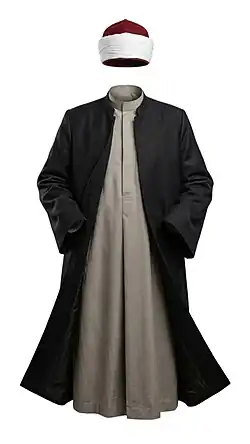 Al-Azhar attire | |
| Type | Religious / formal dress |
|---|---|
| Place of origin |  Egypt |
Al-Azhar attire is the traditional formal dress worn by scholars and students of al-Azhar in Egypt. It is regarded as a symbol of the moderate identity and tolerance represented by the institution through the centuries. The attire consists mainly of the Azhar turban and the body garment represented by the kakoula and the jubba.[1][2][3]
History

The roots of the Azhar attire go deep into the Islamic history of Egypt. Al-Azhar Mosque witnessed different forms of turbans since its foundation in the Fatimid era in 972, when the original aim was to spread Shi'ism, and the turbans then differed in style from the current form. With Egypt's transition to the Sunni school in the Ayyubid era, the attire began to take on a new character.[1]
The current form of the turban (white cloth over the red fez) became established during the Mamluk and Ottoman periods. During the rule of Muhammad Ali Pasha, the fez industry flourished and became an obligatory part of the dress of state employees and students; Azharis distinguished themselves by wrapping the white shawl around the fez to set them apart from other groups. This tradition continued until the 1952 July Revolution, when President Gamal Abdel Nasser abolished the requirement for Egyptians to wear the fez, but the Azhar attire remained a distinctive feature of al-Azhar scholars and students.[4]
The turban
The Azhar turban is a distinctive mark of its scholars. It consists of a red fez (which dates back to the Ottoman era) wrapped with a white shawl made of cloth or wool. Its production relies mainly on precise handicraft work using a needle, and heating with fire is sometimes used to shape its final form.
Types of the turban
The turban differs in its technical details according to the role of the wearer:
- The scholars' and students' turban: This is the traditional, sober turban worn by the Grand Imam of al-Azhar, the Grand Mufti of Egypt, the Egyptian Minister of Endowments, mosque imams, and students of the Sharia faculties at al-Azhar University. It is distinguished by the darker red color of the fez on top and by being wrapped by hand. It is relatively taller than the reciters' turban.[2]
- The turban of reciters and broadcasters: It has an aesthetic character described by craftsmen as "festive." It differs from the scholars' turban in that its fez tends toward a lighter red color, with a "blue button" (tassel) at the top, and its wrapping is more rounded and prominent. It was famously worn by major reciters such as Sheikh Abdel Basset Abdel-Samad and Sheikh al-Tablawi.
 Ibrahim al-Barmawi, the second Grand Imam of al-Azhar, wearing a turban similar to its present form
 The late Sheikh Amin al-Husseini, former Grand Mufti of Jerusalem, wearing al-Azhar attire in the style used in the Levant.
 Fez, the main component of the Azhar turban.
The jubba and kakoula
The body garment consists of several integrated parts:
Related events

- National struggle: The Azhar turban was a symbol of the gathering of Egyptians in resistance against the French campaign in Egypt in 1798, the Urabi revolt, and the 1919 Revolution against the British occupation.
- The 1928 rebellion: This year saw the first official rebellion by students of al-Azhar's secondary section against wearing the "galabeya" under the kakoula, as they demanded replacing it with a Western-style suit, which was met with rejection and strictness from al-Azhar administration at the time.[3]
- More recently, in the late twentieth century, the attire faced competition from other outfits (such as the short galabeya with the Gulf shemagh) preferred by supporters of the Salafi trend, who criticized al-Azhar attire as a "government uniform." The Egyptian Ministry of Endowments currently issues al-Azhar attire regularly to imams to preserve the visual identity of religious scholars, and it prohibits its wearing by anyone other than those affiliated with al-Azhar.[5][6]
See also
References
- 1 2 3 "Egyptian scenes: The Azhar attire - Al-Ahram Daily". gate.ahram.org.eg. Retrieved 2026-03-30.
- 1 2 Report by Mohamed Qassem (2021-11-02). "The story of Egypt's oldest fez maker... I made the Azhar turban for Al-Tablawi and Abdel Basset". Youm7 (in Arabic). Retrieved 2026-03-30.
- 1 2 "Ramadan memories... the turban and the fez!". Al-Ahram Daily (in Arabic). Retrieved 2026-03-30.
- ↑ "After forcing scholars of Azhar institutes and preachers to wear them, turbans shine again". Al-Ahram Daily (in Arabic). Retrieved 2026-03-30.
- ↑ Saeed Hijazi and Abdel Wahab (2019-02-28). "One thousand years of the jubba and caftan... Al-Azhar and Endowments restore the sanctity of religious dress". El Watan (in Arabic). Retrieved 2026-03-30.
- ↑ "EGP 100,000 fine as punishment for wearing Al-Azhar attire by non-graduates - draft law". Masrawy (in Arabic). Retrieved 2026-03-30.