Agrionoptera longitudinalis
| Agrionoptera longitudinalis | |
|---|---|
 | |
| Striped Swampdragon Agrionoptera longitudinalis biserialis | |
Scientific classification  | |
| Kingdom: | Animalia |
| Phylum: | Arthropoda |
| Clade: | Pancrustacea |
| Class: | Insecta |
| Order: | Odonata |
| Infraorder: | Anisoptera |
| Superfamily: | Libelluloidea |
| Family: | Libellulidae |
| Genus: | Agrionoptera |
| Species: | A. longitudinalis |
| Binomial name | |
| Agrionoptera longitudinalis | |
 | |
| Synonyms[3] | |
| |

Agrionoptera longitudinalis is a species of dragonfly in the family Libellulidae.[4]
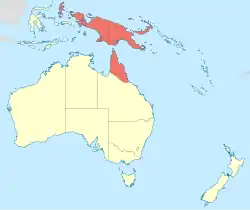
It is native to Indonesia, Papua New Guinea, and Queensland in Australia.[5] It is common, even abundant in some areas.[1]
This species can be found in most any type of standing water, including pools and tree holes. It is adaptable to disturbed habitat and can live and breed in artificial aquatic habitat types.[1]
Subspecies
Subspecies include:
- Agrionoptera longitudinalis biserialis - striped swampdragon
- Agrionoptera longitudinalis dissoluta
- Agrionoptera longitudinalis longitudinalis
Etymology
The genus name Agrionoptera combines Agrion, a genus name derived from the Greek ἄγριος (agrios, "wild"), with the Greek –πτερος (pteros, "winged"), referring to the similarity of the wings to those of Agrion.[6]
The species name longitudinalis is derived from the Latin longitudo ("length"), referring to the distinct yellow band running along the length of the thorax.[6]
References
- 1 2 3 Kalkman, V. (2009). "Agrionoptera longitudinalis". IUCN Red List of Threatened Species. 2009 e.T163850A5659707. doi:10.2305/IUCN.UK.2009-2.RLTS.T163850A5659707.en. Retrieved 20 November 2021.
- ↑ Selys-Longchamps, E. (1878). "Odonates de la région de la Nouvelle Guinée". Mittheilungen aus dem K. Zoologischen Museum zu Dresden (in French). 3: 289–323 [315] – via Biodiversity Heritage Library.
- ↑ Paulson, D.; Schorr, M.; Abbott, J.; Bota-Sierra, C.; Deliry, C.; Dijkstra, K.-D.; Lozano, F. "World Odonata List". OdonataCentral. University of Alabama. Retrieved 23 April 2026.
- ↑ "Species Agrionoptera longitudinalis Selys, 1878". Australian Faunal Directory. Australian Biological Resources Study. 2012. Retrieved 28 February 2017.
- ↑ Watson, J.A.L.; Theischinger, G.; Abbey, H.M. (1991). The Australian Dragonflies: A Guide to the Identification, Distributions and Habitats of Australian Odonata. Melbourne: CSIRO. p. 278. ISBN 0-643-05136-8.
- 1 2 Endersby, Ian; Fliedner, Heinrich (2015). The Naming of Australia's Dragonflies. Eltham, Victoria, Australia: Busybird Publishing. ISBN 9781925260625.