Agbogbloshie
Agbogbloshie | |
|---|---|
Town | |
  Agbogbloshie Location of Agbogbloshie, Ghana in the Greater Accra Region | |
| Coordinates: 05°32′42.0″N 00°13′30″W / 5.545000°N 0.22500°W | |
| Country |  Ghana |
| Region | Greater Accra Region |
| District | Korle-Klottey Municipal District |
| Time zone | UTC0 (GMT) |

Agbogbloshie is the nickname of a commercial district on the Korle Lagoon of the Odaw River, near the center of Accra, Ghana's capital city. Close to the slum called "Old Fadama", the Agbogbloshie site has become known as a destination for externally generated automobile and electronic scrap collected mostly from the Western world. It is a center of a legal and illegal exportation network for the environmental dumping of electronic waste from industrialized nations. The Basel Action Network, a charitable non-governmental organization based in Seattle, has referred to Agbogbloshie as a "digital dumping ground", where millions of tons of e-waste are processed each year. Roughly 40,000 Ghanaians inhabit the area, most of whom are migrants from rural areas.[1][2] Due to its harsh living conditions and rampant crime, the area has been nicknamed "Sodom and Gomorrah".[3]
The Basel Convention prevents the cross-border shipment of hazardous waste from developed to less developed countries. However, under Annex Ix, B1110, the convention specifically allows export for reuse and repair. While numerous international press reports have made reference to allegations that the majority of exports to Ghana are dumped, research by the US International Trade Commission found little evidence of unprocessed e-waste being shipped to Africa from the United States.[4]
Whether domestically generated by residents of Ghana or imported, concerns have remained over the methods of waste processing—especially burning—which releases toxic chemicals into the air, land, and water. Exposure is especially hazardous to children, because those toxins are known to inhibit the development of the reproductive system, the nervous system, and, especially, the brain. Concerns about human health and the environment of Agbogbloshie continue to be raised, because the area is heavily polluted.[2][5][6]
In the 2000s, the Ghanaian government, with new funding and loans, implemented the Korle Lagoon Ecological Restoration Project, an environmental remediation and restoration project that was designed to deal with the pollution problem by dredging the lagoon and Odaw canal to improve drainage and the outfall into the ocean.[7]
Background

In the 1960s, the area of present-day Agbogbloshie was a wetland. As the city of Accra urbanized, a ghetto grew, referred to as Old Fadama or Ayaalolo.[1][8] During the 1980s, the ghetto was a place of shelter for refugees from the Konkomba-Nanumba war.[8] In the late 1990s, newly available electricity from the Akosombo Dam led to increased local demand for electric and electronic appliances.[1]
The electricity from the Akosombo Dam increased demand for functional secondhand televisions and computers, which were imported from the West by Africa's technology sector, to help "bridge the digital divide". Ghanaians welcomed the donations, because the computers cost one-tenth the price of new ones. The Basel Action Network (BAN) circulated a claim in 2008 that as many as 75 percent of the secondhand electronic equipment sent to Africa could not be reused and ended up in landfills instead.[1][9]
The BAN allegation was slightly different from its 2002 claim of 80% waste,[10] which became one of the most cited references in academic journals, though no documentation or peer-reviewed source was made available.[11]
Economy
Unemployed migrants to Accra take part in scrap metal collection, including automotive scrap, to supplement their incomes. A 2018 report stated that each month, an estimated 300 to 600 40-foot-long containers of e-waste shipments reached the ports of Ghana,[12] largely from the United States, France, Germany, South Korea, Switzerland, and the Netherlands.[5][9] Upwards of 85 per cent of electronics and electrical parts imported into Ghana are from the EU, and a large proportion is dumped as e-waste after entering the country.[13] Multinational brands such as Philips, Canon, Dell, Microsoft, Nokia, Siemens, and Sony are commonly found throughout the waste.[5] According to e-waste assessment studies, "Refurbishing of EEE [electrical and electronic equipment] and the sales of used EEE is an important economic sector. It is a well-organized and a dynamic sector that holds the potential for further industrial development. Indirectly, the sector has another important economic role, as it supplies low and middle income households with affordable ICT equipment and other EEE."[14]

In 2008, followers of BAN alleged that non-governmental (NGO) organizations are adding to the waste when excess electronics are donated, with the intention of helping scholarly institutions.[15] They claimed, based on the 75%–80% orphaned waste statistic, that exporters must have found numerous loopholes to avoid legislation forbidding e-waste shipping, such as labeling broken electronics as 'end-of-life' or 'second-hand-goods', falsely identifying them as in working order.[5][15]
Workers, children and adults alike, disassemble cars, appliances, and scrap electronics, gathered in wheeled push carts from Accra neighborhoods. The revenue from the recovery of metals such as copper, aluminium, and iron is very small, however.[5][9][16] According to a 2011 report, half a sack of copper or aluminium sold for about ₵700, amounting to about ₵8–10 Ghana cedis per day (US$4–6).[17]
The informal e-waste recycling industry is highly hierarchical, with burners, collectors, and dismantlers, often the entry point for young people, representing the "lowest" class. Developing enough knowledge, networking, and capital can allow people to attain higher ranks. The Greater Accra Scrap Dealers Association, a group formed by the workers themselves, has established certain rules and regulations and even cooperated with the National Youth Authority, a governmental organization.[12]
Living conditions
The population of Agbogbloshie consists of economic migrants from northern and rural parts of Ghana, where living standards are worse, causing people to move to urban settings, such as Agbogbloshie.[2] Inhabitants of Agbogbloshie live, eat, and work on the land and in the midst the waste.[8][2] School-age children often spend their evenings and weekends processing waste and searching for metals.[18]
Dwellings consist of wooden shacks that lack water and sanitation.[19] The area is also home to armed robbers, prostitutes, drug dealers, and underground markets. Crime and disease are rampant throughout Agbogbloshie, creating a difficult living environment.[2] Due to its harsh living conditions, outsiders have nicknamed the area "Sodom and Gomorrah", after the two condemned biblical cities.[8]
Pollution

The dumping and processing of electronic waste in Agbogbloshie has severely contaminated the air, land, and water in the entire area.[20] Poisons such as lead, mercury, arsenic, dioxins, furans, and brominated flame retardants seep into the surrounding soil and water, severely polluting the landscape.[5][6][16] 2010 Greenpeace laboratory tests showed that water and soil from areas in Agbogbloshie had concentrations of chemicals at levels over a hundred times greater than what is considered safe.[6]

Several studies have confirmed high levels of lead in the soil, with particular risks to workers and children.[21] Environmental lead contamination was predominantly due to burning the plastic covering of copper wires. PVC electrical insulation contains approximately 3,000 mg/kg of lead, used as a stiffener and ultraviolet inhibitor, which is released during burning.[22]
Concentrations of several other toxic chemicals regularly exceed acceptable levels set by Japanese, German, or American governments.[23]
In April 2019, The Guardian reported that a study for IPEN and the Basel Action Network found dangerous levels of dioxins and polychlorinated biphenyls in chicken eggs in Agbogbloshie.[24] A study published by Arnika and IPEN revealed that eggs from backyard farming in Agbogbloshie contained very high concentrations of other persistent organic pollutants, specifically short-chain chlorinated paraffins, brominated dioxins, hexachlorobenzene, and polybrominated diphenyl ethers.[25][26] One egg from a free-range chicken in the area was tested and found to have 220 times the amount of chlorinated dioxins (which can cause cancer and damage the immune system) that the European Food Safety Authority considers safe to consume. Because of that, nearly 80,000 inhabitants living either in or near the Agbogbloshie slum are affected by the toxins in their food.[27]
The Korle Lagoon, on which Agbogbloshie is situated, has extremely low levels of dissolved oxygen, a result of the large and uncontrolled quantities of domestic and industrial waste being released into the water. Studies have indicated that the entrance to the lagoon is severely polluted and not suitable for physical contact, due to the large amount of bacteria present.[28]
Health risks

Processing electronic waste presents a serious health threat to workers at Agbogbloshie. The fumes released from the burning of the plastics and metals are composed of highly toxic chemicals and carcinogens.[5] Workers often inhale lead, cadmium, dioxins, furans, phthalates, and brominated flame retardants.[15][16]
Exposure to fumes is especially hazardous to children, because the toxins are known to inhibit the development of the reproductive system, the nervous system, and the brain.[5] In similar e-waste processing areas, with conditions and demographics like those of Agbogbloshie, 80% of children have dangerous levels of lead in their blood.[16] Inhabitants often suffer from chronic nausea, headaches, and respiratory problems.[15][29]
High levels of toxins have also been discovered in soil and food samples, as chemicals stay in the food chain.[5][15]
There is evidence that, because they lack critical relevant education, workers possess little awareness of the hazards associated with informal e-waste processing, and some attribute their health issues to other sources, such as malaria or sun exposure.[30]
Information security
E-waste presents a potential security threat to individuals and exporting countries. Hard drives that are not properly erased before a computer is disposed of can be reopened, exposing sensitive information. Credit card numbers, private financial data, account information, and records of online transactions can be accessed by those with the necessary knowledge. Organized criminals in Ghana commonly search the drives for information to use in local scams.[8]
Government contracts have been discovered on hard drives found in Agbogbloshie. Multimillion-dollar agreements from United States security institutions, such as the Defense Intelligence Agency, the Transportation Security Administration, and Homeland Security, all resurfaced in Agbogbloshie.[8][31]
Restoration efforts
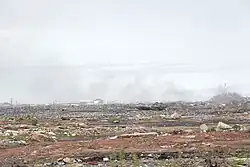
The Ghanaian government has made an effort to restore the area through the Korle Lagoon Ecological Restoration Project (KLERP). In 2003, the OPEC Fund for International Development, the Arab Bank for Economic Development in Africa, and the Kuwait Fund for Arab Economic Development provided a loan for the project, with the expectation that the Ghanaian government would dredge the lagoon and restore its surroundings.[2][19] Other goals of the project included a reduction in flooding, an increase in marine life, an improvement of water quality, and an enhancement in general sanitary conditions.[32]
Due to the invasive nature of the project, the restoration efforts were opposed by the inhabitants of Agbogbloshie. KLERP required people to leave the area, which was the only home for a majority of squatters. The Accra Metropolitan Assembly continually tried to evict people but were met with a great deal of resistance.[2]
In 2014, the NGO Pure Earth funded the creation of a copper wire recycling center within Agbogbloshie and helped install several automated machines to simplify the removal of plastic coating from wires and reduce burning.[33] The efforts appeared to be moderately successful, but burning continued.
From 2017, the German government supported Ghana in introducing sustainable e-waste management.[34] An e-waste programme was implemented by Deutsche Gesellschaft für Internationale Zusammenarbeit, in partnership with the Ghanaian Ministry of Environment Science Technology and Innovation.[35] In 2019, a training facility, a health clinic, and a football pitch were provided.[36]
Attempted demolition
In July 2021, the Ghanaian government attempted to demolish and clear the Agbogbloshie settlement and recycling site,[37] but scrap workers returned to the area following President John Mahama's inauguration in 2025.[38]
In popular culture
- The official video of Placebo's cover of Talk Talk's song "Life's What You Make It" starts with the line "This film is dedicated to the workers of Agbogbloshie" and ends with "When you get rid of your cellphone, computer and home appliances, your cast-offs often go on a voyage across the oceans to Agbogbloshie. Agbogbloshie is a former wetland, which is now home to one of the world's largest electronic waste dumps. Here, young men and boys smash and burn electronic devices to salvage the metals inside them". The whole video was shot on site at Agbogbloshie.[39]
See also
- Guiyu, Guangdong, an electronic waste site in China
References
- 1 2 3 4 "Time up for Sodom and Gomorrah". Peace FM Online. Daily Graphic. 4 September 2009. Archived from the original on 11 March 2012.
- 1 2 3 4 5 6 7 Safo, Amos. "End of the Road for 'Sodom and Gomorrah' Squatters". News from Africa. Archived from the original on 18 July 2011. Retrieved 15 March 2011.
- ↑ Hugo, Pieter (24 July 2011). "Ghana's e-Waste Dump Seeps Poison". Newsweek.
- ↑ U.S. International Trade Commission (February 2013). Used Electronic Products: An Examination of U.S. Exports (PDF) (Report). 4379.
- 1 2 3 4 5 6 7 8 9 "Poisoning the poor – Electronic waste in Ghana". Greenpeace. 5 August 2008. Archived from the original on 11 April 2020.
- 1 2 3 Dogbevi, Emmanuel K. (7 June 2010). "E-waste in Ghana – How many children are dying from lead poisoning?". Ghana Business News. Retrieved 3 January 2022.
- ↑ "The Environmental Impact Assessment [EIA] Study for the Dredging in the Odaw Basin" (PDF). Ministry of Works and Housing: 5. February 2019. Archived from the original (PDF) on 25 February 2024. Retrieved 12 March 2022.
- 1 2 3 4 5 6 "Ghana: Digital Dumping Ground". FRONTLINE/World. PBS. Retrieved 3 January 2022.
- 1 2 3 Darko, Richmond (25 August 2010). "Electronic Waste Dumping on Ghana Still Continues". Opinion. GhanaWeb.
- ↑ Puckett, Jim; Byster, Leslie; Westervelt, Sarah; Gutierrez, Richard; Davis, Sheila; Hussain, Asma; Dutta, Madhumitta (25 February 2002). Exporting Harm: The High-Tech Trashing of Asia (PDF) (Report). Basel Action Network & Silicon Valley Toxics Coalition. Archived from the original (PDF) on 2 May 2022. Retrieved 3 January 2022.
- ↑ Lepawsky, John (7 April 2016). "From Statements to Debates II". Reassembling Rubbish. Mapping E-waste as a Controversy. Retrieved 3 January 2022.
- 1 2 Amuzu, David (3 June 2018). "Environmental injustice of informal e-waste recycling in Agbogbloshie-Accra: urban political ecology perspective". Local Environment. 23 (6): 603–618. Bibcode:2018LoEnv..23..603A. doi:10.1080/13549839.2018.1456515. ISSN 1354-9839. S2CID 159029205.
- ↑ "Your old electronics are poisoning people at this toxic dump in Ghana". Wired UK. ISSN 1357-0978. Retrieved 12 December 2022.
- ↑ Ogungbuyi, Olakitan; Nnorom, Innocent Chidi; Osibanjo, Oladele; Schluep, Mathias (May 2012). e-Waste Country Assessment Nigeria (PDF) (Report). Secretariat of the Basel Convention.
- 1 2 3 4 5 "European Electronic Waste in Ghana and Nigeria." Dan Watch. 25 February 2008. Web. 15 March 2011.
- 1 2 3 4 Monbiot, George (21 September 2009). "From toxic waste to toxic assets, the same people always get dumped on". The Guardian.
- ↑ Nuvor, Francisca (28 January 2011). "Ghana: E-waste becoming business". AfricaNews. Archived from the original on 29 March 2012.
- ↑ Claiborne, Ron (2 August 2009). "U.S. Electronic Waste Gets Sent to Africa". Good Morning America. Accra, Ghana. ABC News. Retrieved 3 January 2022.
- 1 2 Afenah, Afia. "(Re)claiming Citizenship Rights in Accra, Ghana". DPH. HIC (Habitat International Coalition). Retrieved 15 March 2011.
- ↑ Chasant, Muntaka (9 December 2018). "Video and Photos of Agbogbloshie, Ghana". ATC MASK. Archived from the original on 14 December 2018. Retrieved 14 December 2018.
- ↑ Caravanos, Jack; Clark, Edith; Fuller, Richard; Lambertson, Calah (1 February 2011). "Assessing Worker and Environmental Chemical Exposure Risks at an e-Waste Recycling and Disposal Site in Accra, Ghana". Journal of Health and Pollution. 1 (1): 16–25. doi:10.5696/jhp.v1i1.22. ISSN 2156-9614.
- ↑ Aboh, Innocent Joy Kwame; Sampson, Manukure Atiemo; Nyaab, Leticia Abra-Kom; Caravanos, Jack; Ofosu, Francis Gorman; Kuranchie-Mensah, Harriet (1 June 2013). "Assessing Levels of Lead Contamination in Soil and Predicting Pediatric Blood Lead Levels in Tema, Ghana". Journal of Health and Pollution. 3 (5): 7–12. doi:10.5696/2156-9614-3.5.7. ISSN 2156-9614.
- ↑ Tue, Nguyen Minh; Goto, Akitoshi; Takahashi, Shin; Itai, Takaaki; Asante, Kwadwo Ansong; Kunisue, Tatsuya; Tanabe, Shinsuke (25 January 2016). "Release of chlorinated, brominated and mixed halogenated dioxin-related compounds to soils from open burning of e-waste in Agbogbloshie (Accra, Ghana)". Journal of Hazardous Materials. 302: 151–157. Bibcode:2016JHzM..302..151T. doi:10.1016/j.jhazmat.2015.09.062. ISSN 0304-3894. PMID 26474377.
- ↑ Beaumont, Peter (24 April 2019). "Rotten eggs: e-waste from Europe poisons Ghana's food chain". The Guardian. Retrieved 3 January 2022.
- ↑ Petrlik J, Adu-Kumi S, Hogarh J, Akortia E, Kuepouo G, Behnisch P, Bell L, DiGangi J (2019). Persistent Organic Pollutants (POPs) in Eggs: Report from Africa. Accra-Yaoundé-Gothenburg-Prague: Arnika/IPEN/CREPD. p. 48. doi:10.13140/RG.2.2.34124.46723.
- ↑ Petrlik, Jindrich; Bell, Lee; DiGangi, Joe; Allo'o Allo'o, Serge Molly; Kuepouo, Gilbert; Ochola, Griffins Ochieng; Grechko, Valeriya; Jelinek, Nikola; Strakova, Jitka; Skalsky, Martin; Drwiega, Yuyun Ismawati; Hogarh, Jonathan N.; Akortia, Eric; Adu-Kumi, Sam; Teebthaisong, Akarapon (1 January 2022). "Monitoring dioxins and PCBs in eggs as sensitive indicators for environmental pollution and global contaminated sites and recommendations for reducing and controlling releases and exposure". Emerging Contaminants. 8: 254–279. doi:10.1016/j.emcon.2022.05.001. ISSN 2405-6650. S2CID 249113916.
- ↑ "The Rich World's Electronic Waste, Dumped in Ghana". Bloomberg.com. 29 May 2019. Retrieved 12 December 2022.
- ↑ Karikari, A. Y.; Asante, K. A.; Biney, C. A. (2006). "Water quality characteristics at the estuary of Korle Lagoon in Ghana". West African Journal of Applied Ecology. 10 (1). doi:10.4314/wajae.v10i1.45700.
- ↑ Caravanos, Jack; Clarke, Edith E.; Osei, Carl S.; Amoyaw-Osei, Yaw (1 January 2013). "Exploratory Health Assessment of Chemical Exposures at E-Waste Recycling and Scrapyard Facility in Ghana". Journal of Health and Pollution. 3 (4): 11–22. doi:10.5696/2156-9614-3.4.11 (inactive 15 July 2026). ISSN 2156-9614.
{{cite journal}}: CS1 maint: DOI inactive as of July 2026 (link) - ↑ Yu, Emily A.; Akormedi, Matthew; Asampong, Emmanuel; Meyer, Christian G.; Fobil, Julius N. (December 2017). "Informal processing of electronic waste at Agbogbloshie, Ghana: workers' knowledge about associated health hazards and alternative livelihoods". Global Health Promotion. 24 (4): 90–98. doi:10.1177/1757975916631523. ISSN 1757-9759. PMID 27271535. S2CID 25362314.
- ↑ Doctorow, Cory (25 June 2009). "Illegal e-waste dumped in Ghana includes unencrypted hard drives full of US security secrets". Slashdot. Boing Boing. Retrieved 3 January 2022.
- ↑ "Korle Lagoon Ecological Restoration Project". ADK Consortium. Archived from the original on 6 July 2011.
- ↑ "E-Waste Recycling – Agbogbloshie, Ghana – Pure Earth". Pure Earth. Retrieved 17 February 2016.
- ↑ Kaledzi, Isaac (19 March 2017). "Germany supports e-waste disposal in Ghana". Deutsche Welle.
- ↑ "Ghana's biggest e-waste yard receives face-lift". Ghana News Agency. Ministry of Environment, Sciency, Technology and Innovation. 28 March 2019. Retrieved 3 January 2022.
- ↑ "A glimmer of hope comes to Agbogbloshie". 29 March 2019.
- ↑ Boakye, Edna Agnes (20 May 2021). "Relocate to Adjen Kotoku within seven weeks – Onion traders in Accra ordered". Citinewsroom – Comprehensive News in Ghana. Retrieved 20 May 2021.
- ↑ Chasant, Muntaka. "Agbogbolshie Demolition:The End of an Era or an Injustice". muntaka.com. Retrieved 27 January 2026.
- ↑ Munro, Scott (5 June 2017). "Placebo return with new video and UK tour". Teamrock.com. Retrieved 14 July 2026.
External links

- Inside a Massive Electronics Graveyard The Atlantic, December 2014
- Placebo - Life's What You Make It (Official Video) on YouTube
- The World's Junkyard for Electronic Scrap: Digital Dumping in Ghana ENDEVR Documentary, 2022