Afa (Igbo divination)
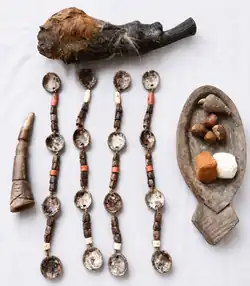
Afa (also rendered as Igba Afa or Afa Ugiri) is the traditional divination system of the Igbo people of southern Nigeria. It is a central practice within Odinani, the indigenous religious and philosophical tradition of the Igbo, and serves as one of the primary means through which individuals, families, and communities seek guidance from the spiritual world. The practitioner of Afa is known as the Dibia Afa (also Ogba Afa, lit. 'interpreter of Afa'), a specialist trained in the interpretation of divination signals and regarded as an intermediary between the living and the ancestral and spiritual realms.[1]
The Igbo word afa derives from the verb root meaning "to name" or "to identify," reflecting the diviner's role in naming the root cause of a problem, illness, misfortune, or uncertainty. A common alternate form is eha or aha, with the letters f and h often interchangeable in Nsukka Igbo dialects.[1] The act of casting afa is called agb'áfa, meaning "cast the word," and the caster is called onye n'agb'áfa - "person who casts afa."[1]
The practice is deeply embedded in Igbo social life and was historically consulted on matters ranging from illness, conflict, and agricultural decisions to marriage, travel, and political leadership. Anedo (2008), in a doctoral dissertation submitted to Nnamdi Azikiwe University, describes afa as "the act of foretelling future events or discovering things secret or obscure by supernatural means," adding that "whatever happened to the Igbo whether naturally or by accident, its cause must be known by consulting a diviner."[2]
Cosmological context
Afa operates within the cosmological framework of Odinani, the Igbo spiritual tradition. In this worldview, human life exists in continuous relationship with several spiritual forces:
- Chukwu - the supreme creator deity, the ultimate source of existence; each individual receives a portion of his divine force as their personal spirit, chi
- Ala - the earth goddess, the moral foundation of Igbo society
- Alusi (also arụsị; alusi in Nri dialect) - spirits worshipped and served within Igbo religion, each governing a specific domain of life
- Mmụọ - ancestral spirits of the departed, who continue to interact with the living
- Agwu - the alusi of health, divination, and medicine, believed to call and possess the Dibia
In Nri cosmological thought, Chukwu is conceived as having four manifestations: as anyanwu, symbolising the sun and omnipresence; as agbala, the fertility of the earth and all living things; as chi, the procreative force enabling living beings to generate themselves from generation to generation; and as okike, the creator of everything visible and invisible. These four attributes are not separate deities but aspects of a single divine reality, and afa as a system operates across all four registers simultaneously, reading the visible world as a reflection of these deeper forces.[3]
In Igbo cosmology, misfortune, illness, or crisis does not occur randomly. Shelton (1965) documented that among the northern Igbo, "most serious material happenings are ascribed ultimately to the work of the spirits." When misfortune strikes, the person first consulted is the afa-diviner, because the cause lies beyond what logic or common sense can determine. The afa identifies which particular spirit brought the calamity, the motives of that spirit, and the types and amounts of sacrifices required to restore balance.[1]
Chi and Agwu
Central to the Nri understanding of afa is the dialectical relationship between the supernatural forces of chi and agwu. Onwuejeogwu (1997) describes this as a fundamental Levi-Straussian opposition in which chi represents predictability, creativity, order, and the stable personality of a person, while agwu represents unpredictability, instability, and the capacity to reveal the hidden workings of the invisible world. Chi is a stable force determined at birth and remains constant; agwu is an ambivalent force that can take possession of a person temporarily, distorting their behaviour and producing erratic actions, but it is also the very force through which hidden knowledge is disclosed to the dibia.[3]
In Nri thought, when a person's actions become erratic, Nri people do not say their chi is bad, they say agwu has taken possession of them. The two forces alternate. Chi manifests as the creative, predictable personality; agwu as the unpredictable. Both affect the structure and quality of a person's personality and are conceived not in dialectical opposition but in alternating relationship. This alternation is publicly performed each year during the fifth month of the Nri traditional calendar, a period called onwa agwu, when young men who have taken the mmanwu title perform mask dances. The mask dancer moves between being masked (agwu - unpredictable) and unmasked (chi - predictable), enacting the cosmological drama through social performance.[3]
Agwu and the calling of the Dibia
The deity Agwu is considered the patron and controlling spirit of divination and medicine in Igbo tradition. Becoming a Dibia Afa is understood not as a voluntary career choice but as a calling. Signs of this calling may include unusual dreams, visions, or illnesses unexplained by conventional means.
One becomes a caster of afa by first obtaining the paraphernalia, with the afa chains being made by an attama (shrine-priest) or by an older caster and sold to the aspirant. The tortoise shell for storage can be purchased from a person who has made a special sacrifice of the tortoise to the Earth-spirit, Ane. With the paraphernalia, the aspirant approaches an afa-caster and inquires if the latter will teach him. If the answer is affirmative, the aspirant is instructed to return on a given day to begin study, which if conducted daily requires from three to six months of diligent memorisation of the secret language and the patterns into which the afa can fall. When the aspirant appears for his first lesson, he brings with him a cock, one or two yams, kola nuts, and palm wine as preliminary payment.[1]
Onwuejeogwu (1997) documented that in the Nri tradition, Dibia Afa were not simply diviners but also healers, intellectual custodians, interpreters of dreams, and agents of communal ethics. Each Dibia had specific specialisations: Dibia Afa (diviners), Dibia Ogwu (healers and charm-makers), and Dibia Mmuo (spirit communicators). Their training was so refined that they could interpret not only ritual signs but also human behaviour, state history, and collective memory.[3]
In the Nri tradition, the training process was exceptionally long and demanding. A child or adult was first ritually inspired (iwa) by agwu before being apprenticed to an established dibia. A child apprenticed at ten took over fifteen years to qualify; someone entering later might require more than twenty years to gain public respect and recognition for excellence. During this period the young dibia memorised the afa signs and learned to decode them with speed and accuracy, including the ability to throw and manipulate the afa beads, recite the ritual incantations, interpret the language of afa through proverbs, riddles, idioms and other figures of speech, relate the aspects of Nri religion and philosophy to the social world, and learn the general history of neighbouring towns and villages. The master prepared two charms for the student: the atu, which sharpened effective use of the tongue in talking, cursing, and predicting; and the ako na uche, which cultivated thoughtfulness and commonsense, the seat of learning.[3]
Anedo (2008) recorded that the calling to become a Dibia Afa was not open to all. Divination was described as "a call, not an all-comers affair," and false diviners who entered without a genuine calling gave rise to false interpretation of afa messages. After the calling is confirmed, formal entry into the profession requires initiation. This included a ceremony known as ilu agwu (appeasing Agwu) and a consecration rite called inu okuku (consecration of the calabash), after which the initiate was considered spiritually equipped to practise.[4]
Female diviners, known as Ezenwanyi Afa, also practise Afa in some Igbo communities, particularly in parts of Anambra and Imo states.
An important proverb among the northern Igbo captures the necessity of the caster: Êha nọọ na mbêkwu anigi agba onwoya; lit. 'Afa sitting in tortoise shell does not cast itself'. The afa must be cast by the caster in order to have meaning of any kind.[1]
Physical instruments
Shelton (1965) documented the physical instruments of Afa among the northern Nsukka Igbo in detail. The afa consist of four strings or chains, each containing four half-shells of either the bush mango seed (ujuru, Irvingia gabonensis) or more commonly the almond seed (ápipi, Pterocarpus osum). The strings are usually about 12 to 15 inches in length, with the half-shells more or less evenly spaced. The strings may also contain cowrie shells or bits of polished stone or seashell.
The afa are stored in the shell of a tortoise (Igbo: mbêkwu) along with a small piece of sacred ofo wood (Detarium senegalense) or wood from one of several varieties of "life-trees" such as ọgbu (Ficus spp.), êjulosi (Newbouldia laevis), or ichikêre (Spondias monbin). The ofo wood is used by the caster as a means of truth-telling during the divination process.
In the Nri tradition documented by Onwuejeogwu (1997), the major instrument used in communication with agwu is a pair of chaplets rather than four separate strings. Each chaplet is a continuous string of four broad beads separated by four beads of cylindrical bones from the spines of fish. Before an afa session, the dibia afa places on the ground before him the image of agwu, all or some of its associated animals, and a small water pebble with which to threaten agwu if it begins to play pranks (Igbo: itin ntu). Other items include locally-made white chalk used for making marks on the ground, the right or left horn of an animal (Igbo: énenmili), used by the afa man to blow off bad talk or signs from agwu, and the dibia's ofo staff, which was handed to him on the day he completed his training as a dibia afa. All these items, apart from the agwu images, are packed in an empty tortoise shell.[3]
The storage of the afa in the tortoise shell carries deep cultural significance. As one afa instructor explained: "In the old days the afa-caster always used the shell of Tortoise to keep the afa, because Tortoise is the way the Igbo people learn many true things, through the stories told about Tortoise in the olden times and even today. People of the old times believed that a story of Tortoise always told a truth, and the afa tell the truth, so they are kept in the house of Tortoise."[1] In Nri cosmological thought, the tortoise also carries specific symbolic weight. It is agwu's favourite plant associated with agwu as a supernatural force precisely because, like agwu, the tortoise is versatile, unpredictable in its movement, and capable of invading both the visible and invisible world. Its roots spread far and wide; it is difficult to locate its main root or determine the direction of its growth.[3]
Pattern system
The actually significant parts of the afa strings are the ápipi or ujuru half-seeds four strings with four seeds on each. The pattern formed when the strings are cast is the actual afa. The pattern is determined by the relationship between "open" (half-seeds falling with the interior concavity upwards) and "closed" (with the exterior convexity upwards) positions.
The afa is read by examining adjacent pairs of seeds within each cast. The combination of open (O) and closed (C) positions across the four strings generates a specific afa word in the secret language of divination. The caster reads the top row of seeds first, examining adjacent pairs: seeds 1+2, 2+3, 3+4, as well as cross combinations 1+4 and 2+4. Each pair combination carries a specific afa word which the caster then translates into practical advice for the client.[1]
Binary foundation
In the Nri system analysed by Onwuejeogwu (1997), each of the two chaplets thrown simultaneously can land in one of sixteen possible seed configurations, since the four broad seeds on each chaplet each face either concave-side up (open) or concave-side down (closed). The position of the four seeds on each chaplet is associated with a given and specific afa word. When two chaplets are thrown together a pair of afa words results. Since one combination from the left chaplet produces sixteen double afa words with meaning, sixteen combinations will produce 256 double afa words with meaning, the complete vocabulary of the divination system.[3]
The afa man builds the afa words into sentences by reading the chaplets from right to left. A single throw of the right or left hand is an afa event and stands for a single afa word which on its own has no meaning. Two throws of the right and left hand done simultaneously produce double afa words that have meaning. The synchronism of the two events transforms them into a unity of meaningful thought. The relationship between the two simultaneous events contains two orders of syntagmatic chains, and successive pairs of throws are related to one another by paradigmatic associations.[3]
Five types of binary relationship
Onwuejeogwu (1997)[3] identified five distinct types of binary relationship that can obtain between any two afa signs when the chaplets are thrown. These determine the logical structure of each cast and, by extension, the structure of the meaning produced:
| Relationship type | Description | Frequency in the 256 combinations |
|---|---|---|
| Binary Dissimilarity | The seeds of the two chaplets are closed or opened in such a way that the one on the right side is, in many respects, unlike the one on the left side | 81.3% |
| Binary Similarity | The seeds of the two chaplets are closed or opened in such a way that the one on the right side is, in all respects, like the one on the left side | 6.2% |
| Binary Opposition | The seeds of the two chaplets are closed or opened such that the one on the right is in all respects opposed to the one on the left | 6.2% |
| Binary Inversion | The seeds are closed or opened in such a way that if either the one on the right or the left is inverted, they assume a relationship of similarity | 3.6% |
| Binary Inversion-Opposition | The seeds are closed or opened such that some of the ones on the right are similar to some on the left, but if either side is inverted they assume a relationship of opposition | 2.7% |
Binary dissimilarity is by far the dominant relationship, accounting for over four-fifths of all possible combinations. Onwuejeogwu notes that the Afa system shows that other types of binary relationships occur in various forms, each is as important and significant as the other, but the overwhelming predominance of dissimilarity reflects the cosmological emphasis on the complexity and irreducibility of social reality. The logic of afa is based on the final results obtained from the various arrangements of all types of combinations obtained from these five types of binary relationships. When these relationships are combined and recombined, the content of a communication emerges and social reality is constructed anew.[3]
Sixteen Afa configurations
The sixteen primary Afa configurations, known collectively as elilie afa, each carry a name in the Igbo language. These names belong to the secret language of Afa divination rather than ordinary Igbo speech, and their full interpretation is transmitted orally through the apprenticeship tradition. In the Nri system as documented by Onwuejeogwu (1997), the sixteen single afa words and their alphabetic codes are:
| Code | Afa Word | Thematic domain |
|---|---|---|
| a | Okala | Events; what happens in the world |
| b | Ogoli | Death and misfortune |
| c | Akwu | Domestic relationships |
| d | Aka | Supernaturals; ancestral forces |
| e | Ululu | Food; the king of food |
| f | Ose | Sacrifice and happiness |
| g | Obala | Commonsense and knowledge |
| h | Ete | Human beings and animals |
| i | Ijite / Ogute | Emotions; the inner life |
| j | Udi / Odi | Lineages and human relationships |
| k | Obi | Action and motion |
| l | Otule | Peace |
| m | Aghali / Agali | Conflicts |
| n | Ofu | Problems |
| o | Ora | Kinship |
| p | Atunukpa / Tunukpa | Nobility and freedom |
Each word in the left column can be combined with each word in the right column to produce a pair, or double afa words, which have a specific meaning. A note applies throughout the dictionary: Nabo is substituted in every case where otherwise there would be a repetition. Thus in the afa dictionary, each combination starts with Nabo e.g., Aka nabo, Akwu nabo, etc. Since one combination produces sixteen double afa words with meaning, sixteen combinations produce 256 double afa words with meaning, forming the complete afa dictionary.[3]
Thematic classification of the 256 double signs
The 256 double afa words can be classified into four broad phenomenal themes. Onwuejeogwu (1997) conducted a frequency analysis across all sixteen combination sets:
| Theme | Raw count | Percentage of total |
|---|---|---|
| Religious phenomenon (supernaturals, ancestral forces) | 34 | 13.28% |
| Natural phenomenon (trees, animals, earth, water) | 27 | 10.55% |
| Socio-cultural phenomenon (kinship, titles, conflict, morality) | 125 | 48.83% |
| Verbs and verbal phrases (actions, states, conditions) | 70 | 27.34% |
The sociocultural domain is the dominant one, accounting for almost half of all afa vocabulary. This reflects the fundamentally social character of the system afa is oriented primarily toward the reconstruction and reordering of social relationships rather than the prediction of abstract future events. Within the sociocultural domain, the most represented themes are kinship (the Ora combinations), titled men and political authority (the Okala combinations), and conflict and resolution (the Aghali combinations). The relatively small proportion of religious terms reflects not the marginality of the supernatural in the system but its integration. Supernatural forces appear across all four domains rather than being segregated into a discrete category.[3]
Transformational relationships in Afa
Beyond the binary structure of individual throws, afa meaning is generated through a process of transformation by which objects, concepts, and relationships in the natural and social world are converted into one another through the logic of the afa signs. Onwuejeogwu (1997) documents this process in detail. For example, within the Akwu combinations the afa sign Akwu Aghali means "meat transformed into blood sacrifice." This is an associational act whereby an animal, a natural being, is converted into a cultural object of religious significance by killing it, letting its blood, and sharing its meat. Meat becomes a sign for sacrifice which symbolises the relationship with the supernaturals. Similarly, Akwu Ete transforms "big man" into "important person," mapping a social category onto a moral status, while Akwu Otunukpa maps an Iroko tree onto a big temple and thence onto a "big man" associating a giant natural object with a cultural object and finally a social identity.[3]
These transformations move across three axes: from Nature to Culture (a natural object becoming a cultural one), from Culture to Social (a cultural object taking on social meaning), and from Social back to Nature (a social identity grounded in natural symbolism). The afa scholar knows the major theme of each combination set — when a session begins, the first few throws generally determine its overall course. If Aka and Otunukpa combinations feature prominently, for instance, the dibia will expect the session to concern matters of kinship, ancestral obligation, and title-taking.[3]
Casting method
Shelton (1965) documented the full casting procedure in detail based on his fieldwork among the northern Nsukka Igbo between 1961 and 1964, during which he was himself an initiated afa-caster.
A client with a problem comes to the caster, makes the usual greetings, and declares: "I come for onye n'agb'afa to read the afa for me." The client then sits or squats across from the caster, who takes out his tortoise shell, shakes out the strings and the small ofo stick, and places the shell aside.
In casting, the diviner follows a prescribed pattern. Strings 1 and 3 are cast simultaneously, String 1 held in the right hand, String 3 in the left, the strings being drawn toward the caster, raised upwards in a curve, and cast straight outward so that the ends of the strings fall toward the supplicant. Strings 2 and 4 are then cast in the same way. After all four strings have been cast, the afa can be read.
During the reading, the caster touches the significantly-patterned seeds with the ofo stick, saying Ka, n'ka (lit. 'This, and this') or n'ka, n'ka, n'ka, indicating the patterns before speaking the afa word. The afa word is in the secret language of divination rather than ordinary Igbo, and cannot be understood by the supplicant. The caster must translate it not into Igbo equivalents but into the appropriate practical advice for the client.
A single consultation typically involves multiple casts. The caster continues casting until the afa provides a complete and consistent answer to the client's problem. In one documented case, 26 separate casts were made before the identity of the required sacrifice was fully revealed.[1]
In the Nri tradition, Onwuejeogwu (1997) documents a full afa session from August 1976 in which an elder of lineage X came with five of his relations to a dibia afa. The session involved 23 throws across a sustained conversation in which the dibia progressively identified the source of the lineage's troubles frequent quarrels, illness, and mishaps as a broken taboo against a supernatural being called Ogugu, a neglect of the medicine in the mother's lineage, and a blood sacrifice owed to an ancestral force. The session ended only when the dibia, speaking in the voice of agwu, declared itself angry at the long neglect. The full transcript reveals the afa session as a sophisticated social drama in which the dibia uses his knowledge of the lineage's biography and social structure to frame the afa signs into a coherent reconstruction of the clients' situation.[3]
Example of a documented consultation
Shelton (1965) recorded a complete afa consultation in which a man suffering from persistent chest pain consulted the afa-caster. The following illustrates how the pattern system works in practice:
In the first cast, the top row read: O C C O (strings 1-4). The adjacent pairs were read as: seeds 1+2 = obi ogoli; seeds 2+3 = ogoli osé; seeds 3+4 = osé óha. The instruction given was: "You will have to go to your home and kill some things and bring them out with other food for your people."
After several more casts, the afa identified that the client had offended his Chi. The instruction: "The afa says that it is Chi whom you have offended. On an Oye day, Chi wants nkashi and palm wine and blood from an animal, and palm oil and meat from the animal too. You must not forget these things to give to Chi at the onuchi (altar to Chi) in your house, and to give good things to your people."
After 26 total casts, the specific animal required for sacrifice was identified: the pattern read akwo égalé, meaning áturo (ewe) or ébéle (ram). The instruction: "The afa has told the kind of animal your Chi wants. It is a sheep."[1]
Social functions
Shelton (1965) identified two broadly overlapping purposes of Afa divination in northern Igbo village society: to determine that which cannot be ascertained through empirical means, and to choose the correct course of action among several probable alternatives.
- Illness - In almost all kinds of sickness, the victim or closest blood relative consults the afa to learn which spirit caused the illness and what must be done. The afa identifies the spiritual cause and prescribes the appropriate sacrifice, while practical medical steps may also be taken simultaneously.
- Witchcraft - When a man feels witchcraft is being exercised against him, he goes to the afa-caster. The afa may indicate that no witch is involved but rather an alusi wanting an offering, or it may identify a witch and prescribe anti-witchcraft medicine obtainable from a dibia.
- Theft and property disputes - Victims of theft consult the afa to identify which alusi to invoke to track the thief or recover stolen property.
- Selection of the attama - When a shrine-priest must be replaced, candidates each bring a marked stick to the afa-caster, who casts until one stick is singled out. This removes the possibility of social disorder through jealousy among candidates.
- Identification of returned ancestors - When a child is born showing traits of a dead ancestor, the parents take the child to the afa-caster to identify which ancestor has been reincarnated.
- Albinism - When a child with albinism is born, the afa is consulted to identify which alusi "owns" the child.
- Judicial proceedings - After elders have reached a verdict in a case, the afa-caster is summoned to determine the particular sacrifice required of both plaintiff and defendant.[5]
Shelton noted the continuing influence of Afa despite formal education: in just one of the villages surrounding the University of Nigeria at Nsukka, a total of 39 different university students consulted the afa-caster during a single eight-month period from October 1962 to May 1963.[1]
Afa in the Kingdom of Nri
The Kingdom of Nri, the oldest known Igbo political and religious institution, was historically the centre of Afa practice and the source of its widest dissemination across Igboland. Nri priests were itinerant ritual specialists who travelled across Igboland performing purification ceremonies and presiding over matters of spiritual law. The Afa system was central to the Nri's authority and their role as custodians of Igbo moral and spiritual order.
Onwuejeogwu (1997) documented the Nri Afa system as a unified philosophical, political, and cosmological framework. In this understanding, Afa functioned simultaneously as a means of divination, a political instrument for maintaining social order, and an epistemological system, a structured theory of knowledge about the nature of reality and human destiny. The Dibia class in Nri was one of the ritual-political groupings (Igbo: otobo) within Nri hegemony, with each Dibia undergoing over fifteen years of intense ritual training, memorising proverbs, learning oral history, and studying cosmological codes.[3]
Afa and political authority in Nri
In the Nri political system, all major and some minor decision-making processes, both by individuals and groups were validated by afa. Afa interpretations gained credibility if they re-echoed the social structure and demonstrated certain aspects of a person's biography which were real to the community. Unknown factors in social life, such as illness, misfortune, and fortunes, were related through afa to known factors connected with the social structure. The unknown was thus mediated and illuminated through the known. Nri elders would cast serious doubt on any afa interpretation that contradicted all existing known facts about the social structure.[3]
The Nri proverb captures this epistemological constraint precisely: "the afa cannot say that a stream flows uphill, for streams are known to flow downhill." An afa interpretation that defied established social fact would lose its credibility. This check meant that the dibia afa, while drawing on mystical authority, was always accountable to the community's collective knowledge of its own history and structure.
At the state level, the lineage and state leadership consulted the dibia afa at regular intervals to accelerate, retard, or alter the decision-making process. The Nri sacred kingship consulted afa in deciding matters of territorial movement, new settlement sites, abandoned shrines, and the establishment of new ones. Historical oral tradition records that Nri Ifikuanim, son of Eri, a great dibia, left the Anambra valley southwards into the forest after receiving an afa revelation. Long-range population movements were tied to afa consultations; the evidence for Nri migrations found in oral traditions of over sixty Igbo towns spread across Igboland is consistent with this pattern.[3]
Afa as philosophy of social action
Onwuejeogwu (1997) argues that afa is best understood not as divination in the conventional sense but as an African philosophy of social action a discipline that belongs to the school of philosophy he calls Empirico-metaphysical phenomenology. Its two central objectives are: to articulate the past, present, and future symbolically, and to reduce them into practical social action. The central theme is the relationship between what was, what is, and what shall be — a philosophical preoccupation he traces to Aurelius Augustine (St. Augustine of Numidia, AD 345–439) and Ibn Khaldun (AD 1332–1406) as the founding formulation of African philosophy of time, and which reappears in the work of Mbiti (1969), though Onwuejeogwu argues Mbiti wrongly claims Africa has no concept of future.[3]
In this framework, social action is defined as the relationship between the past (ancestors), the present (the living), and the future (the unborn). The dibia afa, dealing with the biography of the individual and the social structure and history of Nri, attempts to reconstruct social action. Social action embodies the linkages and the influence of the past, present, and future actions of predecessors (ancestors), contemporaries (the living), and successors (the unborn). The inner and outer forms of afa articulate in the construction of social reality as the relationship between these three worlds.[3]
Afa communication system
In the Nri system, afa functions as a sophisticated communication network operating simultaneously at two levels: the P-circuit (paramount reality), which involves the flow of information from the dibia afa through the invisible world of agwu and the supernaturals, and the observable social circuit, which involves the direct flow of information between the dibia and his clients. The main actor co-ordinating both circuits is the dibia afa, because information that flows through the P-circuit is well known to him and the information believed to flow through the invisible world of spirits and agwu is a transformation of the P-circuit information. The transformation sometimes described as the "mystification" of old knowledge into new knowledge is the chief agent of social change and social communication in the system.[3]
Onwuejeogwu (1997) analysed 310 afa case studies collected in Nri between 1975 and 1977, classifying the communication types into five structural patterns: ego-alter relationships (35.48% of cases), ego-community relationships (25.48%), ego-supernatural relationships (26.77%), community-supernatural relationships (8.38%), and dibia-supernatural-community relationships (3.87%). Of the 310 clients, approximately 42% were traditional believers, 25% syncretists, 18% Anglican, and 15% Roman Catholic — demonstrating the cross-religious reach of afa consultation in contemporary Nri society.[3]
Afa and the Nri four-day week
The Nri afa system is inseparable from the Nri temporal structure, built around the four-day market week whose days are called Eke, Oye, Afo, and Nkwo. In Nri religious myth, Great Creator Chukwu Okike sent four supernatural beings in the form of fish-sellers to the first Eze Nri; these beings, after disclosing their secret names, disappeared and Eze Nri established the four market days and assigned a market to each. Each of the four supernatural beings controls the daily activities of individuals, and every social, economic, and religious activity in Nri is performed on one of the four days according to a ritual calendar. The four-day week is called izu. Afa chaplets are two, one pair for the session and the four broad seeds on each correspond to the four market days and the four alusi associated with them, embedding the afa apparatus in the cyclical structure of Nri time.[3]
Mathematical structure
Okpalike (2024), a Professor of African Traditional Religion at Nnamdi Azikiwe University, has argued that Afa is not only a spiritual system but also a sophisticated mathematical one rooted in the Igbo vigesimal (base-20) numerical tradition.[6]
In Igbo cosmology, the number four carries deep significance. It appears in the four days of the Igbo market week, the four cardinal points, and the 28-day lunar month. The Igbo term for completeness is Ezumezu, and four is its defining expression. Afa is built entirely on this foundation. Okpalike observes that Afa "emerges from a binary (base 2) formation, dialogues in a quaternary (base 4) combination, uses octal (base 8) and hexadecimal interactions to find solutions" operating simultaneously across four numerical bases.[6]
The system generates 256 dualized entities built on base 4. Each of the sixteen primary configurations (the odu n'afa) cannot exist in isolation, each must interact with another to produce a statement, and four entities together produce a statement that relates to human life and conditions. Okpalike describes the system as both heuristic (going beyond conventional problem-solving in quick successive steps, generating multiple possible solutions) and algorithmic (operating through a finite sequence of logic with conditionals and different routes to a conclusion).[6]
The connection to Igbo numerical tradition is direct. The Igbo word Mkpịsị refers to fingers and toes and is the root of Igbo counting, a direct parallel to the Latin Digitus, from which the modern word "digital" derives. The vigesimal system was largely displaced by the decimal system introduced during the colonial period, which Okpalike argues severed the intellectual link between Igbo mathematical tradition and the formal study of Afa.[6]
Methods of divination
Several distinct methods of Afa divination are practised across Igboland.
Afa Ugiri
Afa Ugiri is the most widely practised form, using four strings of half ugiri shells as documented above.
Afa Akpukpala
Afa Akpukpala uses a pair of chaplets of linked broad seeds rather than four separate strings. This method is particularly associated with the Nri tradition and is the form documented in detail by Onwuejeogwu (1997). The chaplets are thrown simultaneously, one held in each hand, and the session builds meaning through sequential paired throws read from right to left.[3]
Other methods
Additional divination methods documented across Igboland include water divination, palm reading, kola nut divination, cowrie shell divination, and dream interpretation.[7]
Contemporary practice
Afa divination continues to be practised across Igboland, though its social prominence has declined with the widespread adoption of Christianity beginning in the colonial period. Anedo (2008) noted that Christian missionaries categorised Afa and related practices as incompatible with Christian faith, leading many Igbo communities to abandon or conceal the practice. Anedo cited a United Nations warning that, without intervention, certain Igbo cultural practices risked extinction within decades.[8] Many Igbo communities today practise Afa alongside Christianity, maintaining consultation with the Dibia for matters perceived as spiritual in origin.
Academic interest in Afa has grown in recent decades. Researchers from Nnamdi Azikiwe University Awka and the University of Nigeria Nsukka have produced doctoral theses and journal articles documenting the system's structure, cultural significance, and mathematical foundations. Okpalike (2024) argued that Igbo mathematicians and software developers have yet to engage seriously with Afa's numerical structure, and that doing so could produce new frameworks for computation rooted in African intellectual tradition.[9]
See also
References
- 1 2 3 4 5 6 7 8 9 10 11 Shelton, Austin J. (1965). "The Meaning and Method of Afa Divination among the Northern Nsukka Ibo". American Anthropologist. 67 (6): 1441–1455. doi:10.1525/aa.1965.67.6.02a00030.
- ↑ Anedo, Alexander Alfred Onukwube (2008). Afa (Divination): The Mouthpiece of the Unseen (PhD thesis). Nnamdi Azikiwe University, Awka.
- 1 2 3 4 5 6 7 8 9 10 11 12 13 14 15 16 17 18 19 20 21 22 23 24 25 26 27 Onwuejeogwu, M. Angulu (1997). Afa Symbolism and Phenomenology in Nri Kingdom and Hegemony: An African Philosophy of Social Action (PDF). Benin City, Nigeria: Ethiope Publishing Corporation.
- ↑ Anedo, Alexander Alfred Onukwube (2008). Afa (Divination): The Mouthpiece of the Unseen (PhD thesis). Nnamdi Azikiwe University, Awka.
- ↑ Shelton, Austin J. (1965). "The Meaning and Method of Afa Divination among the Northern Nsukka Ibo". American Anthropologist. 67 (6): 1441–1455. doi:10.1525/aa.1965.67.6.02a00030.
- 1 2 3 4 Okpalike, Chika JB Gabriel. "The Mathematical Nature of Afa Igbo Repository as Opportunity of African Identity in a Digital Culture". Pope John Paul II Journal of Philosophy. 4 (1): 28–41.
- ↑ "Afa: The Mouthpiece of the Unseen" (PDF). Nnamdi Azikiwe University, Awka. Retrieved 2026-06-07.
- ↑ Anedo, Alexander Alfred Onukwube (2008). Afa (Divination): The Mouthpiece of the Unseen (PhD thesis). Nnamdi Azikiwe University, Awka.
- ↑ Okpalike, Chika JB Gabriel. "The Mathematical Nature of Afa Igbo Repository as Opportunity of African Identity in a Digital Culture". Pope John Paul II Journal of Philosophy. 4 (1): 28–41.
Further reading
- Umeh, John Anenechukwu (1997). After God is Dibia: Igbo Cosmology, Divination and Sacred Science in Nigeria. Karnak House.
- Onwuejeogwu, M. Angulu (1981). An Igbo Civilization: Nri Kingdom and Hegemony. Ethnographica.
- Isichei, Elizabeth (1976). A History of the Igbo People. Macmillan Press.