Achillea ageratum
| Achillea ageratum | |
|---|---|
 | |
Scientific classification  | |
| Kingdom: | Plantae |
| Clade: | Embryophytes |
| Clade: | Tracheophytes |
| Clade: | Angiosperms |
| Clade: | Eudicots |
| Clade: | Asterids |
| Order: | Asterales |
| Family: | Asteraceae |
| Genus: | Achillea |
| Species: | A. ageratum |
| Binomial name | |
| Achillea ageratum | |
| Synonyms[1] | |
| |
Achillea ageratum, also known as sweet yarrow,[2] sweet-Nancy,[3] English mace,[4] or sweet maudlin,[5] is a species of flowering plant in the sunflower family.
Description
The plant grows to a height of 30 to 46 centimetres (12 to 18 inches). A hardy perennial, it can be identified by its narrow and serrated leaves, and clusters of small flowers.[4]
Taxonomy
The plant was first given a species name by Carl Linnaeus and published in his Species Plantarum 1753.[1]
Etymology
Achillea is a reference to the Greek hero Achilles, who was trained to use herbs by his mentor, the centaur Chiron.[4] The flowers last for a relatively long period, hence the inclusion of ageratum in the species name.[5]
Distribution and habitat
The species is native to southern Europe and Morocco.[6]
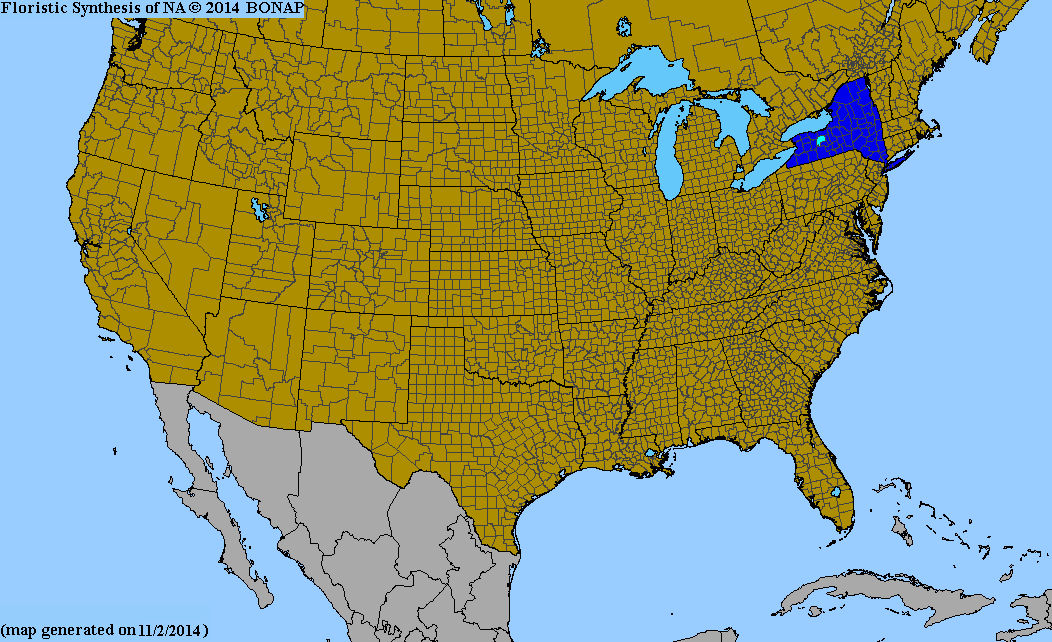
In the United States, the plant is cultivated in the state of New York and sparingly naturalized in a few places outside its native range.[1][7]
Uses
The leaves can be chopped and used raw as a herb, or added with other herbs to soups and stews.[8] Modern uses of the herb include its use as a flavouring, as a dried flower, and as an ornamental herb.[4]
In the Middle Ages it was used as a strewing herb to repel insects such as moths, lice and ticks and spread a good smell in private rooms.[9]
References
- 1 2 3 "Achillea ageratum L." Plants of the World Online. Royal Botanic Gardens, Kew. Retrieved 19 November 2021.
- ↑ BSBI List 2007 (xls). Botanical Society of Britain and Ireland. Archived from the original (xls) on 26 June 2015. Retrieved 17 October 2014.
- ↑ NRCS. "Achillea ageratum". PLANTS Database. United States Department of Agriculture (USDA). Retrieved 7 January 2016.
- 1 2 3 4 Linford 2011, p. 32.
- 1 2 Quincy 1794, p. 32.
- ↑ "Achillea ageratum L." Catalogue of Life. Retrieved 16 December 2020.
- ↑ Biota of North America Program 2014 county distribution map
- ↑ Farrell 2019, p. 24.
- ↑ Bailey & Bailey 1976, p. 17.
Sources
- Bailey, Liberty Hyde; Bailey, Ethel Zoe (1976). Hortus Third: A Concise Dictionary of Plants Cultivated in the United States and Canada. New York: Macmillan. ISBN 978-00250-5-470-7.
- Farrell, Holly (2019). The Kew Gardener's Guide to Growing Herbs. London: White Lion Publishing. ISBN 978-07112-3-936-4.
- Linford, Jenny (2011). The Ultimate Guide to Herbs. Bath, UK: Parragon Books. ISBN 978-14454-5-392-7.
- Quincy, John (1794). Lexicon physico-medicum (11th ed.). London: T. Longman. OCLC 1048314313.
Further reading

- McVicar, Jekka (1995). Herbs for the Home: A Definitive Sourcebook to Growing and Using Herbs. New York: Viking Studio Books. ISBN 978-06708-6-352-5.