Acacia lineata
| Acacia lineata | |
|---|---|
 | |
Scientific classification  | |
| Kingdom: | Plantae |
| Clade: | Embryophytes |
| Clade: | Tracheophytes |
| Clade: | Angiosperms |
| Clade: | Eudicots |
| Clade: | Rosids |
| Order: | Fabales |
| Family: | Fabaceae |
| Subfamily: | Caesalpinioideae |
| Clade: | Mimosoid clade |
| Genus: | Acacia |
| Species: | A. lineata |
| Binomial name | |
| Acacia lineata | |
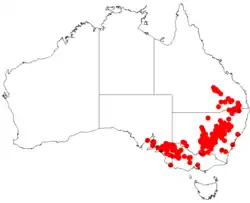 | |
| Occurrence data from AVH | |
| Synonyms[1] | |

Acacia lineata commonly known as streaked wattle or narrow lined-leaved wattle,[2] is a species of flowering plant in the family Fabaceae and is endemic to south-eastern continental Australia. It is an erect or bushy, spreading shrub with crowded, more or less linear phyllodes, spherical heads of bright golden yellow flowers, and curved to wavy or twisted, firmly papery to thinly leathery, glabrous sticky pods.
Description
Acacia lineata is a bushy, spreading shrub typically 0.5–2 m (1 ft 8 in – 6 ft 7 in) high and 1–2.5 m (3 ft 3 in – 8 ft 2 in) wide and has more or less terete, often sticky branchlets covered with soft hairs. Its phyllodes are somewhat crowded, ascending to erect, normally more or less narrowly oblong, 7–20 mm (0.28–0.79 in) long, 1–2.5 mm (0.039–0.098 in) wide with an oblique point on the end or sometimes almost hooked.[2][3][4][5]
The flowers are borne in one or two spherical heads in axils on slender, normally glabrous peduncles 5–12 mm (0.20–0.47 in) long, each head with 10 to 18 bright golden yellow flowers. Flowering occurs from July to October, and the pods are curved to wavy or twisted, firmly papery to thinly leathery, up to 50 mm (2.0 in) long, 2–4 mm (0.079–0.157 in) wide, glabrous and sticky. The seeds are oblong, 3–5 mm (0.12–0.20 in) long, slightly shiny brown with an aril on the end.[2][3][4][5]
Taxonomy
Acacia lineata was first formally described in 1832 by George Don in his book, A General History of Dichlamydeous Plants, from an unpublished description by Allan Cunningham.[6][7]
Distribution and habitat
Streaked wattle has a scattered distribution from the Eyre Peninsula and Cowell in South Australia, through north-western Victoria and New South Wales to near the Carnarvon Range in Central Queensland.[2][3][4][5] It grows in a variety of habitats such as sclerophyll forest and woodland, but mostly occurs in mallee communities.[2]
Ecology
Acacia lineata can grow in alkaline, sandy, or gravely soils.[2]
Having phyllodes instead of leaves help A. lineate to survive in dry semi-arid environments, by reducing water loss. The phyllodes of A. lineatea are small, point up and are slightly hairy; adaptations that further reduce water loss.[8][9]
Acacias are able to fix nitrogen in the soil via a host bacteria that live on the roots called rhizobia, which aids in the growth of other plant species.
Reproduction and dispersal
A. lineata flowers appear from July to October depending on the region, with seeds maturing over summer.[10]
The pale aril of the A. lineata seeds, suggests dispersal by ants.[11]
Use in horticulture
Acacia lineata is planted as an ornamental shrub in parks and along roadsides. It prefers temperate regions, is moderately drought and frost tolerant, and will grow from a seed or cutting.[10] Acacias are a good source of pollen; sheltered nesting habitat for birds and seeds which are eaten by birds.[12]
References
- 1 2 "Acacia lineata". Australian Plant Census. Retrieved 19 August 2026.
- 1 2 3 4 5 6 Maslin, Bruce R. Kodela, Phillip G. (ed.). "Acacia lineata". Flora of Australia. Australian Biological Resources Study, Department of Climate Change, Energy, the Environment and Water: Canberra. Retrieved 19 August 2026.
- 1 2 3 Kodela, Phillip G. "Acacia lineata". Royal Botanic Garden, Sydney. Retrieved 19 August 2026.
- 1 2 3 Entwisle, Timothy J.; Maslin, Bruce R.; Cowan, Richard S.; Court, Arthur B.; Stajsic, Val. "Acacia lineata". Royal Botanic Gardens Victoria. Retrieved 19 August 2026.
- 1 2 3 "Acacia lineata". FloraSA. Retrieved 19 August 2026.
- ↑ "Acacia lineata". Australian Plant Name Index. Retrieved 19 August 2026.
- ↑ Don, George (1832). A General History of Dichlamydeous Plants. Vol. 2. London: Gilbert and Rivington. p. 403. Retrieved 19 August 2026.
- ↑ "Plants of the Mallee Shrublands" (PDF). Australian National Botanic Gardens, learning resources. 2000. Archived from the original (PDF) on 22 October 2020. Retrieved 21 October 2020.
- ↑ Dorken, V.M; Ladd, P.G; Parsons, R.F (2020). "Anatomical aspects of xeromorphy in arid-adapted plants". Australian Journal of Botany. 68: 245–266. doi:10.1071/BT19073.
- 1 2 "Growing Natives". Australian National Botanical Gardens. 2015. Retrieved 5 October 2020.
- ↑ Davidson, D.W; Morton, S.R (1984). "Dispersal Adaptations of Some Acacia Species in Australian Arid Zone". Ecology. 64 (4): 1038–1051. Bibcode:1984Ecol...65.1038D. doi:10.2307/1938312. JSTOR 1938312.
- ↑ Bennetts, L; Birmingham, E (2008). "Adaptable Acacias". Permaculture Research Institute. Retrieved 5 October 2020.