Acacia leucolobia
| Acacia leucolobia | |
|---|---|
 | |
Scientific classification  | |
| Kingdom: | Plantae |
| Clade: | Embryophytes |
| Clade: | Tracheophytes |
| Clade: | Angiosperms |
| Clade: | Eudicots |
| Clade: | Rosids |
| Order: | Fabales |
| Family: | Fabaceae |
| Subfamily: | Caesalpinioideae |
| Clade: | Mimosoid clade |
| Genus: | Acacia |
| Subgenus: | Acacia subg. Phyllodineae |
| Species: | A. leucolobia |
| Binomial name | |
| Acacia leucolobia | |
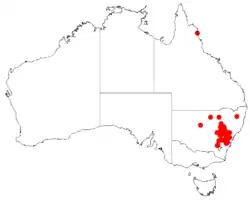 | |
| Occurrence data from AVH | |
| Synonyms[1] | |
| |
Acacia leucolobia is a species of flowering plant in the family Fabaceae and is endemic to New South Wales, Australia. It is an open, glabtrous shrub with red to red-brown branchlets, egg-shaped to lance-shaped to narrowly elliptic phyllodes, spherical heads of bright golden yellow flowers, and firmly papery to thinly leathery, blackish pods.
Description
Acacia leucolobia is an open, glabrous shrub that typically grows to a height of 1.5–3 m (4 ft 11 in – 9 ft 10 in) and has red to red-brown branchlets, sometimes covered with a white, powdery bloom. The phyllodes are egg-shaped to lance-shaped with the narrower end towards the base or elliptic to narrowly elliptic, 15–30 mm (0.59–1.18 in) long and 6–14 mm (0.24–0.55 in) wide with a small point on, or near the end. The phyllodes are leathery, glaucous to subglaucous with an obsure midrib and a gland 0.5–4 mm (0.020–0.157 in) aboe the pulvinus. The flowers are borne in five to nine spherical heads in racemes mostly 10–50 mm (0.39–1.97 in) long, on peduncles 3–6 mm (0.12–0.24 in) long. The heads are 8–10 mm (0.31–0.39 in) in diameter with 5 to 10 loosely arranged bright golden yellow flowers. Flowering occurs from August to October and the pods are straight to slightly curved, up to 80 mm (3.1 in) long, 6–8 mm (0.24–0.31 in) wide, firnly papery to thinly leathery and blackish. The seeds are oblong to egg-shaped, about 5 mm (0.20 in) long and black with a club-shaped aril.[2][3][4]
Taxonomy
In 1825, Allan Cunningham described Acacia dealbata in On the Botany of the Blue Mountains in Barron Field's Geographical Memoirs on New South Wales,[5] but that name was illegitimate, because it was given to a different species by Link in 1822.[6] In 1830, Robert Sweet changed the name to Acacia leucolobia in his Hortus Britannicus.[7][8]
Distribution and habitat
Acacia leucolobia is native to an area from around Coolah to around Katoomba, and from around Bowral to Wingello where it grows in open Eucalyptus woodland .[2][3][9]
See also
References
- 1 2 "Acacia leucolobia". Australian Plant Census. Retrieved 13 August 2026.
- 1 2 Maslin, Bruce R. "Acacia leucolobia". Flora of Australia. Australian Biological Resources Study, Department of Climate Change, Energy, the Environment and Water: Canberra. Retrieved 13 August 2026.
- 1 2 Maslin, Bruce R. "Acacia leucolobia". Australian Biological Resources Study. Retrieved 13 August 2026.
- ↑ Kodela, Phillip G. "Acacia leucolobia". Royal Botanic Garden, Sydney. Retrieved 13 August 2026.
- ↑ Cunningham, Allan (1825). Field, Barron (ed.). Geographical Memoirs on New South Wales. London: John Murray. p. 345. Retrieved 1 January 2023 – via Project Gutenberg Australia.
- ↑ "Acacia dealbata". Australian Plant Name Index. Retrieved 13 August 2026.
- ↑ "Acacia leucolobia". Australian Plant Name Index. Retrieved 13 August 2026.
- ↑ Sweet, Robert (1830). Hortus Britannicus, Second edition. Piccadilly: James Ridgway. p. 175. Retrieved 13 August 2026.
- ↑ "Acacia leucolobia". World Wide Wattle. Western Australian Herbarium. Retrieved 19 June 2019.